
At the 10x Genomics Atera World Tour 2026 in Paris, Explicyte presented two case studies tackling the question every spatial biology team faces: how do we extract more biological value from FFPE tumor samples, while keeping turnaround time and cost under control?
The challenge: spatial transcriptomics at scale
Single-cell spatial transcriptomics is now a production tool in oncology. But scaling Xenium campaigns runs into the same three constraints every time: a finite panel size, per-sample cost, and turnaround time.
Our “Smarter Xenium” framework addresses all three — on real FFPE tumor cohorts, with measurable results.
Case study 1 — Xenium beyond 5K
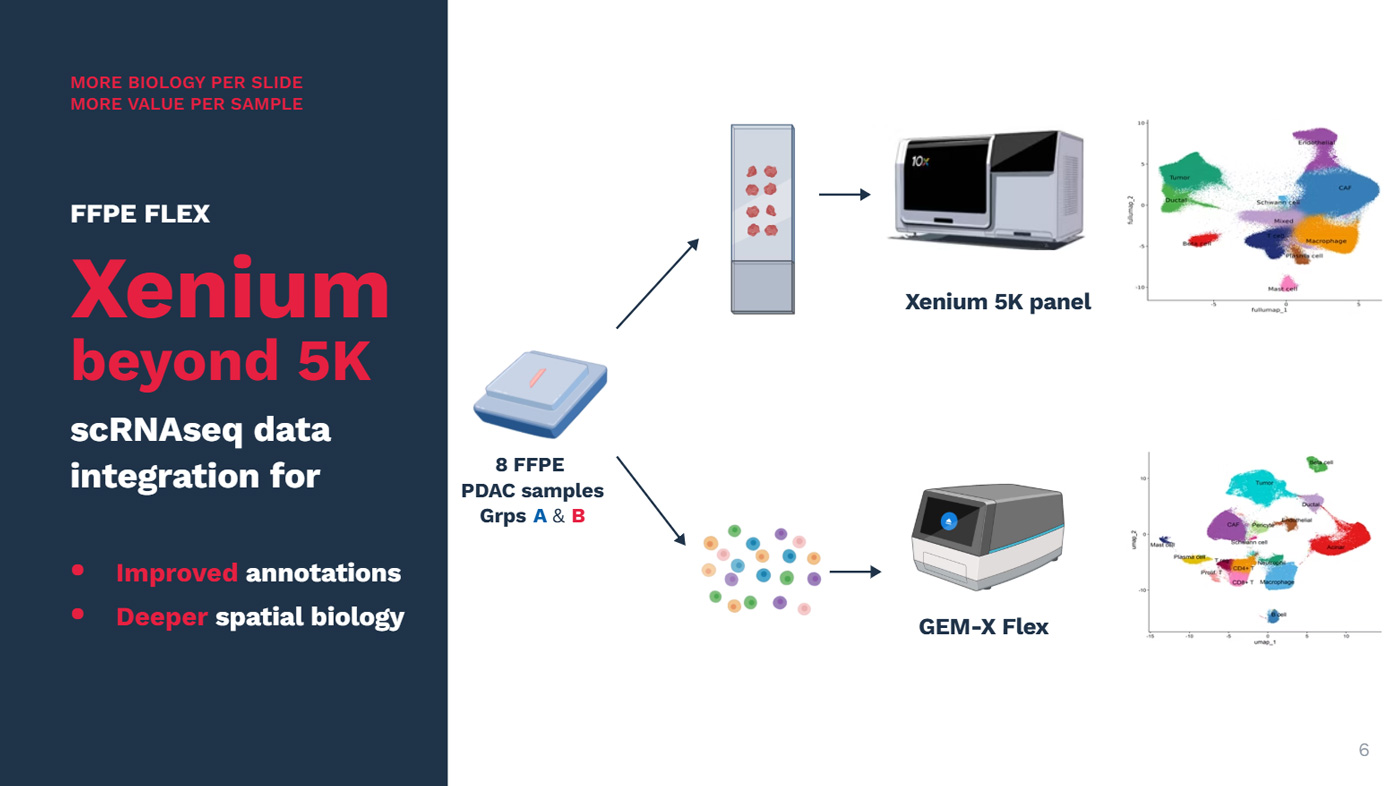
On a cohort of FFPE PDAC samples, we tested whether matched scRNAseq data could unlock biology hidden from the Xenium 5K panel.
By integrating scRNA-seq data with Xenium, we substantially improved cluster annotation and resolved cell populations that were partially merged in the standard Xenium analysis — including B-cell populations, for example.
The rationale is straightforward: scRNA-seq provides greater transcriptomic depth and more powerful differential gene expression analysis, while Xenium preserves the spatial context. By using the matched scRNA-seq dataset as a reference, we were able to infer richer transcriptomic information onto Xenium spatial coordinates, enabling a deeper biological characterization of the tissue while still addressing key spatial questions such as cell localization, neighborhood organization, and tumor microenvironment architecture.
Altogether, the combination of scRNA-seq and Xenium represents a strong asset for deep spatial biology, bringing together transcriptomic depth, improved cell annotation, and spatially resolved interpretation.
Case study 2 — Sample multiplexing with Bioptimus
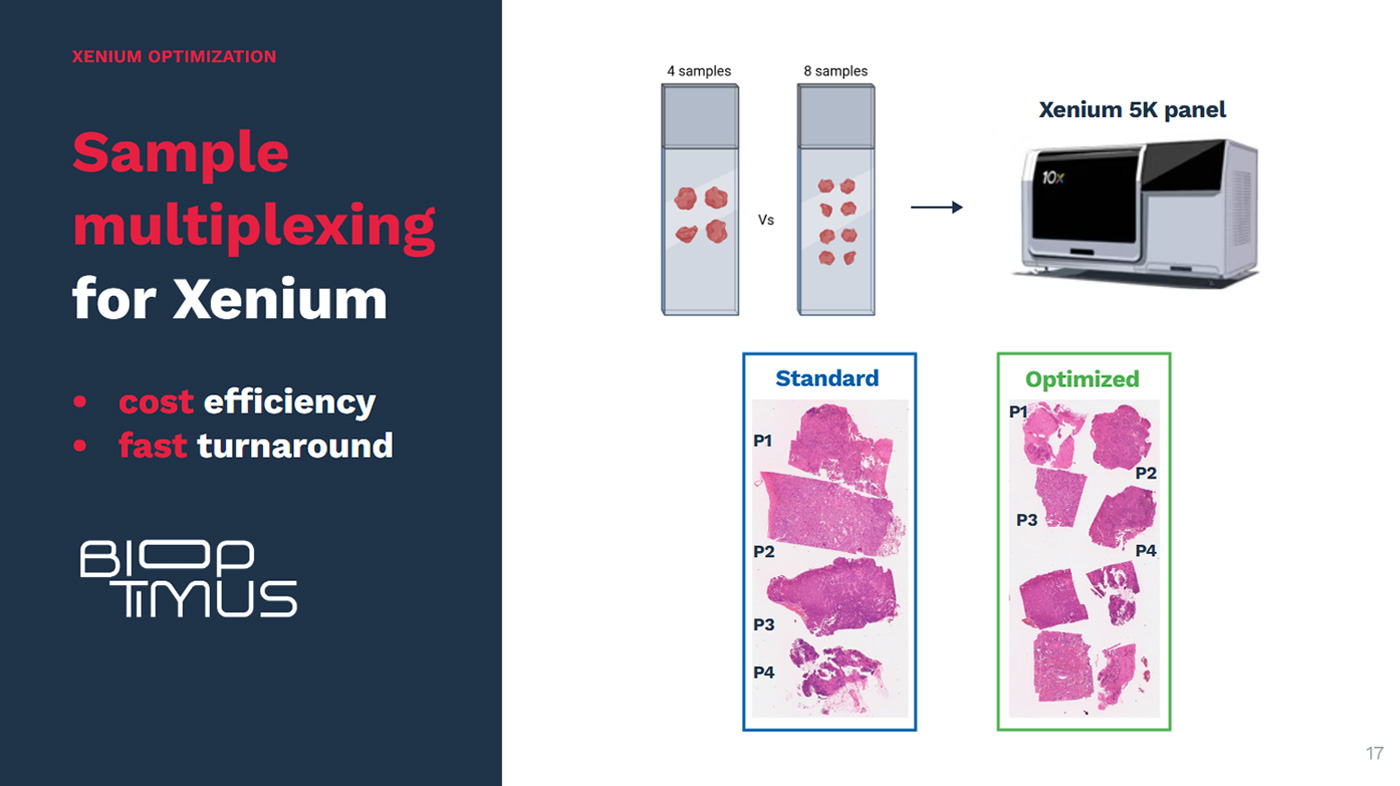
The second case study, in partnership with AI company Bioptimus, addresses cost and throughput head-on.
We doubled the number of FFPE samples per Xenium slide and ran a rigorous head-to-head against the standard format. Across QC metrics, cell-type proportions, and gene expression profiles, the data held up — with sample-to-sample correlations between formats reaching near-perfect agreement.
The implication: cohort-scale spatial transcriptomics is now faster and more cost-effective.
About Explicyte
Explicyte is a preclinical and translational CRO specializing in precision oncology, with 10+ years of experience and 40+ peer-reviewed publications in immuno-oncology. As a 10x Genomics Certified Service Provider across the full single-cell and spatial biology portfolio — Chromium X, Visium HD, and Xenium — we help pharma and biotech sponsors turn FFPE tumor samples into actionable biological insight: from new target and biomarker discovery to biospecimen analysis in early-phase clinical trials.