
MODALITY-SPECIFIC PRECLINICAL ASSAYS
Preclinical assays for multispecific antibodies and immune cell engagers
Determine whether your molecule selectively redirects the intended immune effector population toward target-positive tumor cells - and characterize the resulting antitumor activity, immune-cell activation and cytokine-release profile
Explicyte designs fit-for-purpose studies for T-cell engagers, NK-cell engagers and other multispecific immune-cell–redirecting therapeutics, combining target qualification, primary human immune-cell co-cultures, tumor killing, effector-cell phenotyping, multi-donor cytokine release and CRS-related liability profiling, and mechanistic analysis.
PRECLINICAL CAPABILITIES
Preclinical assays by engager format: T-cell, NK-cell and multispecific
From T-cell and NK-cell engagers to other dual-targeting and immune-cell–redirecting formats, we adapt the tumor models, primary effector cells and functional readouts to the intended mechanism of action.

Multispecific case studies
Case studies: tarlatamab efficacy and single-cell CRS profiling
T-CELL ENGAGER · FUNCTIONAL CHARACTERIZATION
Target-dependent tumor cell killing and immune response to tarlatamab
DLL3-positive small cell lung cancer cells and DLL3-negative non-small cell lung cancer cells were used to establish a target-defined co-culture system with primary human T cells. In the presence of T cells, tarlatamab induced potent, dose-dependent tumor cell killing in DLL3-positive models, while no activity in the DLL3-negative control model.
Integrated analysis captured anti-tumor activity, target specificity and the underlying T cell response, combining functional tumor cell readouts with immune cell activation, cytokine release and cytotoxic effector profiling.
CYTOKINE RELEASE · SINGLE-CELL PROFILING
Resolve cytokine release responses and cellular drivers of immune activation
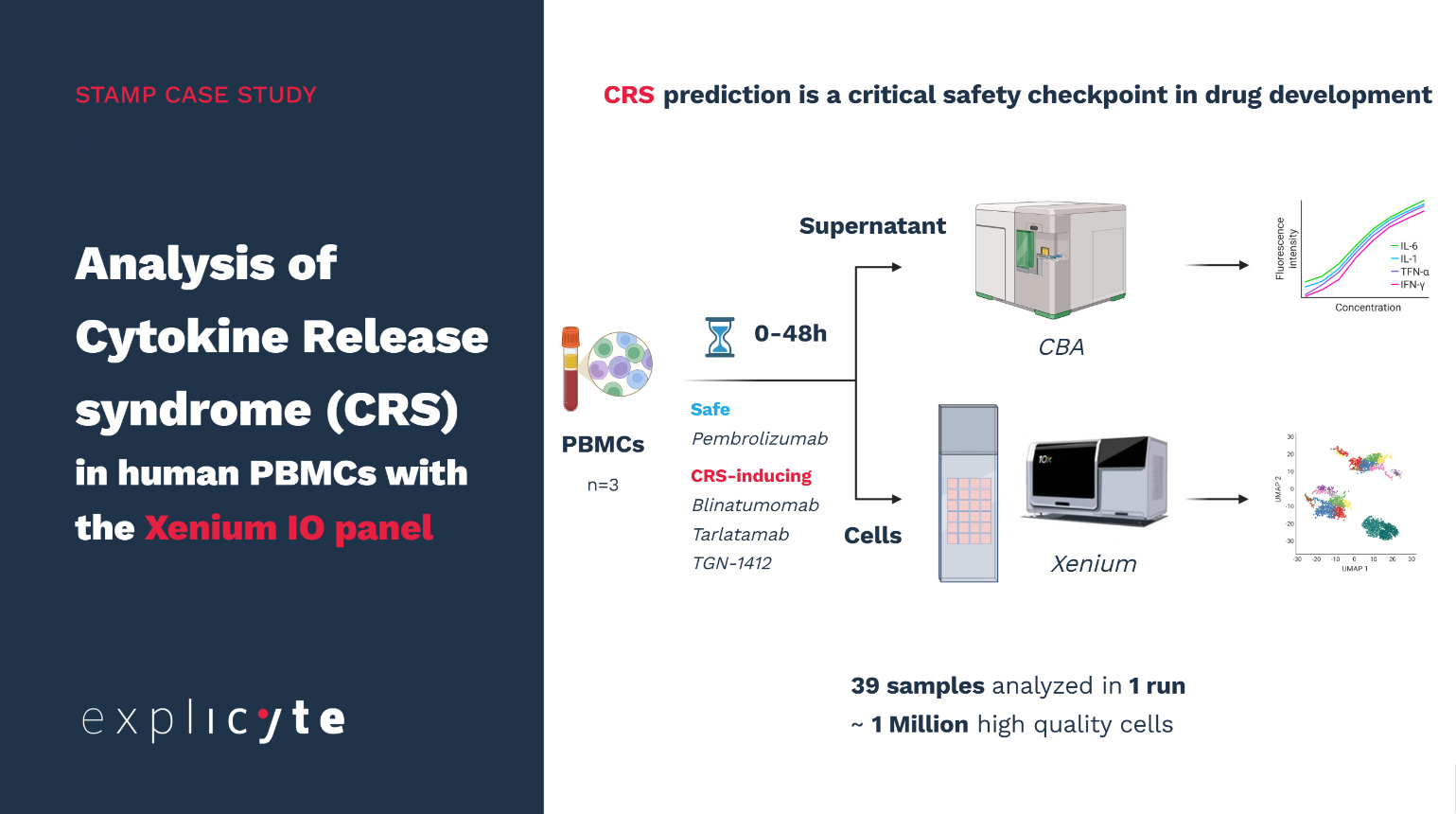
PBMCs from three healthy donors were exposed over 0-48 hours to reference compounds with distinct immune activation profiles (CRS-positive and negative references). Multiplex cytokine measurements were combined with Xenium STAMP single-cell transcriptomic profiling to characterize cytokine release kinetics, treatment-associated immune cell dynamics and the cellular populations and transcriptional programs associated with cytokine expression.
The study included pembrolizumab, blinatumomab, tarlatamab and TGN1412, with 39 samples analyzed in a single run, generating approximately one million high-quality cells for downstream single-cell analysis.
PRECLINICAL CAPABILITIES
From target qualification to CRS-related profiling: the engager assay workflow
Explicyte combines target-defined tumor models with primary human effector cells and fit-for-purpose analytical readouts. Programs are scoped modularly to the questions that matter for your molecule.
WHY EXPLICYTE
Why work with Explicyte as your multispecific and immune-cell engager CRO?
Track record in tumor-immune biology, from bench to publication
Primary immune cells from characterized donors, in biology-relevant co-cultures
Efficacy and early non-clinical safety in one integrated program
PhD-led interpretation, backed by multiomics and data science

Paul Marteau, PharmD (study director), Imane Nafia, PhD (CSO), Loïc Cerf, MSc (COO), Alban Bessede, PhD (founder, CEO), Jean-Philippe Guégan, PhD (CTO)
Contact our team
Discuss your multispecific or immune-cell engager program
Tell us about your targets, molecular format, intended effector population, indication and development stage. We can help define the cellular models, primary immune-cell systems, controls and readouts needed to characterize efficacy, immune activation, cytokine release and mechanism of action.
MULTISPECIFIC & ENGAGER FAQ