
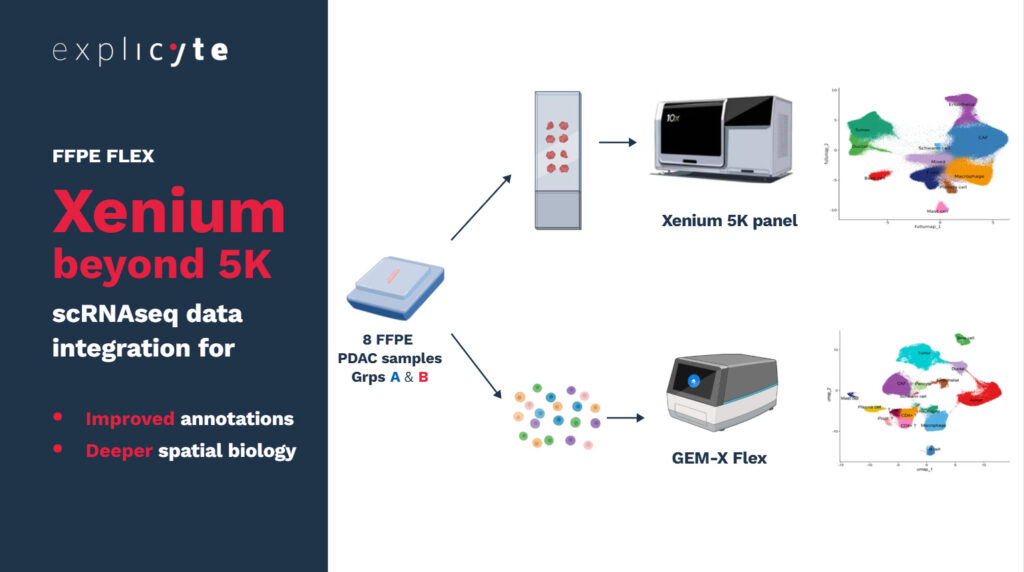
On a cohort of FFPE PDAC samples, we tested whether matched scRNAseq data could unlock biology hidden from the Xenium 5K panel.
By integrating scRNA-seq data with Xenium, we substantially improved cluster annotation and resolved cell populations that were partially merged in the standard Xenium analysis — including B-cell populations, for example.
The rationale is straightforward: scRNA-seq provides greater transcriptomic depth and more powerful differential gene expression analysis, while Xenium preserves the spatial context. By using the matched scRNA-seq dataset as a reference, we were able to infer richer transcriptomic information onto Xenium spatial coordinates, enabling a deeper biological characterization of the tissue while still addressing key spatial questions such as cell localization, neighborhood organization, and tumor microenvironment architecture.
Altogether, the combination of scRNA-seq and Xenium improved Xenium cell annotation and enabled spatial exploration of genes absent from the 5K panel. DEG analysis, however, remains more appropriate on the whole-transcriptome scRNA-seq data.