
Immune Function & Modulation Assays
Immune cell migration assays
Does your compound recruit effector immune cells toward the tumor — or block the migration of cancer cells and suppressive subsets?
Our transwell chemotaxis assays read migration by live-cell imaging, giving a full time course rather than a single endpoint.
Immune cell migration assay: format & readouts
Real-time chemotactic migration of immortalized T cells toward SDF1α in a 96-well plate. Transmembrane migration quantified on the IncuCyte® live-cell analysis system.

Assay principle
How our immune cell migration assays work
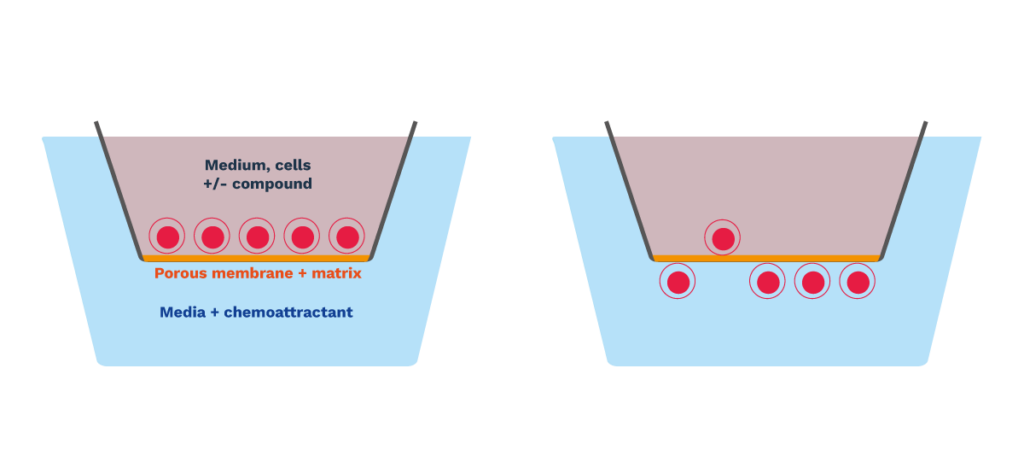
1
Seed the cells
2
Set the gradient
3
Track migration in real time
4
Layer on deeper readouts
Illustrative CELL MIGRATION data
T-cell and neutrophil chemotaxis: example results
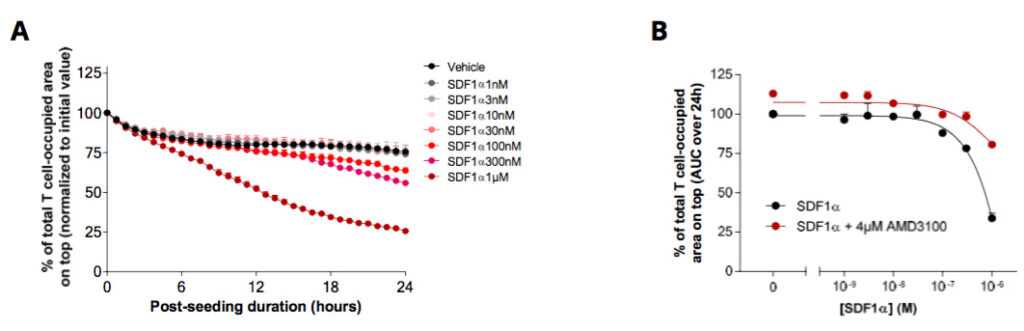
Dose-dependent T-cell chemotaxis, reversed by CXCR4 blockade
Primary human T-cell migration is dose-dependently induced by SDF1α over 24 h (A). The chemoattractive effect is reversed by the CXCR4 inhibitor AMD-3100 (B).
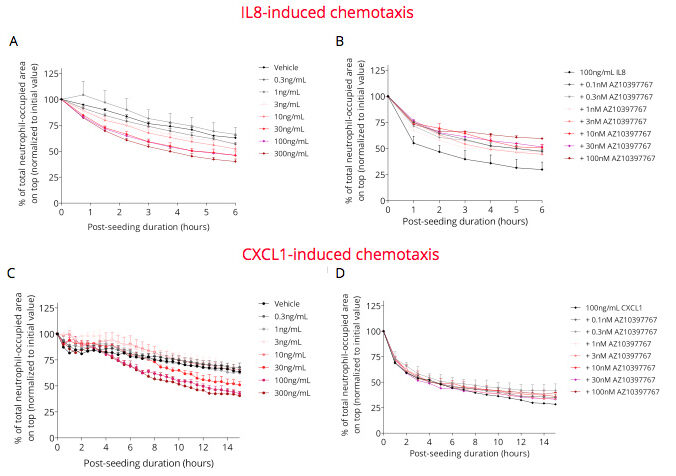
Neutrophil chemotaxis to IL-8 and CXCL1, blocked by CXCR2 antagonism
Freshly isolated human neutrophils migrate dose-dependently to IL-8 (A) and CXCL1 (C). A CXCR2 antagonist AZD10397767 partially abolishes the IL-8– (B) and CXCL1–induced (D) effects. Migration was tracked by live-cell imaging over 6 h and 15 h, respectively.
Making a difference as a preclinical CRO in oncology
Why work with Explicyte
The right cells for the question
Ten years of in-vitro immuno-oncology
Published, peer-reviewed science
One study director, end to end

Paul Marteau, PharmD (study director), Imane Nafia, PhD (CSO), Loïc Cerf, MSc (COO), Alban Bessède, PhD (founder, CEO), Jean-Philippe Guégan, PhD (CTO)
Contact our team
Discuss your migration study
Tell us about your compound and the migration question you need answered — recruiting effector cells, or blocking cancer-cell or suppressive-cell migration. We'll come back with a fit-for-purpose proposal and a PhD-level study director.