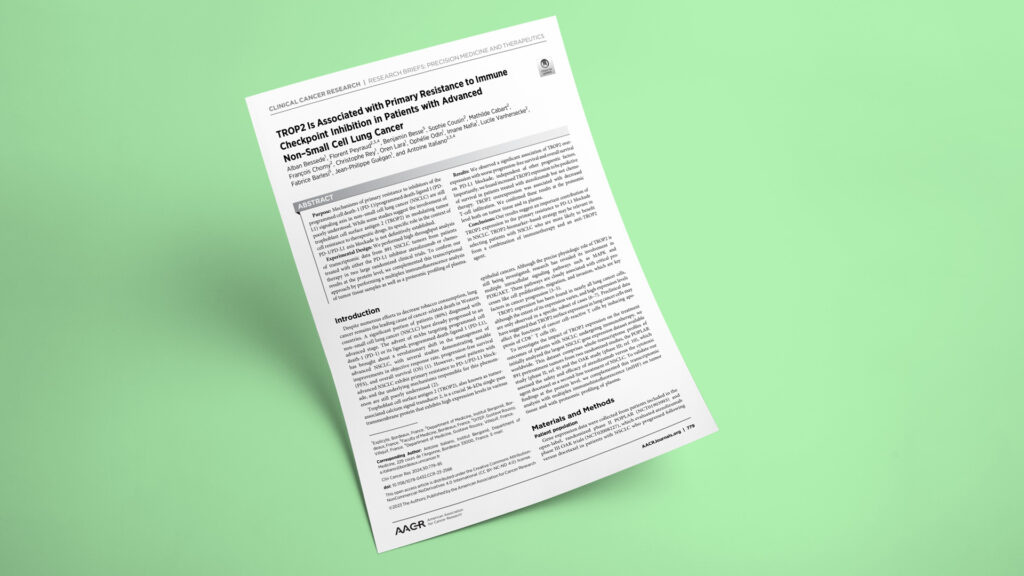
Publication in Clinical Cancer Research

How TROP2 predicts resistance to immune checkpoint inhibitors in advanced lung cancer — and who might benefit from combinations

Explicyte collaborated with: Institut Bergonié·Institut Gustave Roussy·University of Bordeaux
TROP2 Is Associated with Primary Resistance to Immune Checkpoint Inhibition in Patients with Advanced Non-Small Cell Lung Cancer
ThoracicBiomarker analysisBiomarker discoveryDiscoveryTarget discoveryTrialsBioinformaticsMultiplex IF/IHCProteomicsRNAseq
JournalClinical Cancer Research
DateFeb 2024
Read full paper →

Most patients with advanced non-small cell lung cancer never respond to PD-1/PD-L1 checkpoint inhibitors, and why has stayed unclear. Mining whole-transcriptome data from 891 tumors across two randomized atezolizumab-versus-chemotherapy trials — then confirming at the protein level with multiplex immunofluorescence and plasma proteomics — the team found that high TROP2 expression predicts primary resistance to immunotherapy, but not to chemotherapy. Because circulating TROP2 tracks tumor expression, a simple blood test could flag the patients who resist checkpoint blockade and might instead benefit from immunotherapy combined with an anti-TROP2 antibody-drug conjugate.

This study in Clinical Cancer Research — with Alban Bessede (Explicyte) as first author and led by Prof. Antoine Italiano (Institut Bergonié; Gustave Roussy) — asks why so many patients with advanced NSCLC fail to respond to PD-1/PD-L1 checkpoint blockade. The work brings together Institut Bergonié, Gustave Roussy, and Explicyte, and builds on the teams’ earlier research on tertiary lymphoid structures in cancer. Tumor and plasma samples came from the institutional Bergonié Institute Profiling program (BIP, NCT02534649), with funding from Conseil Régional Aquitaine. Explicyte contributed the multiplex immunofluorescence profiling, the Olink plasma proteomics, and the bioinformatic analysis of the transcriptomic datasets that anchored the discovery.

The question

Why do many advanced non-small cell lung cancers resist immune checkpoint inhibitors — and can a single biomarker flag them upfront, non-invasively?

Key steps

  1. 1

    Transcriptomic screen across two randomized trials

    The team analyzed whole-transcriptome data from 891 pretreatment NSCLC tumors from the POPLAR (phase II) and OAK (phase III) trials, which compared atezolizumab against docetaxel. High expression of the TROP2 gene (TACSTD2) tracked with significantly worse PFS (median 2.5 vs 4.1 months; P < 0.001) and OS (12.6 vs 16.3 months; P = 0.007) — but only in the atezolizumab arm, not the docetaxel arm, marking TROP2 as predictive of immunotherapy resistance rather than prognostic. An independent 72-tumor cohort from the BIP program reproduced the association.

  2. 2

    TROP2-low tumors are the immune-rich ones

    Deconvolution of the transcriptomic data showed that TACSTD2-low tumors carried the highest infiltration of T follicular helper cells, T cells, cytotoxic lymphocytes, and B cells, while GO-BP enrichment placed B-cell receptor and immune-response-regulating pathways in the low-TROP2 group. High TROP2 thus coincided with an immune-poor microenvironment — a plausible route to checkpoint-inhibitor resistance.

  3. 3

    Multiplex IHF pinpoints intracellular TROP2

    Explicyte ran a 5-plex multiplex immunofluorescence panel (PanCK, TROP2, CD8, PD-L1, DAPI) on the Ventana Discovery XT platform with Akoya Opal reagents and PhenoImager HT imaging, on FFPE tumors from 50 ICI-treated patients. Total and membrane TROP2 did not track with outcome, but high intracellular (nuclear) TROP2 did — worse PFS (median 1.4 vs 13.4 months; P = 0.038) and a lower durable clinical benefit rate (16.7% vs 60.5%; P = 0.008) — consistent with the cleaved, tumorigenic intracellular domain being the functional driver.

  4. 4

    Circulating TROP2 mirrors the tumor

    Explicyte profiled plasma from 74 prospectively enrolled NSCLC patients on the Olink Explore 1536 proximity extension assay. Circulating TROP2 correlated with tumor TACSTD2 expression, and high plasma TROP2 predicted worse durable clinical benefit (17.5% vs 52.9%; P = 0.003), PFS (median 2.4 vs 10.9 months; P = 0.003), and OS (8.5 vs 24.6 months; P = 0.045) — evidence that a non-invasive blood test could stratify patients before treatment.

Impact

TROP2 is already a validated antibody-drug-conjugate target — this work shows it also flags the NSCLC patients least likely to respond to immunotherapy, and that it can be read from blood.

891
NSCLC tumors analyzed across the POPLAR and OAK randomized trials
2.5 vs 4.1 mo
median PFS on atezolizumab, TROP2-high vs TROP2-low (P < 0.001)
16.7% vs 60.5%
durable clinical benefit rate, intracellular-TROP2-high vs low

For drug developers, this reframes TROP2 from a pure ADC target into a companion biomarker: the same high-TROP2 tumors that resist checkpoint blockade are the ones most likely to need an anti-TROP2 agent. That argues for testing TROP2 ADCs such as datopotamab deruxtecan in combination with PD-1/PD-L1 inhibitors, and for enriching those trials by TROP2 status. Because circulating TROP2 mirrors tumor expression, patient selection could run off a blood draw rather than a biopsy.

Validating a TROP2 or ADC-companion biomarker in lung cancer? Let's talk about tissue and plasma profiling.

Talk to us
Explicyte Oncology CRO logo

Capabilities

Modalities