
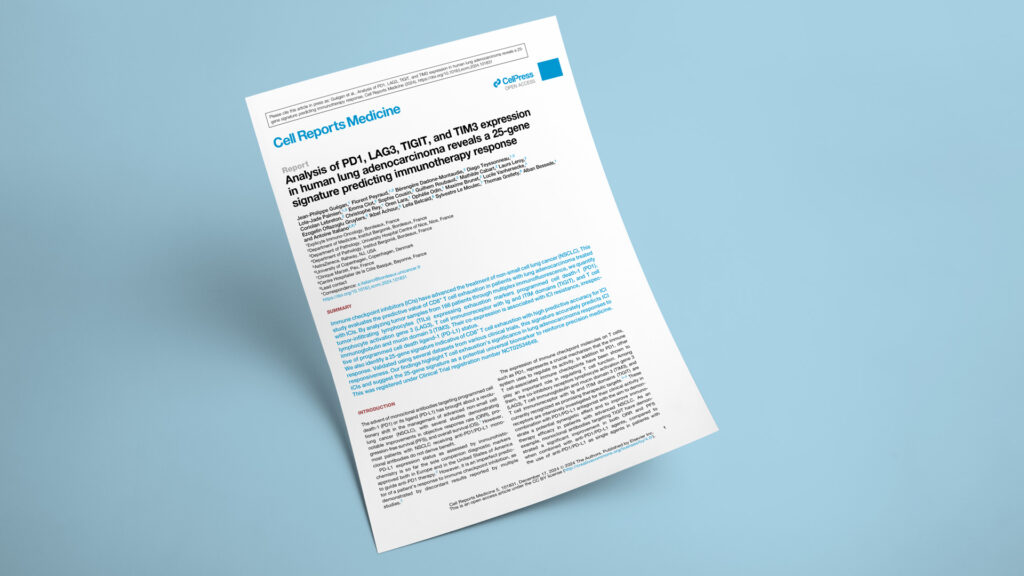
Most patients with advanced lung cancer never respond to PD-1/PD-L1 checkpoint inhibitors, and PD-L1 staining alone doesn't reliably say who will. Profiling tumors from 166 lung adenocarcinoma patients with a six-marker multiplex immunofluorescence panel — then whole-transcriptome sequencing of 135 of them — the team found that CD8+ T cells co-expressing PD1 with LAG3, TIGIT, or TIM3 (an exhausted phenotype) mark tumors that resist immunotherapy, independent of PD-L1 status. From this they built a 25-gene exhaustion signature that predicted checkpoint-inhibitor response in lung cancer and, across external trial datasets, in melanoma and renal cancer too — pointing toward a pan-tumor immunotherapy biomarker.
A study in Cell Reports Medicine — with Jean-Philippe Guégan (Explicyte) as first author and led by Prof. Antoine Italiano (Institut Bergonié) — asks why so many lung adenocarcinoma patients fail to benefit from PD-1/PD-L1 checkpoint inhibitors, and whether the exhaustion state of their CD8+ T cells holds the answer. The work draws on the institutional Bergonié Institute Profiling program (BIP, NCT02534649) and was funded by AstraZeneca and the Nouvelle-Aquitaine Regional Council (Conseil Régional Aquitaine). Explicyte contributed the six-marker multiplex immunofluorescence profiling and the whole-transcriptome (HTG) analysis from which the 25-gene signature was derived.
Immune exhaustion has long been read as a sign of poor prognosis; this work reframes it as a predictive, immunotherapy-specific biomarker — and packages it into a 25-gene test that carries across tumor types.
For drug developers, the signature offers a molecularly defined way to enrich immunotherapy trials — and a ready-made rationale for the bispecific antibodies (PD1 × LAG3/TIGIT/TIM3) now in development, whose intended target population is precisely the exhausted-T-cell tumors it identifies. Because it reads out on a scalable bulk-transcriptomic assay rather than single-cell sequencing, it is plausible as a clinical diagnostic. Its performance in melanoma and renal cancer points toward use as a pan-tumor immunotherapy biomarker, pending prospective validation.