
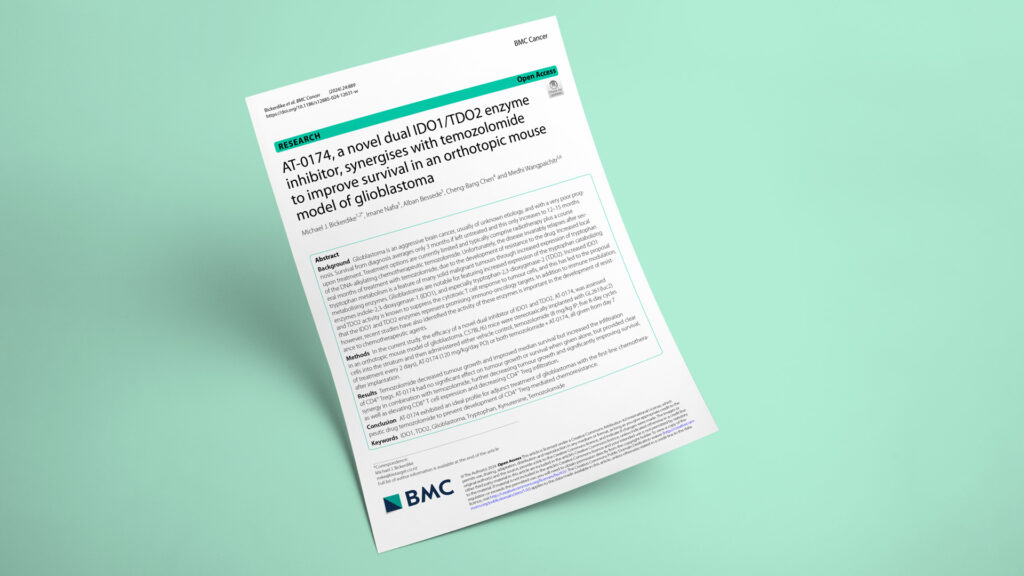
Glioblastoma almost always relapses on temozolomide as resistance sets in, and the tryptophan-catabolizing enzymes IDO1 and TDO2 — both overexpressed in these tumors — help drive that resistance while suppressing anti-tumor immunity. Testing the dual IDO1/TDO2 inhibitor AT-0174 in an orthotopic mouse model, the team found it did nothing on its own but synergized sharply with temozolomide: tumor growth slowed further, survival jumped (73% alive at day 54 vs. a 54-day median for temozolomide alone), and the tumor's T-cell balance flipped from immunosuppressive Tregs toward cytotoxic CD8+ cells.
This study in BMC Cancer — led by Michael J. Bickerdike of Antido Therapeutics, the developer of AT-0174 — asks whether dual IDO1/TDO2 enzyme inhibition can strengthen temozolomide (TMZ), the standard-of-care chemotherapy for glioblastoma. IDO1 and, especially, TDO2 are overexpressed in glioblastoma, where they deplete tryptophan and raise kynurenine to blunt CD8+ T-cell activity and expand regulatory T cells — a program also linked to chemoresistance. Explicyte built and ran the orthotopic glioblastoma mouse model at the center of the work, executing the in vivo efficacy and survival study and the flow-cytometry immune profiling that showed how the combination reshapes the tumor microenvironment. All studies were funded by Antido Therapeutics; in vivo work was conducted by Explicyte.
The result reframes IDO1/TDO2 inhibition as a chemo-sensitizing partner rather than a standalone immunotherapy — and shows why dual, rather than IDO1-only, blockade may matter in a TDO2-high cancer like glioblastoma.
For developers of tryptophan-pathway inhibitors, the takeaway is that dual IDO1/TDO2 compounds may earn their place as chemo-adjuncts — sensitizing temozolomide and blunting Treg-mediated resistance — rather than as monotherapies, where selective IDO1 inhibitors previously stalled in the clinic. Glioblastoma, with its high TDO2 expression and dismal prognosis, is a rational setting to test that combination logic. The immune readout also strengthens the case for pairing these agents with checkpoint blockade.