
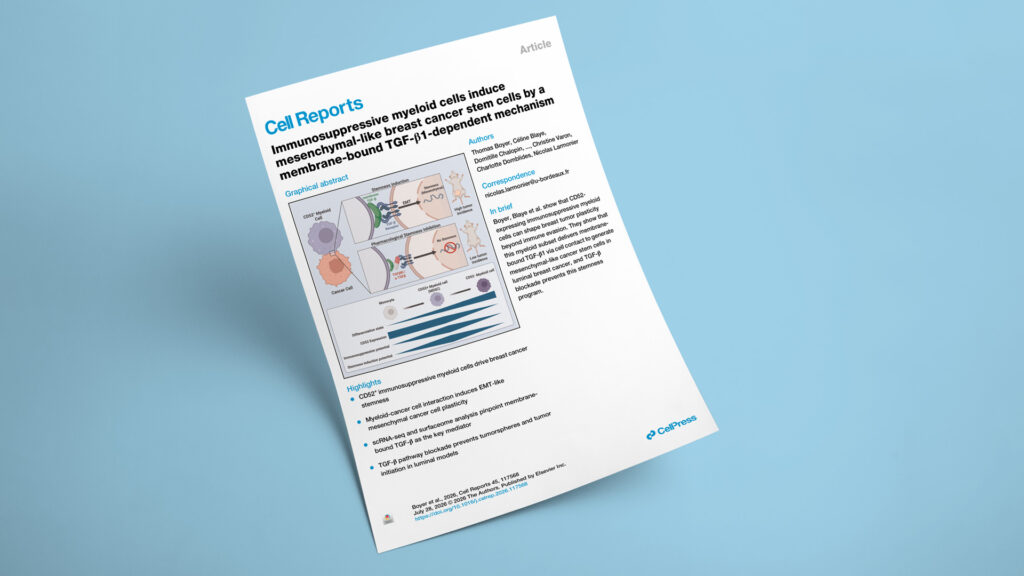
Immunosuppressive myeloid cells are known for shielding tumors from immune attack — but whether they also make cancer cells harder to eradicate has been unclear. Combining single-cell transcriptomics, cell-surface proteomics, and in vivo tumor-initiation assays, the team shows that a CD52-expressing myeloid subset reprograms luminal breast cancer cells into mesenchymal cancer stem cells. The trigger is membrane-bound TGF-β1 delivered through direct cell-to-cell contact — not a secreted factor — pointing to a spatially restricted target that today's soluble-TGF-β inhibitors may miss.
A new study in Cell Reports — led by Nicolas Larmonier (University of Bordeaux, CNRS, INSERM, ImmunoConcEpT UMR5164), with Thomas Boyer and Céline Blaye as co-first authors and Christine Varon and Charlotte Domblides as co-senior authors — shows that immunosuppressive myeloid cells do more than evade immunity: they actively reprogram breast cancer cells toward a stem-like, mesenchymal state. The work drew on malignant pleural effusions collected from breast cancer patients at Institut Bergonié and was supported by the French National League Against Cancer, SIRIC-BRIO, the ARC Foundation, ITMO Aviesan (ANR), and the GILEAD Research Scholars Program.
The findings recast immunosuppressive myeloid cells as active drivers of cancer stemness rather than passive immune shields, and point to a contact-dependent, membrane-tethered form of TGF-β1 that behaves differently from the soluble cytokine most therapies target.
For drug developers, this positions membrane-bound TGF-β1 as a spatially restricted target that soluble-TGF-β inhibitors may fail to engage — arguing for agents that reach the ligand at the myeloid–tumor interface. The strict luminal-subtype dependence is a stratification signal: TNBC models with pre-existing mesenchymal programs did not respond. CD52 offers a candidate handle on the responsible myeloid population, though the authors caution it is context-dependent and insufficient on its own to define a homogeneous subset.