
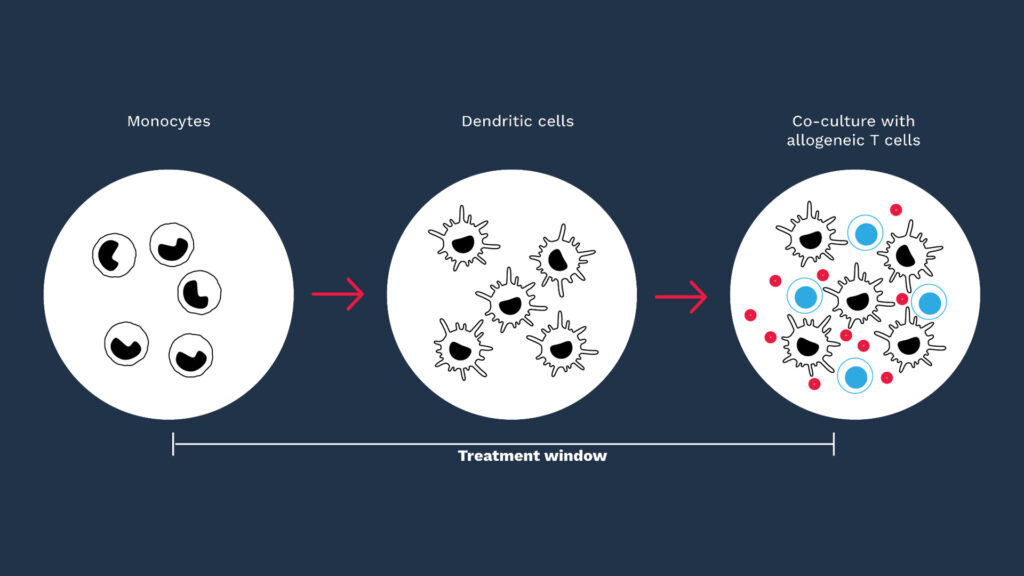
The immunological synapse between T lymphocytes and dendritic cells is a key component of an effective immune response. Dendritic cells are central to the initiation and orientation of T cell responses, and their function can be either immunogenic or tolerogenic depending on the signals received from their microenvironment.
In cancer immunotherapy, modulating dendritic cell function represents an important strategy to amplify anti-tumor immune responses or to relieve immunosuppressive mechanisms that impair T cell activation.
The mixed leukocyte reaction assay provides a robust in vitro platform to evaluate dendritic cell-mediated T cell activation and to assess the immunomodulatory activity of therapeutic candidates.
Study Objective
The objective of this case study was to illustrate how the mixed leukocyte reaction assay can be used to evaluate immunotherapeutics designed to modulate dendritic cell function and T cell activation.
The assay was configured to assess both a basal immune response and an impaired immune response induced by an immunosuppressive condition, such as adenosine exposure.
Assay Principle
Explicyte’s mixed leukocyte reaction assay is based on the co-culture of allogeneic CD4+ T cells, used as responder cells, with monocyte-derived dendritic cells, used as stimulator cells.
The functional response is evaluated by measuring cytokines released into the culture supernatant, including IL-2 and IFNγ, using HTRF-based quantification.
In parallel, dendritic cell phenotype and maturation status can be characterized by flow cytometry to investigate how specific conditions or therapeutic agents modulate dendritic cell function.
Experimental Model
Peripheral blood monocytes were isolated and differentiated into monocyte-derived dendritic cells. These dendritic cells were then co-cultured with allogeneic CD4+ T cells to induce a mixed leukocyte reaction.
Two complementary assay configurations were evaluated:
- a basal MLR response, used to assess the ability of mature dendritic cells to stimulate CD4+ T cells;
- an adenosine-impaired MLR response, used to model an immunosuppressive condition leading to tolerogenic and functionally dysregulated dendritic cells.
The effects of PD1 blockade and adenosine receptor antagonism were then assessed through cytokine release and immune cell phenotype analysis.
Results
PD1 blockade enhances dendritic cell-mediated T cell activation
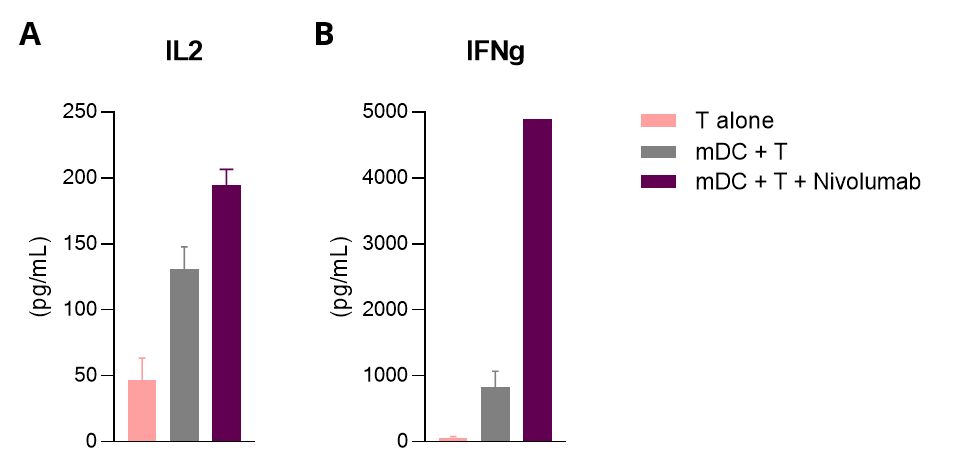
Mature dendritic cells displayed the expected ability to stimulate allogeneic CD4+ T cells in the MLR assay.
This response was demonstrated by the release of IL-2 and IFNγ in the culture supernatant.
Following PD1 blockade with Nivolumab, the MLR response was further enhanced, showing that the assay can detect the immunostimulatory effect of immune checkpoint inhibition on dendritic cell-mediated T cell activation.
Adenosine impairs dendritic cell phenotype and function
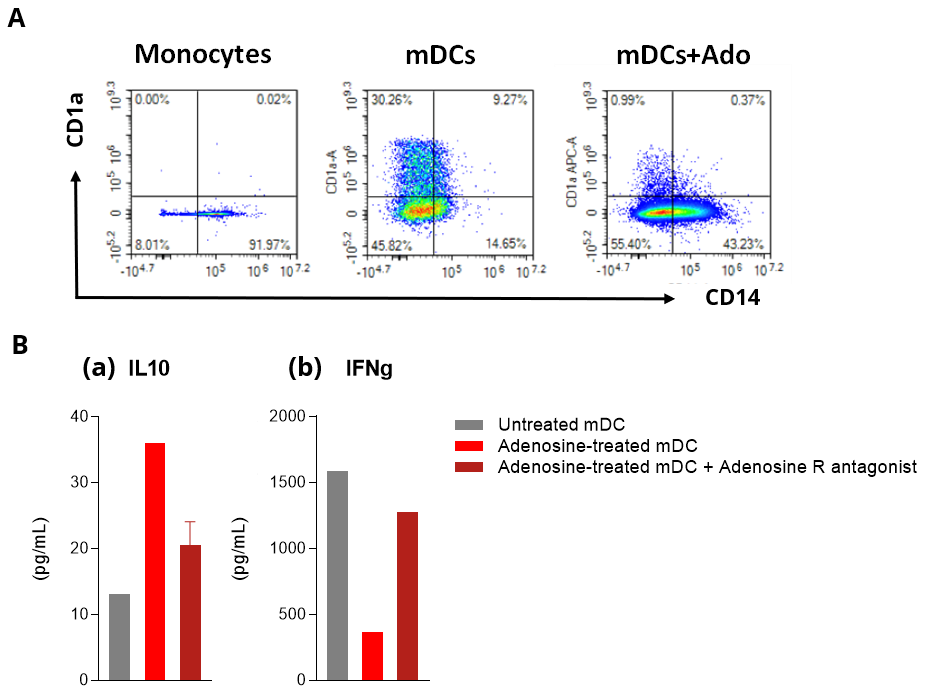
When dendritic cells were challenged with adenosine, their differentiation and maturation were altered.
Flow cytometry analysis showed that adenosine skewed dendritic cell differentiation toward a CD1a low / CD14+ cell population, indicating the generation of phenotypically dysregulated dendritic cells.
Functionally, adenosine-treated dendritic cells showed a reduced ability to stimulate allogeneic CD4+ T cells.
This impaired allostimulatory activity was reflected by increased IL-10 release from dendritic cells and decreased IFNγ release from T cells in the MLR co-culture.
Adenosine receptor antagonism relieves immune suppression
The immunosuppressive effects induced by adenosine were relieved in the presence of an adenosine receptor antagonist.
This confirmed that adenosine-mediated dendritic cell dysregulation and impaired T cell activation were driven through adenosine receptor signaling.
These results demonstrate the relevance of the assay for evaluating compounds designed to alleviate immunosuppressive conditions and restore dendritic cell-mediated T cell-stimulating activity.
Conclusion
This case study demonstrates the value of Explicyte’s mixed leukocyte reaction assay as a functional platform to evaluate immunotherapeutic modulation of dendritic cell and T cell responses.
By combining allogeneic CD4+ T cell and monocyte-derived dendritic cell co-culture, cytokine quantification, flow cytometry-based phenotyping, and pharmacological modulation, the assay enables the characterization of both immune activation and immune suppression mechanisms.
This platform can support the preclinical assessment of immune checkpoint inhibitors, adenosine pathway modulators, and novel immunotherapeutic candidates designed to amplify or restore anti-tumor immune responses.