MODALITY-SPECIFIC PRECLINICAL ASSAYS

Preclinical assays for multispecific antibodies and immune cell engagers

Determine whether your molecule selectively redirects the intended immune effector population toward target-positive tumor cells - and characterize the resulting antitumor activity, immune-cell activation and cytokine-release profile

Explicyte designs fit-for-purpose studies for T-cell engagers, NK-cell engagers and other multispecific immune-cell–redirecting therapeutics, combining target qualification, primary human immune-cell co-cultures, tumor killing, effector-cell phenotyping, multi-donor cytokine release and CRS-related liability profiling, and mechanistic analysis.

10+ years
of experience in preclinical & translational precision oncology
40+
Peer-reviewed publications in immuno-oncology
Multispecific
programs already supported at preclinical stage
100+
human cancer cell lines available for co-culture with primary immune cells

PRECLINICAL CAPABILITIES

Preclinical assays by engager format: T-cell, NK-cell and multispecific

From T-cell and NK-cell engagers to other dual-targeting and immune-cell–redirecting formats, we adapt the tumor models, primary effector cells and functional readouts to the intended mechanism of action.

T-CELL ENGAGERS

T-cell redirection & tumor killing

Evaluate T-cell–redirecting formats - including BiTE, IgG-like TCEs, DART and TriTAC — in target-defined tumor models using primary PBMCs or purified T cells, with integrated assessment of tumor killing, T-cell activation and cytokine release.

Typical focus: target-dependent killing · CD4/CD8 activation · granzymes / perforin / granulysin · cytokine release · CRS-liability de-risking

NK-CELL ENGAGERS

NK-cell engagement & cytotoxic activity

Characterize NK-cell–redirecting molecules - including NKCE, BiKE and TriKE formats engaging NK cell receptors such as CD16 or NKG2D — using target-defined tumor models with primary NK cells or PBMCs to quantify cytotoxic activity and the associated NK cell response.

Typical focus: target-dependent killing · NK-cell activation · CD107a degranulation · granzymes / perforin · Fc-mediated effector function

OTHER MULTISPECIFICS

Mechanism-adapted functional assays

For dual-targeting antibodies and multispecifics engaging other immune cell populations, immune pathways or receptor combinations, assays are designed around the intended biology and functional mechanism.

Typical formats: CD3×CD28 co-stimulatory bispecifics · checkpoint bispecifics (PD-1×LAG-3, PD-1×TIM-3) · tumor-targeted IL-2/IL-15 fusion proteins · 4-1BB agonist bispecifics · trispecific engagers

Typical focus: target co-expression · pathway modulation · functional response · mechanism of action

Imane Nafia, PhD, Chief Scientific Officer at Explicyte

For an immune cell engager, the model needs to reflect the relevant biology, and the readouts need to address the intended mechanism of action.

We work with primary human immune cells from characterized donors – T cell subsets, NK cells and other populations – in co-culture with target tumor cells to assess the efficacy and target specificity of the antitumor response, the underlying immune response and effector function, as well as cytokine release liability, all within an integrated experimental framework.

Imane Nafia, PhD

Chief Scientific Officer, Explicyte

Multispecific case studies

Case studies: tarlatamab efficacy and single-cell CRS profiling

T-CELL ENGAGER · FUNCTIONAL CHARACTERIZATION

Target-dependent tumor cell killing and immune response to tarlatamab

DLL3-positive small cell lung cancer cells and DLL3-negative non-small cell lung cancer cells were used to establish a target-defined co-culture system with primary human T cells. In the presence of T cells, tarlatamab induced potent, dose-dependent tumor cell killing in DLL3-positive models, while no activity in the DLL3-negative control model.

Integrated analysis captured anti-tumor activity, target specificity and the underlying T cell response, combining functional tumor cell readouts with immune cell activation, cytokine release and cytotoxic effector profiling.

Key outputs

  • Target expression and model qualification
  • Target- and immune cell-dependent tumor killing
    • Tumor cell viability
    • Tumor cell death/apoptosis, caspase-3 activation
  • T cell activation, immune response and effector function
    • T cell activation profiling
    • Cytokine response : broad panel including IFNγ, TNFα, and IL10 release
    • Cytotoxic effector function : Granzyme B, granzyme A, and granulysin profiling

CYTOKINE RELEASE · SINGLE-CELL PROFILING

Resolve cytokine release responses and cellular drivers of immune activation

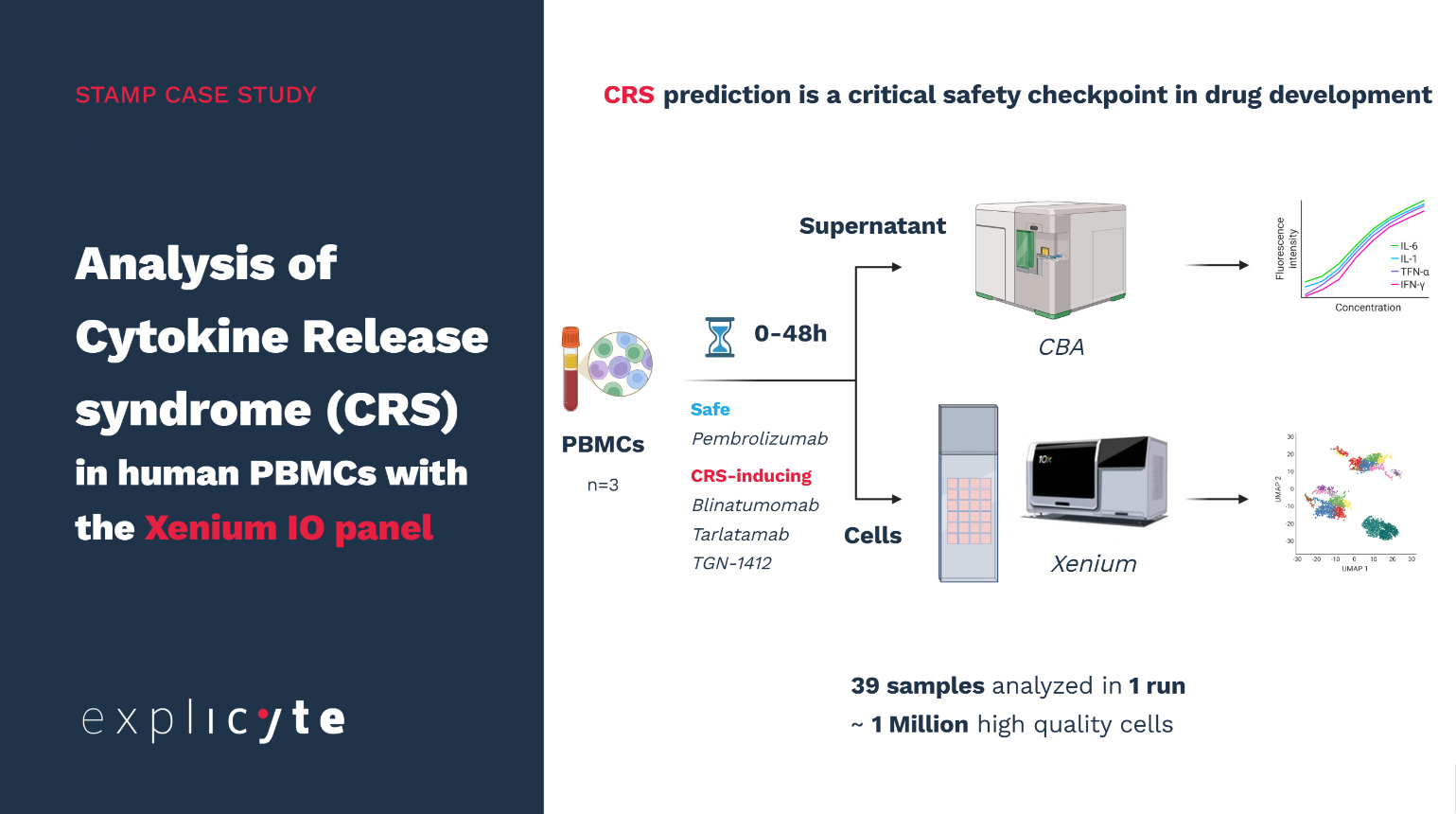
PBMCs from three healthy donors were exposed over 0-48 hours to reference compounds with distinct immune activation profiles (CRS-positive and negative references). Multiplex cytokine measurements were combined with Xenium STAMP single-cell transcriptomic profiling to characterize cytokine release kinetics, treatment-associated immune cell dynamics and the cellular populations and transcriptional programs associated with cytokine expression.

The study included pembrolizumab, blinatumomab, tarlatamab and TGN1412, with 39 samples analyzed in a single run, generating approximately one million high-quality cells for downstream single-cell analysis.
Key outputs

  • Cytokine response
    • Cytokine release kinetics
    • Multi-donor variability
  • Immune cell response & population dynamics
    • Treatment-associated shifts in immune cell populations
    • Cell-state and activation programs
  • Cellular & transcriptional characterization of the cytokine response
    • Candidate cellular populations associated with cytokine expression
    • Cell population-specific transcriptional responses

PRECLINICAL CAPABILITIES

From target qualification to CRS-related profiling: the engager assay workflow

Explicyte combines target-defined tumor models with primary human effector cells and fit-for-purpose analytical readouts. Programs are scoped modularly to the questions that matter for your molecule.

Explicyte's preclinical assay capabilities for multispecific antibodies and immune-cell engagers, from target qualification to functional efficacy, cytokine-release profiling and mechanistic analysis.
Step Stage & development question Models & effector cells Key readouts Methods & technologies
01 Target qualification & model selection Is the target expressed in the right tumors, tissues and experimental models? Human tumor cohorts & relevant normal tissues; cancer cell-line panels spanning target-high, target-low and target-negative expression Target prevalence · membrane localization · expression intensity · intra- and inter-tumor heterogeneity · cell-surface expression IHC / multiplex IF , flow cytometry
02 Effector-cell redirection & tumor killing Does the engager selectively redirect the intended immune population toward target-positive tumor cells? Target-positive, target-low and target-negative tumor cells co-cultured with primary PBMCs, purified T cells, NK cells or other relevant effector populations Tumor-cell killing · viability · apoptosis · potency · target dependence · effector-to-target dependence · treatment kinetics Flow cytometry · live-cell imaging · fluorescent tumor reporters · dose-response modelling
03 Immune-cell activation & effector function Which effector populations respond and what mechanisms accompany tumor-cell killing? Tumor / PBMC, tumor / T-cell or tumor / NK-cell co-cultures; multi-donor primary human immune-cell systems T-cell or NK-cell activation · immune-subset dynamics · perforin · granzymes A/B · CD107a degranulation · granulysin · killer-lineage markers Multiplex flow cytometry · intracellular staining · secretome / effector-molecule profiling
04 Cytokine-release & immune-activation profiling What inflammatory response accompanies functional efficacy? Primary human PBMCs or relevant effector-cell co-cultures across multiple donors, concentrations and time points Multiplex cytokine release · dose response · kinetics · donor variability · benchmarking against relevant CRS-positive molecules (blinatumomab, TGN1412) · relationship between efficacy and inflammatory activation Multiplex cytokine assays · flow cytometry · Xenium STAMP for cellular-resolution profiling where relevant
05 Mechanism of action & translational biomarkers Which cellular states, pathways and biomarkers are associated with response? Treated cell-based co-cultures and, where appropriate, patient-derived 3D tumor models ; matched pre- and post-treatment samples Treatment-associated cell states · response biomarkers · resistant populations · cytokine-associated transcriptional programs · pathway modulation Flow cytometry · bulk transcriptomics · scRNA-seq · spatial transcriptomics · Xenium STAMP

WHY EXPLICYTE

Why work with Explicyte as your multispecific and immune-cell engager CRO?

Track record in tumor-immune biology, from bench to publication

10+ years of preclinical and translational work on the tumor microenvironment across solid and hematologic indications, with 40+ peer-reviewed publications spanning immune-cell profiling, target biology and mechanism-of-action studies. When your program needs published, biology-relevant methodology, we have it.

Primary immune cells from characterized donors, in biology-relevant co-cultures

Multi-donor primary human PBMCs, T-cell subsets and NK cells from qualified donor pools, co-cultured with target-defined tumor models spanning cell-line panels and patient-derived 3D systems. Every study is scoped to the biology of your target, effector arm and indication — not to a fixed assay menu.

Efficacy and early non-clinical safety in one integrated program

Target-dependent killing, effector-cell activation and cytokine-release liability characterized in parallel within the same experimental system. Multi-donor, multi-concentration, multi-timepoint cytokine release and CRS-related liability profiling with relevant clinical CRS benchmarks (e.g. blinatumomab, TGN1412) where appropriate.

PhD-led interpretation, backed by multiomics and data science

A dedicated PhD-level study director carries the biological logic from study design to interpretation, with a bioinformatics team and multiomics platform (Xenium STAMP, spatial transcriptomics, scRNA-seq) on call when a deeper mechanistic question emerges.

The Explicyte team at their Bordeaux laboratory

Paul Marteau, PharmD (study director), Imane Nafia, PhD (CSO), Loïc Cerf, MSc (COO), Alban Bessede, PhD (founder, CEO), Jean-Philippe Guégan, PhD (CTO)

Contact our team

Discuss your multispecific or immune-cell engager program

Tell us about your targets, molecular format, intended effector population, indication and development stage. We can help define the cellular models, primary immune-cell systems, controls and readouts needed to characterize efficacy, immune activation, cytokine release and mechanism of action.

MULTISPECIFIC & ENGAGER FAQ

Frequently asked questions about multispecific and immune-cell engager testing

What preclinical assays are used to characterize immune-cell engagers?

Preclinical characterization can combine target-expression profiling, target-dependent tumor-cell killing, effector-cell activation, cytotoxic-effector measurements and cytokine-release profiling. The precise assay configuration depends on the engager format, target biology and immune population being recruited.

Target-positive and appropriate target-negative tumor cells are co-cultured with primary human PBMCs or purified T cells and exposed to the engager across a concentration range. Tumor-cell viability, apoptosis and killing can be measured alongside T-cell activation, effector function and cytokine release.

Yes. NK-cell engager studies can use primary NK cells or PBMC-based systems combined with target-defined tumor models to investigate target-dependent killing, NK-cell activation, cytotoxic function, cytokine release and donor variability.

Studies can incorporate target-positive, target-low and target-negative cellular models, together with appropriate immune-cell-free and other mechanistic controls. This helps distinguish target-dependent redirection from nonspecific cytotoxic or immune-activation effects.

Yes. Functional efficacy and cytokine release can be evaluated in parallel across concentration, time and donor conditions, allowing the relationship between antitumor activity and inflammatory immune activation to be characterized.

Primary human PBMCs can be exposed to test molecules across multiple donors, concentrations and time points, followed by multiplex cytokine analysis and immune-cell phenotyping. For selected programs, deeper transcriptomic or single-cell profiling can be added to characterize the cellular programs associated with the cytokine response.

Yes. Explicyte can characterize target prevalence, membrane localization and heterogeneity in human tumors, together with expression in relevant normal tissues to support indication selection and early assessment of potential target expression-related risks

Yes. Functional assays can be complemented by single-cell or transcriptomic profiling to resolve treatment-associated immune-cell states, response pathways and candidate cellular sources of cytokine expression.

Candidate engagers are evaluated alongside relevant reference molecules, where appropriate, using fit-for-purpose tumor and immune cell assay systems. Reference molecules provide contextual benchmarks for immune effector activation & function and tumor cell killing potency, while assay conditions and readouts are adapted to the mechanism and format of each candidate. 

Cytokine release liability can be characterized across multiple healthy PBMC donors, concentrations and time points, using relevant CRS references with distinct CRS profiles (e.g. blinatumomab, TGN1412). Single-cell profiling with Xenium STAMP can be added, where appropriate, to resolve the cellular sources of cytokine expression and the transcriptional programs associated with the response, helping to identify mechanistic differences between candidates that may show similar bulk cytokine profiles.

Explicyte Oncology CRO logo

Capabilities

Modalities