
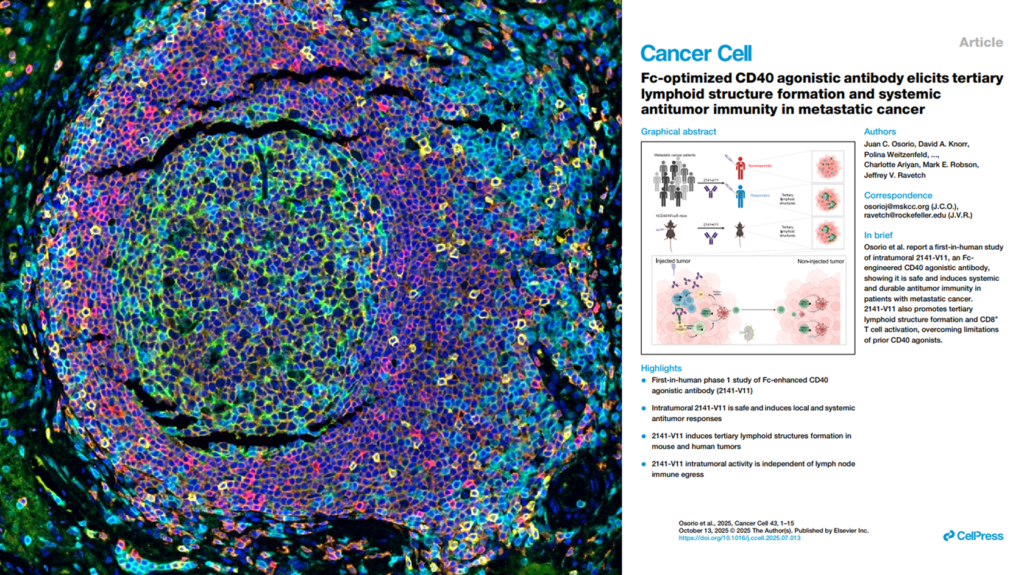
An Fc-engineered CD40 agonist, injected directly into tumors, was safe in a first-in-human trial and pushed two metastatic cancers into complete remission — including a melanoma patient still disease-free at 28 months. The drug worked by building tertiary lymphoid structures, organized immune hubs, inside tumors. Explicyte's multiplex immunofluorescence made those structures visible in patient biopsies, confirming that mature TLS appeared in responders' injected and even non-injected lesions, but were absent in a non-responder.
The first-in-human phase 1 trial (NCT04059588) was led by Juan Osorio, David Knorr, and Jeffrey Ravetch’s group across Memorial Sloan Kettering Cancer Center and Rockefeller University, building on more than a decade of antibody-engineering work on CD40 agonism. Explicyte Immuno-oncology (Bordeaux) ran the multiplex immunofluorescence on patient FFPE biopsies — the readout that revealed tertiary lymphoid structures in responders — on an automated Ventana Discovery XT workflow with Opal/TSA multiplexing and a TLS-focused panel (CD8, CD4, CD20, CD21, CD23). It’s exactly the kind of spatial, multiplex IHF readout Explicyte’s translational platform is built to deliver, from TLS induction and maturation through dendritic-cell activation and chemokine programs.
The trial reframes TLS from a favorable bystander biomarker into something a therapy can deliberately build — and shows a local injection can generate body-wide, durable immunity.
For drug developers, the work validates Fc engineering as a route to CD40 agonists that are both safer and more active, and it positions multiplex IHF as a practical, tissue-level readout for TLS-directed therapies. The findings support advancing 2141-V11 into phase 2 and offer a template for measuring TLS induction, maturation, and spatial immune remodeling in future immunotherapy programs.