

Dendritic cells are central regulators of anti-tumor immunity. By capturing antigens and stimulating T cell responses, they contribute to the initiation and amplification of adaptive immune responses against cancer cells. However, dendritic cell differentiation, maturation, and function are strongly influenced by their microenvironment. In cancer, the tumor microenvironment can accumulate high levels of immunosuppressive mediators, including adenosine, a major pathway involved in the inhibition of anti-tumor immune responses. Adenosine receptor stimulation can alter dendritic cell biology by skewing their differentiation toward a tolerogenic and suppressive phenotype. These dysregulated dendritic cells may express high levels of immune suppressive and pro-inflammatory factors while displaying impaired capacity to stimulate T cell responses.
Study objective
The objective of this case study was to evaluate the impact of adenosine on human dendritic cell differentiation, phenotype, and functional activity.
The assay was designed to assess whether adenosine-mediated suppression could impair dendritic cell-mediated T cell activation, and whether this effect could be reversed using adenosine receptor antagonists.
Assay principle
Explicyte developed a dendritic cell-based in vitro assay platform combining:
- human monocyte-derived dendritic cell differentiation;
- allogeneic mixed leukocyte reaction using CD4+ T cells;
- cytokine quantification by HTRF;
- flow cytometry-based phenotypic profiling;
- pharmacological modulation using adenosine receptor antagonists.
This integrated approach enables the functional evaluation of adenosine pathway modulators and candidate immunotherapeutics designed to restore or enhance dendritic cell-mediated T cell activation.
Experimental model
Peripheral blood monocytes were isolated and differentiated into dendritic cells under control conditions or in the presence of adenosine.
The resulting dendritic cells were then evaluated using two complementary approaches.
First, their functional activity was assessed in a mixed leukocyte reaction assay by co-culturing dendritic cells with allogeneic CD4+ T cells. IFNγ release was measured after 72 hours using an HTRF-based assay as a surrogate marker of T cell activation.
Second, dendritic cell phenotype was characterized by flow cytometry to assess the impact of adenosine on differentiation and maturation markers.
Adenosine receptor antagonists were used to determine whether the suppressive effects of adenosine were mediated through adenosine receptor signaling.
Results
Adenosine impairs dendritic cell-mediated T cell activation
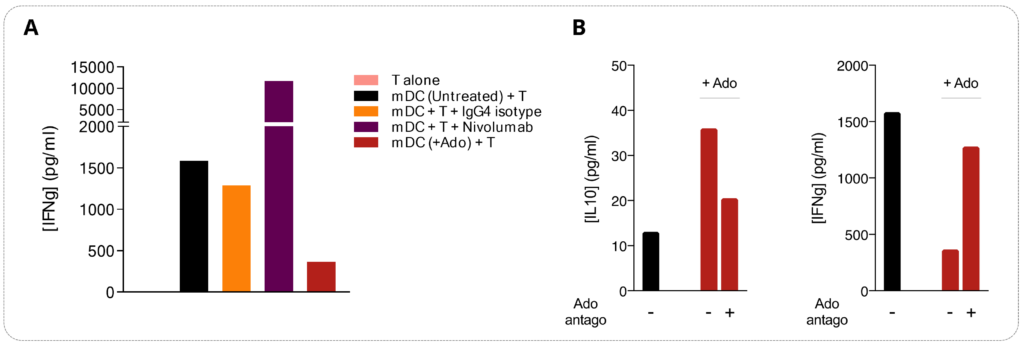
Normal mature dendritic cells induced a robust allogeneic T cell response in the mixed leukocyte reaction assay, as shown by IFNγ release in the culture supernatant.
This response was further enhanced following PD-1 blockade, confirming the capacity of the assay to detect immune checkpoint-mediated optimization of T cell activation.
In contrast, dendritic cells differentiated in the presence of adenosine displayed a strongly impaired ability to stimulate T cell responses, resulting in reduced IFNγ release.
These results demonstrate that adenosine can suppress the allostimulatory function of human dendritic cells.
Adenosine promotes a suppressive cytokine profile
Adenosine-differentiated dendritic cells showed increased expression of suppressive mediators, including IL-10.
They also expressed pro-inflammatory factors such as IL-8, indicating the generation of a phenotypically and functionally dysregulated dendritic cell population.
When adenosine receptor antagonists were added, these effects were abolished, confirming that the observed dysregulation was mediated through adenosine receptor signaling.
Adenosine induces an aberrant dendritic cell phenotype
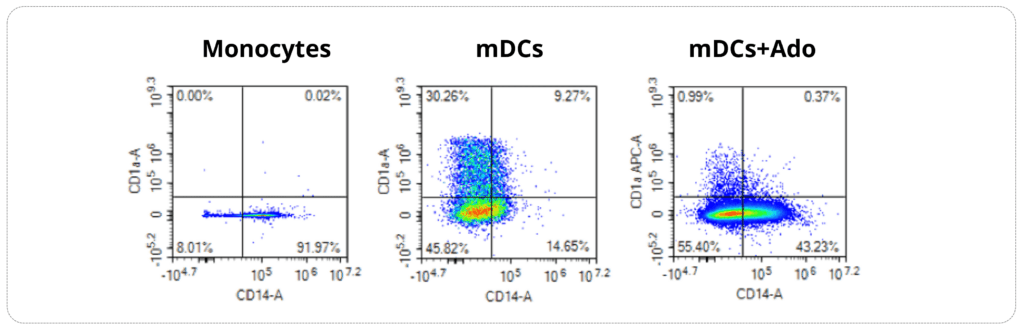
Flow cytometry-based profiling showed that adenosine altered dendritic cell differentiation and maturation.
Instead of generating a conventional mature dendritic cell phenotype, adenosine skewed differentiation toward a CD1a low / CD14+ cell population.
This phenotype is consistent with an aberrant and less immunostimulatory dendritic cell state.
Adenosine receptor antagonism restores dendritic cell functionality
The use of adenosine receptor antagonists relieved the suppressive effects of adenosine on dendritic cell differentiation and function.
This pharmacological reversal supports the relevance of Explicyte’s dendritic cell-based assays for evaluating adenosine pathway inhibitors and other immunotherapeutic candidates designed to restore dendritic cell-mediated T cell activation.
Conclusion
This case study demonstrates that adenosine strongly alters human dendritic cell differentiation, phenotype, and T cell-stimulating activity.
By combining dendritic cell differentiation, mixed leukocyte reaction, cytokine quantification, flow cytometry, and pharmacological pathway modulation, Explicyte provides a robust in vitro platform to investigate dendritic cell function in immuno-oncology.
This assay can support the preclinical evaluation of adenosine pathway modulators, immune checkpoint inhibitors, and combination strategies aimed at restoring effective anti-tumor immune responses.