

Neutrophils are increasingly recognized as important contributors to the tumor microenvironment. Beyond their antimicrobial functions, tumor-associated neutrophils can infiltrate several tumor types and have been associated with poor clinical outcome. Their recruitment is driven by key chemokines produced by tumor cells or by the surrounding microenvironment, including CXCL8/IL-8 and CXCL1.
By promoting the recruitment of additional immunosuppressive cell populations, such as regulatory T cells and tumor-associated macrophages, tumor-associated neutrophils may contribute to the establishment and maintenance of a local immunosuppressive microenvironment. Targeting neutrophil recruitment and migration therefore represents a relevant strategy in cancer immunotherapy.
Study objective
The objective of this case study was to establish and validate a functional assay enabling real-time monitoring of human neutrophil chemotaxis in response to selected chemoattractants.
The assay was designed to support the screening and characterization of candidate compounds able to modulate or inhibit neutrophil migration toward tumor-associated chemotactic signals.
Assay principle
Explicyte developed a real-time neutrophil migration assay based on the kinetic monitoring of chemotaxis across an optically clear filter membrane. This format enables time-lapse imaging and quantitative analysis of neutrophil migration in response to defined chemoattractants.
Freshly isolated human neutrophils are plated on the upper side of a coated optically clear filter membrane. Chemoattractants are then added to the lower compartment to induce directional neutrophil migration. Cell migration is monitored by live-cell imaging over defined time windows, allowing kinetic analysis of chemotactic responses.
Experimental model
In this case study, human neutrophil chemotaxis was evaluated in response to three chemoattractants:
- fMLP, a prototypical neutrophil chemoattractant.
- IL-8 / CXCL8, a key chemokine involved in neutrophil recruitment.
- CXCL1, another CXCR2-associated chemokine involved in neutrophil migration.
To validate assay pharmacology, neutrophil migration was also assessed in the presence or absence of pathway inhibitors, including a phospholipase C inhibitor for fMLP-induced migration and a CXCR2 antagonist for IL-8- and CXCL1-induced migration.
Migration was monitored over 6 hours for fMLP- and IL-8-induced chemotaxis, and over 15 hours for CXCL1-induced chemotaxis.
Results
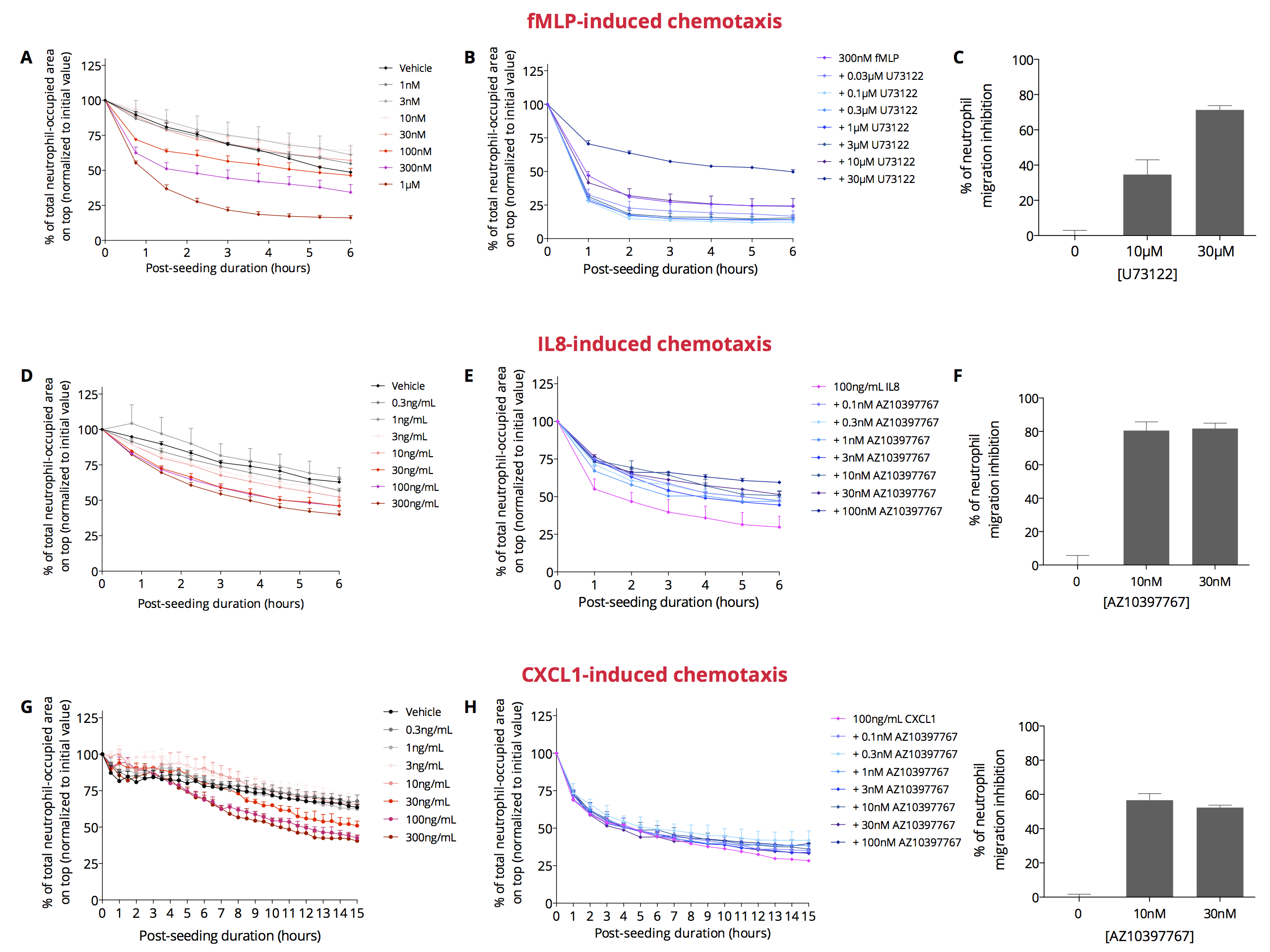
fMLP induces rapid and dose-dependent neutrophil chemotaxis
Freshly isolated human neutrophils showed a rapid chemotactic response toward fMLP. Migration increased in a dose-dependent manner and was detectable during the 6-hour monitoring period.
The fMLP-induced chemotactic response was partially inhibited by the phospholipase C inhibitor, confirming the ability of the assay to detect pharmacological modulation of neutrophil migration.
IL-8 drives CXCR2-dependent neutrophil migration
IL-8 induced a clear and dose-dependent neutrophil migration response over the 6-hour assay period.
The addition of a CXCR2 antagonist partially reduced IL-8-induced chemotaxis, supporting the relevance of the assay for evaluating compounds targeting chemokine-driven neutrophil recruitment.
CXCL1 promotes sustained neutrophil chemotaxis
CXCL1 also induced dose-dependent neutrophil migration, monitored over a 15-hour period.
As observed with IL-8, CXCL1-induced chemotaxis was partially inhibited by CXCR2 blockade, further validating the assay as a functional platform to evaluate neutrophil migration downstream of CXCR2-associated chemokine signaling.
Conclusion
This case study demonstrates the ability of Explicyte’s real-time neutrophil chemotaxis assay to quantify human neutrophil migration in response to key chemoattractants involved in tumor-associated immune cell recruitment.
By combining freshly isolated human neutrophils, live-cell imaging, kinetic monitoring, and pharmacological validation, the assay provides a robust functional platform to evaluate immunomodulatory compounds designed to interfere with neutrophil recruitment into the tumor microenvironment.
This approach can support the preclinical screening and characterization of cancer immunotherapy candidates targeting chemokine-driven immune cell migration.