
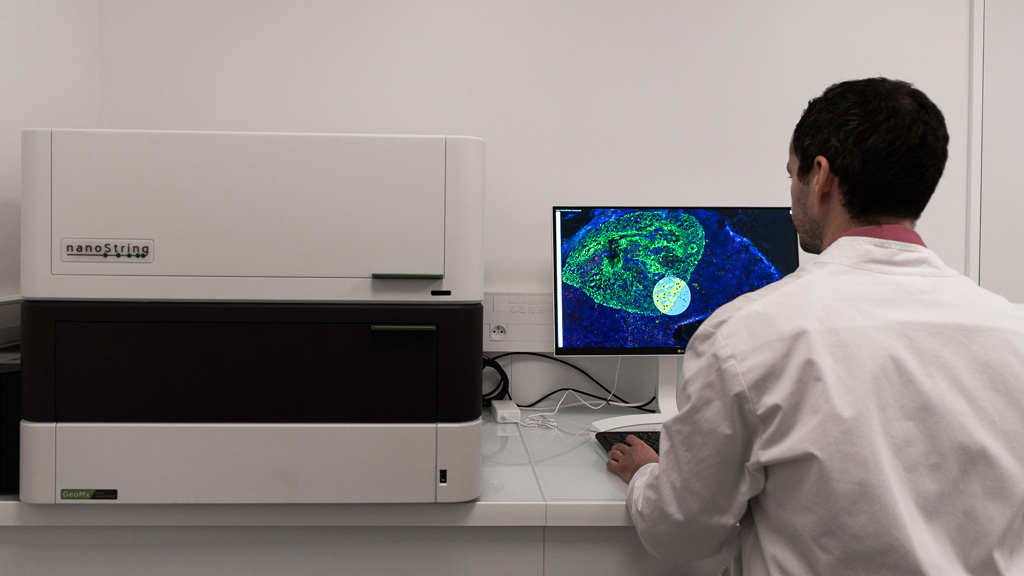
Immune checkpoint blockers have transformed the therapeutic landscape of oncology. In particular, therapies targeting the PD-1/PD-L1 axis have demonstrated major anti-tumor activity and are now approved across several solid tumors, including non-small cell lung cancer. However, most patients treated with PD-1 or PD-L1 inhibitors do not derive clinical benefit. There is therefore a critical need to better understand the mechanisms underlying response and resistance to immune checkpoint blockade, with the objective of identifying predictive biomarkers and new therapeutic targets. In collaboration with Institut Bergonié, Explicyte applied spatial transcriptomics using the GeoMx Digital Spatial Profiling platform to investigate tumor and stromal molecular features associated with response to anti-PD-(L)1-based immunotherapy in NSCLC.
Study objective
The objective of this case study was to characterize the spatial transcriptomic profile of pre-treatment NSCLC tumor samples from responder and non-responder patients.
The study aimed to identify biological pathways and molecular determinants associated with sensitivity or resistance to immune checkpoint blockade, with a specific focus on the distinction between tumor and stromal compartments.
Analytical approach
Tumor samples collected before treatment initiation were analyzed using the GeoMx DSP platform and the GeoMx Immune Pathways Panel.
Tissue sections were stained with morphology markers to guide region selection and compartment segmentation:
- Pan-Cytokeratin, to identify tumor epithelial areas;
- CD45, to identify immune cell-rich regions.
Regions of interest were selected in mixed tumor and stromal areas, then segmented into:
- tumor compartments, defined as PanCK-positive areas;
- stromal compartments, defined as PanCK-negative areas.
Expression of 78 protein-coding genes related to tumor microenvironment and immune pathway biology was then analyzed using the NanoString nCounter platform.
Patient samples
A total of 16 NSCLC tumor samples were analyzed:
- 8 responder patients, classified as objective responders;
- 8 non-responder patients, classified as progressive disease.
For each patient, 11 to 12 regions of interest were analyzed, enabling spatially resolved comparison of tumor- and stroma-specific gene expression profiles.
Results
Spatial transcriptomics enables compartment-specific immune profiling
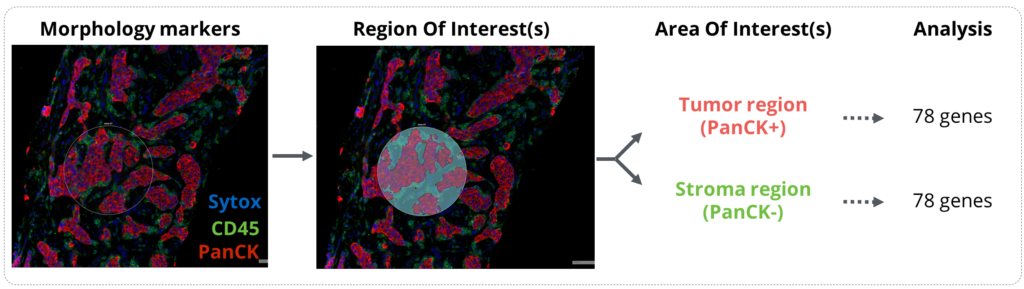
The GeoMx workflow allowed the independent analysis of tumor and stromal gene expression from the same tissue sections.
By separating PanCK-positive tumor areas from PanCK-negative stromal regions, the analysis captured compartment-specific immune and tumor microenvironment signatures that would not be accessible through bulk profiling alone.
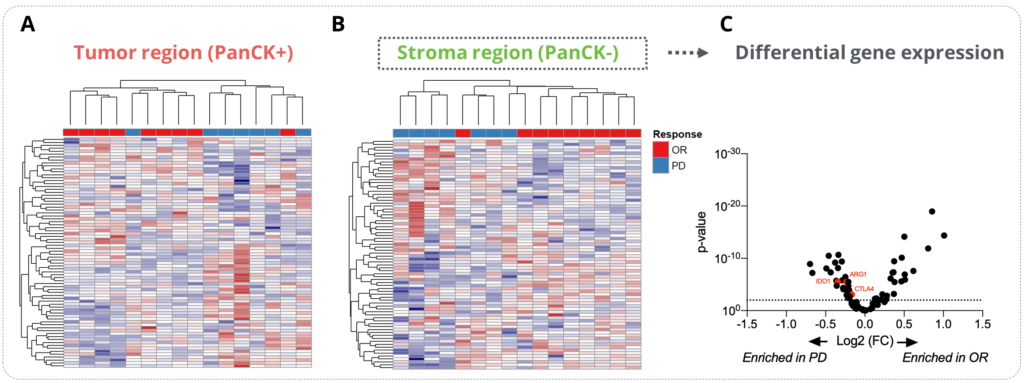
Stromal gene expression strongly stratifies responders and non-responders
Unsupervised clustering revealed a strong separation between responder and non-responder patients when using gene expression data collected from the stromal compartment.
This finding highlights the importance of the tumor stroma in shaping response to immune checkpoint blockade and supports the relevance of spatial transcriptomics for identifying response-associated microenvironmental features.
Differential gene expression reveals determinants of resistance
Differential gene expression analysis was performed on stroma-specific data from responders and patients with progressive disease.
This analysis identified genes associated with immune escape and resistance to immune checkpoint blockade. Several immune regulatory genes, including CTLA4, ARG1, and IDO1, were enriched in progressive disease patients.
These results suggest that stromal immune suppressive programs may contribute to resistance to anti-PD-(L)1 therapy in NSCLC.
Explicyte’s contribution
This case study illustrates Explicyte’s ability to implement spatial transcriptomics workflows for translational immuno-oncology research.
Explicyte’s contribution included the application of tissue-based spatial profiling, morphology-guided region selection, tumor and stroma segmentation, and downstream analysis of immune pathway gene expression.
By combining histology, spatial molecular profiling, and bioinformatics analysis, Explicyte supports the identification of biomarkers and biological mechanisms associated with response or resistance to cancer immunotherapies.
Conclusion
This study demonstrates the value of spatial transcriptomics to investigate immune checkpoint blockade response in NSCLC.
By preserving spatial information and enabling tumor- and stroma-specific gene expression analysis, the GeoMx DSP platform revealed that the stromal compartment carries strong biological information capable of stratifying responder and non-responder patients.
These findings support the use of spatial transcriptomics in translational oncology programs aimed at biomarker discovery, mechanism-of-action studies, and the identification of new therapeutic targets in the tumor microenvironment.