
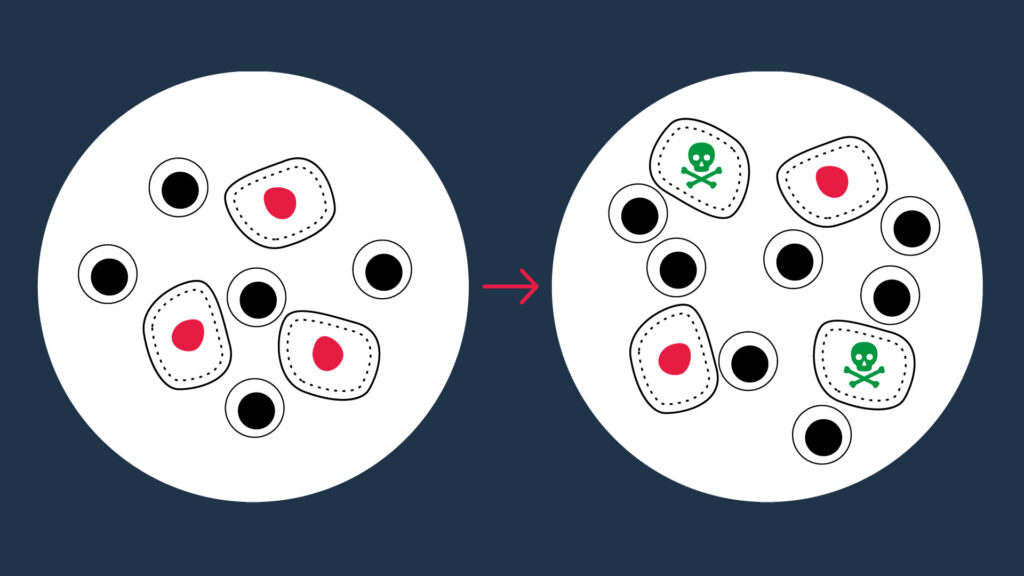
The initiation of an anti-tumor immune response and the subsequent elimination of cancer cells are central mechanisms of cancer immunosurveillance. In immuno-oncology drug development, one key objective is to enhance the ability of immune effector cells to recognize, engage, and eliminate tumor cells.
In this context, in vitro immune cell-mediated killing assays provide a highly relevant functional readout to assess whether candidate compounds or antibodies can potentiate immune-driven tumor cell elimination.
Explicyte has developed a specialized in vitro immune cell-mediated killing assay designed to evaluate the capacity of immunomodulatory agents to enhance immune effector function against tumor cells.
Assay principle
Using a live-cell imaging platform, this sensitive and quantitative assay is performed in a 96-well plate co-culture format combining human tumor cells with primary human peripheral blood mononuclear cells (hPBMCs).
The assay can be adapted to several human tumor cell models, including MDA-MB-231 breast cancer cells, SKOV-3 ovarian cancer cells, A549 lung cancer cells, and H1299 lung cancer cells.
Tumor cells are engineered to express a nuclear red fluorescent probe, allowing specific identification and tracking of the tumor cell population over time. Apoptosis is monitored using a caspase-3/7 green fluorescent probe, enabling kinetic quantification of apoptotic events specifically within tumor cells.
Data can be analyzed as real-time kinetic curves, endpoint measurements, or integrated area under the curve values over a defined time window.
Experimental model
In this case study, H1299 lung cancer cells stably expressing a nuclear red fluorescent probe were co-cultured with human PBMCs at an optimized effector-to-target ratio.
PBMCs were either left unstimulated or activated with increasing concentrations of anti-CD3 antibody. Tumor cell apoptosis was then monitored over time by live-cell imaging for up to 120 hours.
Results
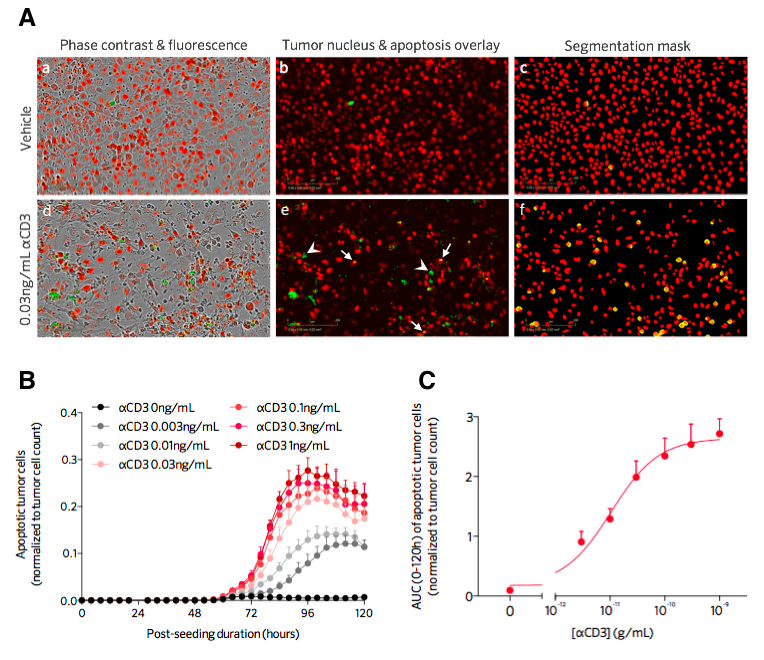
A. Anti-CD3 induces PBMC-mediated apoptotic killing of H1299 tumor cells
Live-cell imaging performed 72 hours after co-culture showed increased apoptotic killing of H1299 tumor cells in the presence of anti-CD3-activated PBMCs compared with unstimulated PBMCs.
Tumor cells were identified based on nuclear red fluorescence, while apoptotic cells were detected using the caspase-3/7 green fluorescent signal. Image segmentation and analysis were used to quantify apoptosis specifically within the tumor cell population, corresponding to caspase-3/7-positive events detected within nuclear red-positive cells.
This approach allows discrimination between apoptotic tumor cells and apoptotic non-tumor immune cells within the co-culture.
B. Anti-CD3 induces a kinetic and dose-dependent increase in tumor cell apoptosis
Kinetic monitoring showed that anti-CD3 activation promoted PBMC-mediated apoptotic killing of H1299 cancer cells over time.
Tumor cell apoptosis was quantified, normalized to tumor cell number, and plotted over a 120-hour post-treatment period. The results demonstrated a clear time-dependent increase in tumor cell apoptosis following PBMC activation.
C. Integrated analysis confirms dose-dependent immune-mediated tumor cell killing
To further quantify the response, tumor cell apoptosis was integrated over the 120-hour monitoring period and expressed as area under the curve values.
This analysis confirmed a dose-dependent effect of anti-CD3 in promoting PBMC-mediated apoptotic killing of H1299 lung cancer cells.
Conclusion
This case study demonstrates the ability of Explicyte’s live-cell imaging-based immune cell-mediated killing assay to quantitatively monitor PBMC-driven tumor cell apoptosis in real time.
By combining fluorescent tumor cell tracking, apoptosis detection, and image-based segmentation, the assay provides a robust functional platform to evaluate immunomodulatory compounds, therapeutic antibodies, or combination strategies designed to enhance anti-tumor immune responses.