
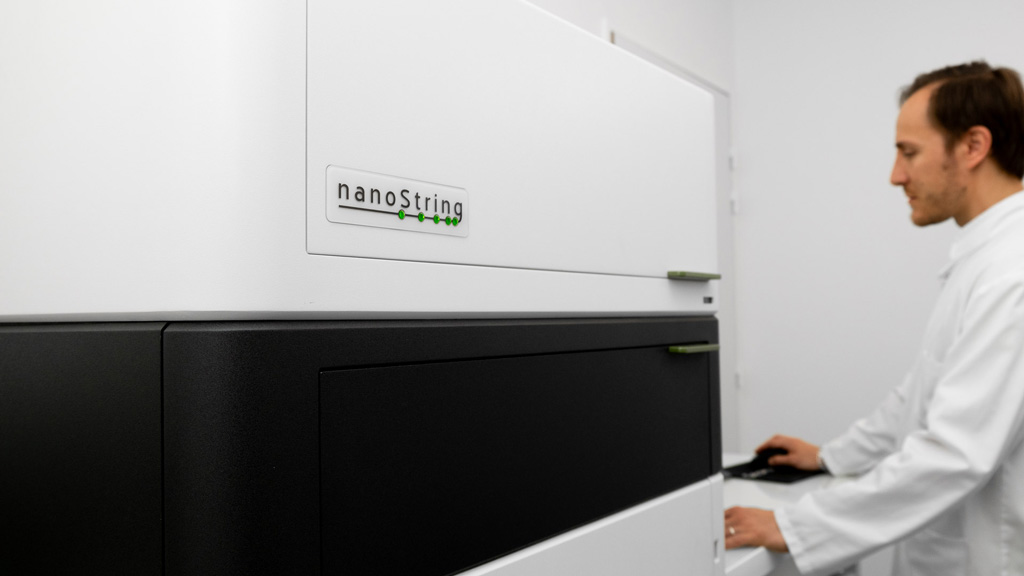
Explicyte is proud to announce its certification as a NanoString partner, reinforcing its commitment to bringing advanced spatial biology technologies to oncology and immuno-oncology research programs.
With the increasing need to better understand tumor complexity and heterogeneity, spatially resolved technologies are becoming essential to investigate biological mechanisms directly within tissue compartments of interest, such as tumor and stroma.
Bringing Spatial Resolution to High-Plex Molecular Profiling
The GeoMx Digital Spatial Profiling platform combines the spatial resolution of immunohistofluorescence with high-plex gene and protein expression analysis.
Starting from FFPE tissue samples, this technology enables the simultaneous analysis of selected RNA or protein panels across multiple regions of interest. These regions can be further segmented into specific compartments, allowing researchers to compare molecular profiles between tumor areas, stromal regions, and immune-rich niches.
In addition to targeted panels, Explicyte now runs the Cancer Transcriptome Atlas, covering 1,800 genes and more than 50 cancer-related pathways, providing a comprehensive approach to spatial transcriptomic profiling.
From FFPE Tissue to Spatial Molecular Insights
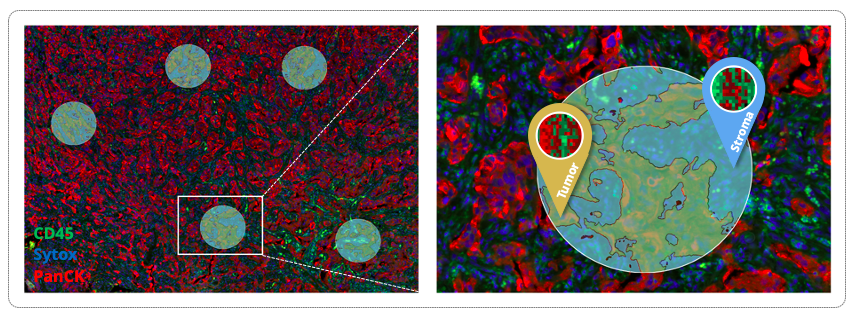
In a representative human lung cancer FFPE tissue section, fluorescent morphology markers were used to guide tissue segmentation, including:
- PanCK, to identify tumor epithelial areas;
- CD45, to identify immune cell-rich regions;
- Sytox, for nuclear counterstaining.
Oligo-tagged RNA probes targeting the 1,800 genes of the Cancer Transcriptome Atlas were applied to the tissue section. Regions of interest were then selected and segmented into tumor and stromal compartments.
Following UV-mediated release of oligos from selected areas of illumination, samples were collected and processed for library preparation and next-generation sequencing.
Revealing Tumor and Stromal Compartment-Specific Signatures
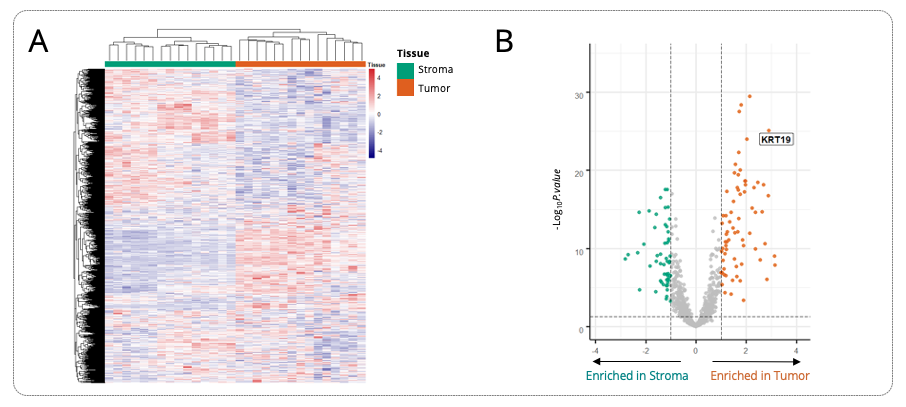
Using this workflow, multiple regions of interest from human lung cancer tissue were analyzed and divided into tumor and stromal areas.
Unsupervised clustering of the spatial transcriptomic data highlighted distinct gene expression patterns across tumor and stromal compartments. Differential gene expression analysis further identified genes significantly enriched in each compartment, demonstrating the ability of Digital Spatial Profiling to uncover compartment-specific molecular programs within the tumor microenvironment.
Explicyte’s Role as a Spatial Biology CRO Partner
As a certified NanoString partner, Explicyte supports sponsors in the implementation of spatial profiling strategies for translational oncology and immuno-oncology research.
Explicyte’s integrated workflow includes FFPE tissue processing, automated staining, region of interest selection, tissue segmentation, spatial transcriptomic or proteomic profiling, and downstream data analysis.
This capability strengthens Explicyte’s position as a specialized oncology CRO able to support biomarker discovery, target validation, mechanism-of-action studies, and patient stratification strategies using spatially resolved technologies.
Supporting the Digital Spatial Profiling Revolution
Digital Spatial Profiling opens new opportunities to investigate cancer biology directly within the tissue architecture.
By combining advanced staining, spatial compartment selection, high-plex molecular profiling, and bioinformatics analysis, Explicyte helps translate complex tissue information into actionable biological insights.
Learn more about Explicyte’s spatial transcriptomics and digital pathology services.