
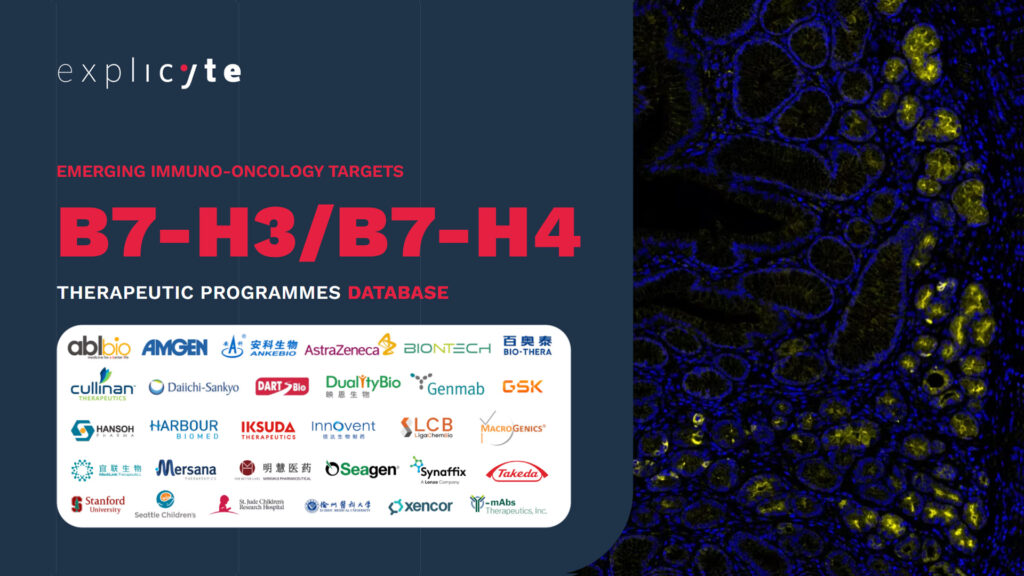
The anti-B7-H3 and anti-B7-H4 oncology landscape in one free database: 37 preclinical and clinical programs, led by 17 antibody-drug conjugates alongside bispecific antibodies, monoclonal antibodies, CAR-T and CAR-NK cells, and a radiotherapy program — mapped by developer and clinical stage.
37 preclinical and clinical programs targeting B7-H3 or B7-H4
B7-H3 (CD276) and B7-H4 (VTCN1) are cell-surface proteins of the B7 immune-regulatory family. Both are overexpressed across a wide range of solid tumors — B7-H3 in small cell lung, prostate, and gynecologic cancers among others — while their expression in normal tissue stays limited, and high expression tends to track with poorer prognosis. That contrast puts an accessible antigen on the tumor surface and opens a therapeutic window for antibody- and cell-based drugs that spares normal tissue.
No B7-H3– or B7-H4–directed therapy has reached approval yet, but the field is advancing quickly in the clinic — led by antibody-drug conjugates. The most advanced candidate, the B7-H3 ADC ifinatamab deruxtecan (Daiichi Sankyo and Merck), is under FDA priority review for extensive-stage small cell lung cancer, behind a deep pipeline of ADCs, bispecific antibodies, monoclonal antibodies, CAR-T and CAR-NK cells, and an early radiotherapy program.
Featured companies include:
ABL Bio, Amgen, Anhui Anke Biotechnology, AstraZeneca, Biocytogen, BioNTech, Bio-Thera Solutions, Cullinan Oncology, Daiichi Sankyo, Dartsbio Pharmaceuticals, DualityBio, Five Prime, GSK, Hansoh Pharma, Harbour BioMed, Iksuda Therapeutics, LigaChem Biosciences, Lonza, Mabstone Biotechnologies, MacroGenics, Maverick Therapeutics, MediLink Therapeutics, Memorial Sloan Kettering, Merck, Mersana Therapeutics, Minghui Pharmaceutical, NextCure, Pfizer, Seagen, Synaffix, Takeda, Xencor, Y-mAbs Therapeutics
Need to discover or validate new targets, test your compounds, or analytical support for a trial?
Contact us