
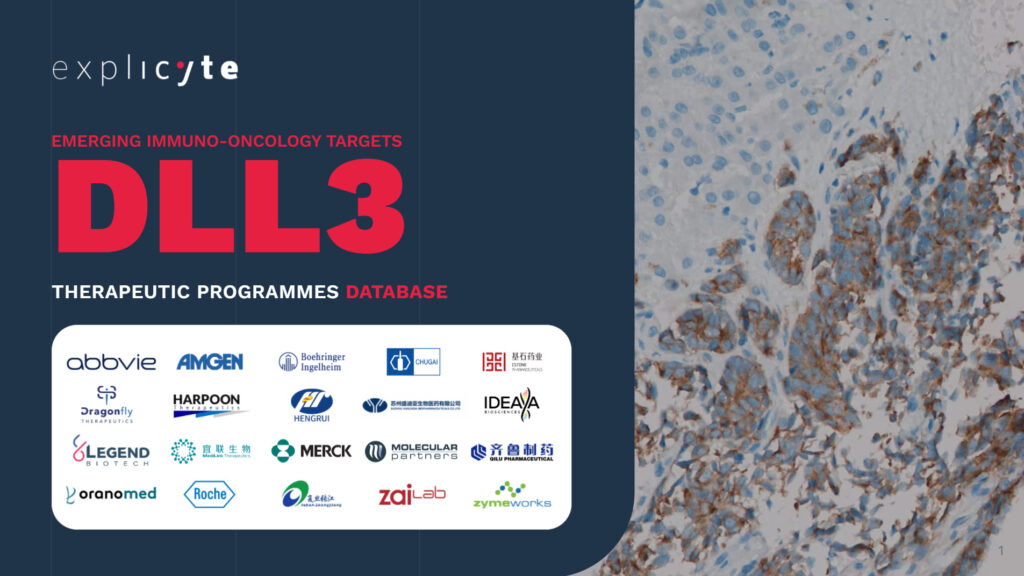
Targets featured in this dataset:
The anti-DLL3 oncology landscape in one free database: 18 preclinical and clinical programs targeting DLL3, across antibody-drug conjugates, bispecific and trispecific antibodies, CAR-T and CAR-NK cells, and radiotherapy — mapped by developer and clinical stage. Four discontinued anti-DLL3 trials are tracked separately.
18 preclinical and clinical programs targeting DLL3
DLL3 (delta-like ligand 3) is an inhibitory Notch ligand that sits on the cell surface of small cell lung cancer (SCLC) and other high-grade
neuroendocrine tumors, where it appears in the large majority of cases while staying almost absent from healthy tissue. That contrast — high tumor expression, minimal normal-tissue expression — makes DLL3 reachable at the cell surface and opens a therapeutic window that spares normal cells.
The target is now clinically proven. Tarlatamab (Imdelltra), a DLL3-directed T-cell engager from Amgen, became the first DLL3-targeted therapy to reach the FDA — accelerated approval in May 2024, followed by full approval in November 2025 for extensive-stage SCLC after platinum-based chemotherapy. Behind it sits a pipeline spanning antibody-drug conjugates, bispecific and trispecific antibodies, CAR-T and CAR-NK cells, and an early radiotherapy program.
Featured companies include:
AbbVie, Amgen, Biocytogen, Boehringer Ingelheim, Chugai Pharmaceutical, CStone Pharma, Dragonfly Therapeutics, Harpoon Therapeutics, IDEAYA, Jiangsu Hengrui, Legend Biotech, MediLink Therapeutics, Merck, Molecular Partners, Novartis, Orano Med, Qilu Pharmaceuticals, Roche, Shanghai Fudan-Zhangjiang BioPharma, Stemcentrx, Suzhou Suncadia Biopharmaceuticals, Zai Lab, Zymeworks
Need to discover or validate new targets, test your compounds, or analytical support for a trial?
Contact us