
Background
Mature tertiary lymphoid structures have been reported to play a major role in the efficacy of PD-L1 blockade in non-small cell lung cancer.
In TLS-positive NSCLC, the objective response rate to single-agent PD1/PD-L1 inhibition is similar to response rates observed in all-comer NSCLC patients treated with immune checkpoint inhibitors combined with chemotherapy.
However, a substantial proportion of patients with TLS-positive NSCLC do not derive clinical benefit from immune checkpoint blockade.
This study aimed to identify determinants of response and resistance to immune checkpoint inhibitors in mature TLS-positive NSCLC.
Methods
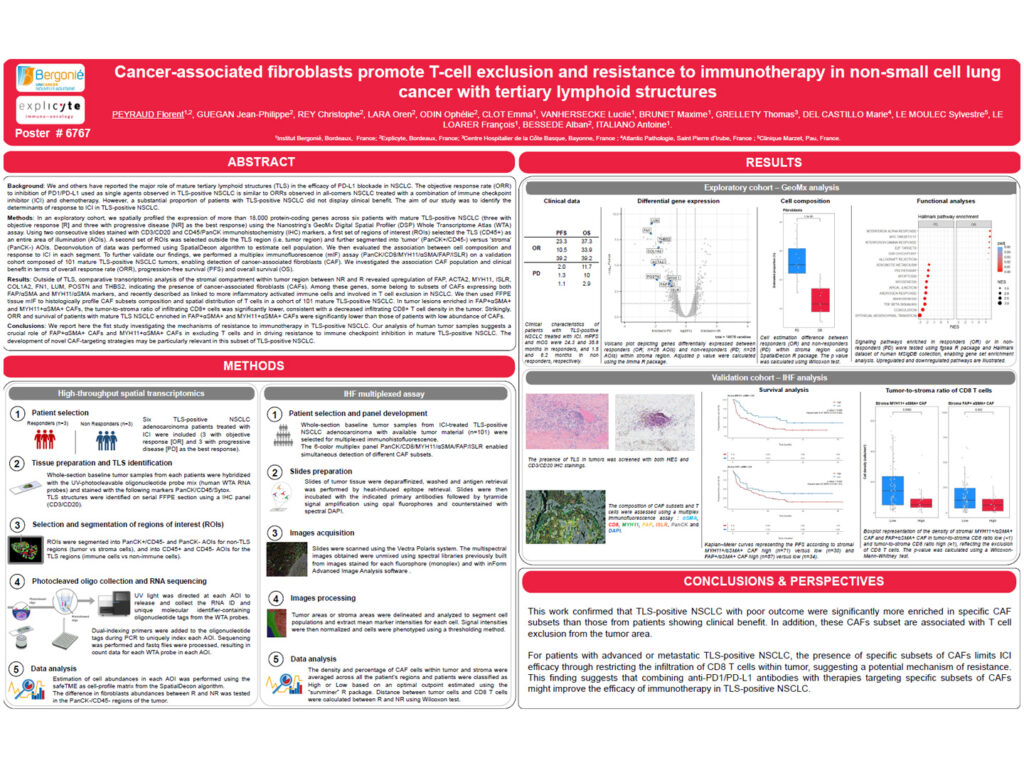
In an exploratory cohort, the expression of more than 18,000 protein-coding genes was spatially profiled across six patients with mature TLS-positive NSCLC.
The cohort included three patients with objective response and three patients with progressive disease as best response.
Spatial transcriptomic profiling was performed using NanoString GeoMx Digital Spatial Profiler Whole Transcriptome Atlas assay.
Using consecutive slides stained with CD3/CD20 and CD45/PanCK markers, a first set of regions of interest was selected within TLS areas. These CD45-positive TLS regions were analyzed as entire areas of illumination.
A second set of regions of interest was selected outside TLS areas, within the tumor region, and further segmented into tumor and stromal areas according to PanCK and CD45 staining.
Cell population deconvolution was performed using SpatialDecon to estimate immune and stromal cell composition. The association between cell composition and response to immune checkpoint blockade was then evaluated in each tissue segment.
To validate the findings, a multiplex immunofluorescence assay was performed on a validation cohort of 101 mature TLS-positive NSCLC tumors.
The multiplex panel included PanCK, CD8, MYH11, αSMA, FAP, and ISLR, enabling the detection and characterization of cancer-associated fibroblast subsets.
The association between CAF populations and clinical benefit was investigated in terms of objective response rate, progression-free survival, and overall survival.
Results
Outside TLS regions, comparative spatial transcriptomic analysis of the stromal compartment revealed upregulation of several genes in non-responders compared with responders.
These genes included FAP, ACTA2, MYH11, ISLR, COL1A2, FN1, LUM, POSTN, and THBS2, indicating the presence of cancer-associated fibroblast programs.
Some of these genes are associated with CAF subsets expressing FAP/αSMA and MYH11/αSMA markers, previously linked to inflammatory immune activation and T cell exclusion in NSCLC.
Multiplex immunofluorescence analysis was then used to profile CAF subset composition and the spatial distribution of T cells in the validation cohort of 101 mature TLS-positive NSCLC samples.
Tumor lesions enriched in FAP+αSMA+ and MYH11+αSMA+ CAFs showed a significantly lower tumor-to-stroma ratio of infiltrating CD8+ T cells.
This finding was consistent with reduced CD8+ T cell infiltration within the tumor compartment.
Patients with mature TLS-positive NSCLC enriched in FAP+αSMA+ and MYH11+αSMA+ CAFs showed significantly lower objective response rates and poorer survival compared with patients with low CAF abundance.
Conclusion
This study provides evidence that specific cancer-associated fibroblast subsets may contribute to resistance to immune checkpoint blockade in mature TLS-positive NSCLC.
The data suggest that FAP+αSMA+ and MYH11+αSMA+ CAFs may promote T cell exclusion from tumor regions, thereby limiting the anti-tumor immune response despite the presence of mature TLS.
These findings support the development of novel CAF-targeting strategies, particularly for patients with TLS-positive NSCLC who do not benefit from immune checkpoint inhibitors.