
Background
Development of novel immunotherapeutics in oncology is of major interest. Their preclinical evaluation relies on two key elements: the relevance of the animal model used and the implementation of a comprehensive strategy to deeply characterize the mechanisms underlying drug resistance or sensitivity.
Methods
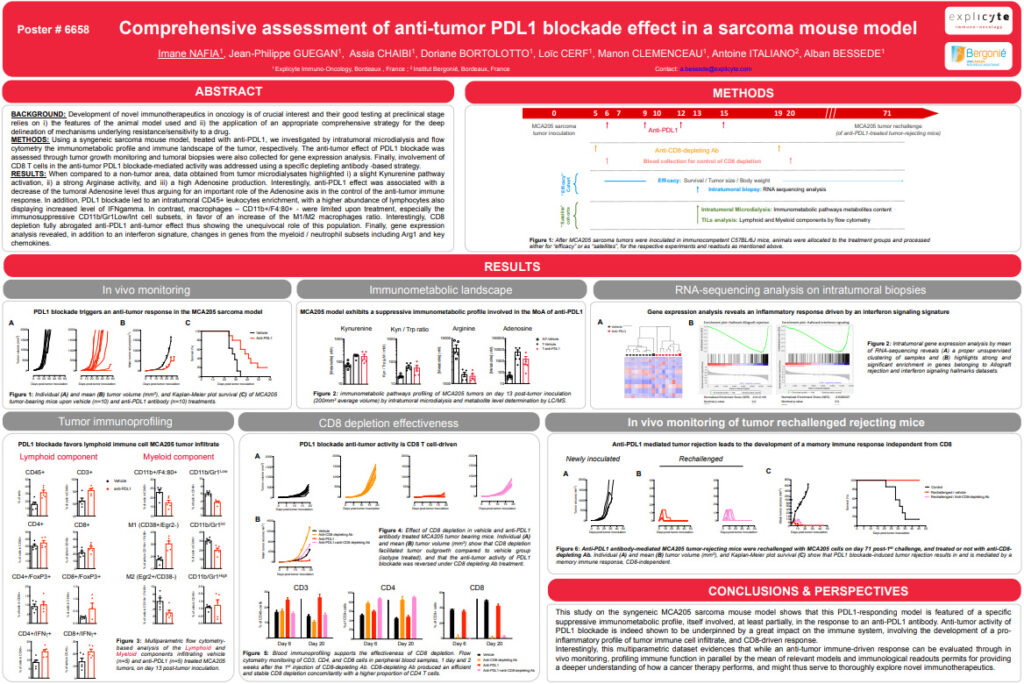
Using a syngeneic sarcoma mouse model treated with anti-PD-L1, we investigated the immunometabolic profile and immune landscape of the tumor by intratumoral microdialysis and flow cytometry, respectively.
The anti-tumor effect of PD-L1 blockade was assessed by monitoring tumor growth. Tumor biopsies were also collected for gene expression analysis.
Finally, the involvement of CD8 T cells in the anti-tumor activity mediated by PD-L1 blockade was evaluated using a specific antibody-based CD8 depletion strategy.
Results
Compared with non-tumor areas, tumor microdialysates showed:
i) slight activation of the kynurenine pathway;
ii) strong arginase activity;
iii) high adenosine production.
Interestingly, the anti-PD-L1 effect was associated with decreased adenosine levels within the tumor, suggesting an important role of the adenosine axis in the regulation of the anti-tumor immune response.
In addition, PD-L1 blockade led to an enrichment of intratumoral CD45+ leukocytes, with a higher abundance of lymphocytes displaying increased IFNγ levels.
In contrast, macrophages, identified as CD11b+/F4:80+ cells, were reduced upon treatment, particularly immunosuppressive CD11b+/Gr1low/int cell subsets. This was associated with an increased M1/M2 macrophage ratio.
Interestingly, CD8 depletion fully abrogated the anti-tumor effect of anti-PD-L1 treatment, demonstrating the essential role of CD8 T cells in this response.
Finally, gene expression analysis revealed, in addition to an interferon signature, modulation of genes associated with myeloid and neutrophil subsets, including Arg1 and key chemokines.