
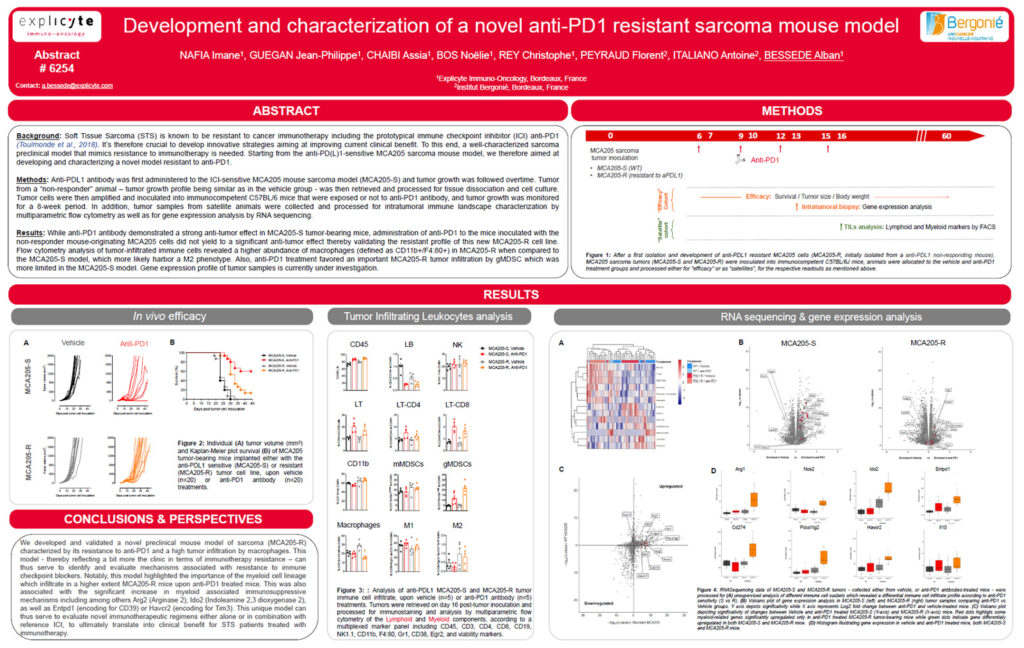
Soft tissue sarcoma (STS) is known to be resistant to cancer immunotherapy, including prototypical immune checkpoint inhibitors such as anti-PD1 antibodies. It is therefore crucial to develop innovative strategies aimed at improving current clinical benefit.
To support this objective, well-characterized sarcoma preclinical models that mimic resistance to immunotherapy are needed. Starting from the anti-PD(L)1-sensitive MCA205 sarcoma mouse model, this study aimed to develop and characterize a novel model resistant to anti-PD1 treatment.
Methods
Anti-PDL1 antibody was first administered to the immune checkpoint inhibitor-sensitive MCA205 mouse sarcoma model, referred to as MCA205-S, and tumor growth was monitored over time.
A tumor from a non-responder animal, displaying a tumor growth profile similar to that observed in the vehicle group, was retrieved and processed for tissue dissociation and cell culture.
The resulting tumor cells were amplified and inoculated into immunocompetent C57BL/6 mice, which were then treated or not with anti-PD1 antibody. Tumor growth was monitored over an 8-week period.
In addition, tumor samples from satellite animals were collected and processed for intratumoral immune landscape characterization by multiparametric flow cytometry, as well as for gene expression analysis by RNA sequencing.
Results
While anti-PD1 antibody demonstrated a strong anti-tumor effect in MCA205-S tumor-bearing mice, administration of anti-PD1 to mice inoculated with non-responder mouse-derived MCA205 cells did not result in a significant anti-tumor effect.
These results validated the resistant profile of this new MCA205-R cell line.
Flow cytometry analysis of tumor-infiltrating immune cells revealed a higher abundance of macrophages, defined as CD11b+/F4:80+ cells, in the MCA205-R model compared with the MCA205-S model.
These macrophages were more likely associated with an M2-like phenotype, suggesting the establishment of a more immunosuppressive tumor microenvironment in the resistant model.
Anti-PD1 treatment also favored an important
Conclusion
This work supports the development of MCA205-R as a novel anti-PD1-resistant sarcoma preclinical model.
By combining tumor growth monitoring, multiparametric flow cytometry, and RNA sequencing, this model provides a valuable platform to investigate mechanisms of resistance to immune checkpoint blockade and to evaluate innovative therapeutic strategies designed to restore sensitivity to immunotherapy in soft tissue sarcoma.