
Background
Antiangiogenic and other targeted therapies have shown efficacy in both preclinical and clinical settings. However, tumors can acquire resistance, allowing them to survive and grow under hypoxic conditions.
In this context, combining angiogenesis- and/or hypoxia-targeted strategies with immune checkpoint inhibitors, such as anti-PD1 or anti-PDL1 antibodies, is of particular interest.
These therapeutic combinations may help overcome resistance mechanisms or enhance the ability of the immune system to recognize and attack tumor cells.
Methods
This study used the murine syngeneic RENCA tumor model to investigate the effects of an antiangiogenic strategy using sunitinib and a hypoxia-regulating strategy using everolimus, an mTOR inhibitor.
Each agent was evaluated alone and in combination, in the presence or absence of PD1/PDL1 blockade.
In vivo anti-tumor activity was assessed by monitoring tumor growth and survival.
Blood and tumor samples were immunoprofiled by flow cytometry.
In addition, immune cell infiltration, hypoxia, and vascular density within the tumor were assessed by multiplex immunohistofluorescence.
Results
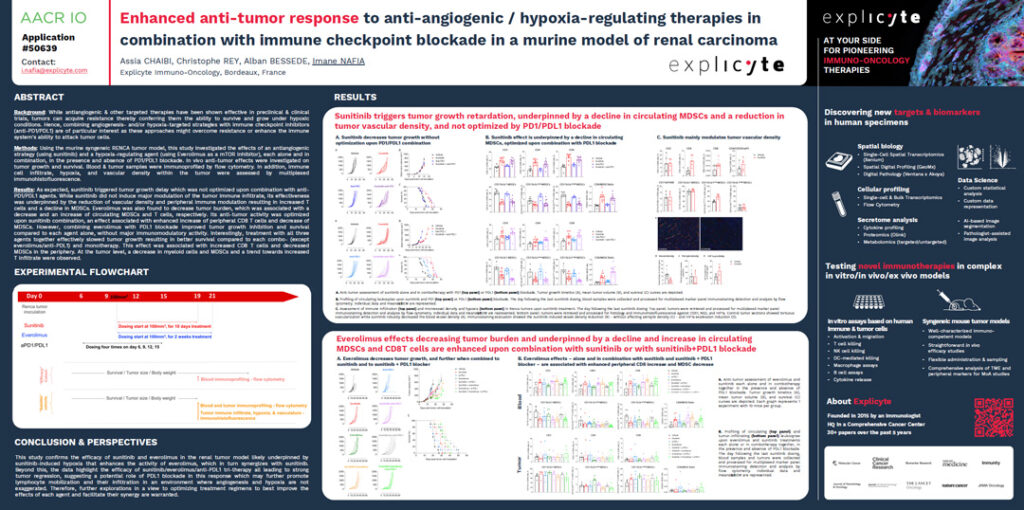
As expected, sunitinib induced a delay in tumor growth. However, this effect was not further enhanced when sunitinib was combined with anti-PD1 or anti-PDL1 agents.
Sunitinib did not induce major changes in the tumor immune infiltrate. Its activity was mainly associated with reduced vascular density and peripheral immune modulation, including increased T cells and decreased myeloid-derived suppressor cells.
Everolimus also reduced tumor burden. This effect was associated with a decrease in circulating myeloid-derived suppressor cells and an increase in circulating T cells.
The anti-tumor activity of everolimus was enhanced when combined with sunitinib. This combination was associated with a stronger increase in peripheral CD8 T cells and a decrease in myeloid-derived suppressor cells.
Combining everolimus with PDL1 blockade improved tumor growth inhibition and survival compared with each agent alone, although no major immunomodulatory activity was observed.
Interestingly, the triple combination of sunitinib, everolimus, and immune checkpoint blockade effectively slowed tumor growth and improved survival compared with most dual combinations and monotherapies.
This effect was associated with increased peripheral CD8 T cells and decreased peripheral myeloid-derived suppressor cells.
At the tumor level, the triple combination was associated with decreased myeloid cells and myeloid-derived suppressor cells, together with a trend toward increased T cell infiltration.
Conclusion
These findings support the rationale for combining antiangiogenic, hypoxia-targeting, and immune checkpoint strategies to improve anti-tumor activity in the RENCA model.
While sunitinib and everolimus each demonstrated anti-tumor activity, combination strategies, particularly the triple treatment approach, showed enhanced effects on tumor growth and survival.
The study highlights the importance of integrating tumor growth monitoring, survival analysis, peripheral immune profiling, tumor immune characterization, and multiplex histology to better understand the mechanisms underlying therapeutic combinations in immuno-oncology.