
Background
Long neglected, tumor immune escape is now considered a key mechanism promoting tumor growth and immune evasion.
Beyond the prototypical PD1/PDL1 axis, several additional pathways have been identified as important contributors to the immune editing process.
Indoleamine 2,3-dioxygenase 1, or IDO1, is a first rate-limiting enzyme of the kynurenine pathway. This pathway has been described as a contributor to immune tolerance and tumor immune escape through the production of several metabolites, including L-kynurenine.
However, the functional impact of L-kynurenine on immune cell-mediated tumor cell killing remains to be further characterized.
Methods
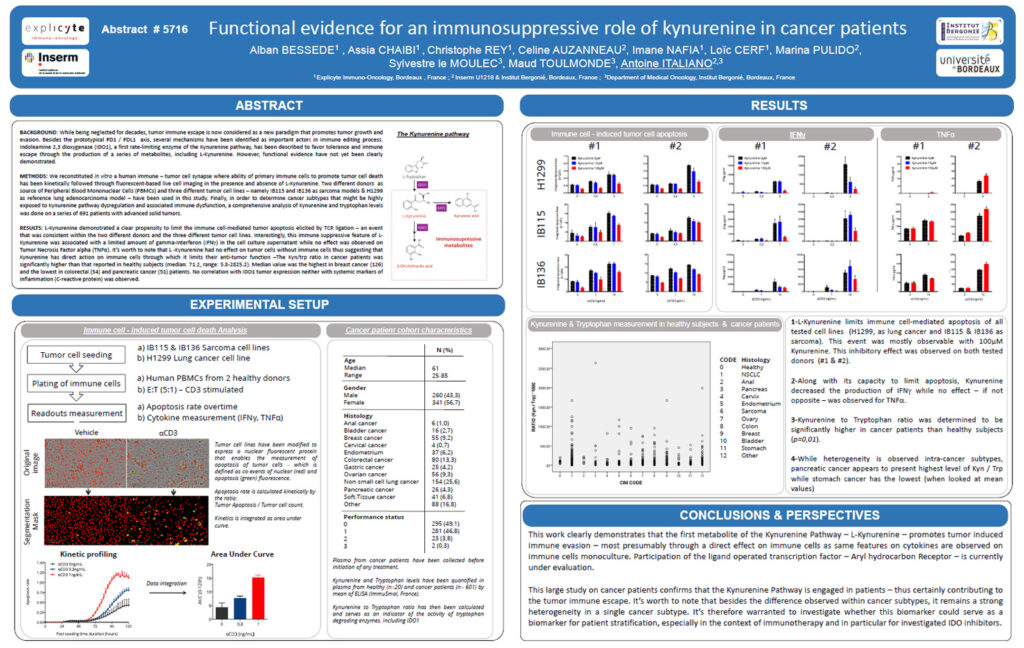
An in vitro human immune-tumor cell synapse model was established to evaluate the ability of primary immune cells to promote tumor cell death in the presence or absence of L-kynurenine.
Tumor cell apoptosis was kinetically monitored using fluorescence-based live-cell imaging.
Peripheral blood mononuclear cells from two different donors were used as the immune cell source.
Three tumor cell lines were evaluated: IB115 and IB136 as sarcoma models, and H1299 as a reference lung adenocarcinoma model.
In parallel, to identify cancer subtypes potentially exposed to kynurenine pathway dysregulation and associated immune dysfunction, kynurenine and tryptophan levels were analyzed in a cohort of 691 patients with advanced solid tumors.
Results
L-kynurenine clearly limited immune cell-mediated tumor apoptosis induced by TCR ligation.
This immunosuppressive effect was consistently observed across the two PBMC donors and the three tumor cell lines tested.
The reduced tumor cell killing observed in the presence of L-kynurenine was associated with decreased IFNγ levels in the cell culture supernatant.
In contrast, no effect was observed on TNFα release.
L-kynurenine had no effect on tumor cells cultured without immune cells, suggesting that its activity is mediated through immune cells rather than through a direct effect on tumor cells.
In patients with advanced solid tumors, the kynurenine-to-tryptophan ratio was significantly higher than levels reported in healthy subjects, with a median value of 71.2 and a range from 5.8 to 2825.2.
The highest median kynurenine-to-tryptophan ratio was observed in breast cancer patients, while the lowest median values were observed in colorectal and pancreatic cancer patients.
No correlation was observed between the kynurenine-to-tryptophan ratio and IDO1 tumor expression or systemic inflammation markers such as C-reactive protein.
Conclusion
These findings support the immunosuppressive role of L-kynurenine in limiting immune cell-mediated tumor cell killing.
The data suggest that L-kynurenine acts primarily on immune cells, reducing their anti-tumor function and limiting IFNγ release, without directly affecting tumor cells in the absence of immune cells.
The elevated kynurenine-to-tryptophan ratio observed in patients with advanced solid tumors further supports the relevance of the kynurenine pathway as a potential contributor to immune dysfunction in cancer.