
Background
Immunotherapy represents a novel weapon in the cancer armamentarium, with unprecedented responses observed in several indications, including metastatic melanoma and lung cancer.
However, the limited response rate, accounting for approximately 30%, requires further optimization and calls for a better understanding of the mechanisms underlying sensitivity to immune checkpoint inhibitors.
G protein-coupled receptors (GPCRs) are the largest gene family of cell membrane-associated molecules involved in signal transmission and several physiological functions, including the shaping of the immune response. However, their role in tumor biology, particularly in immune evasion and resistance to immunotherapy, remains to be elucidated.
Methods
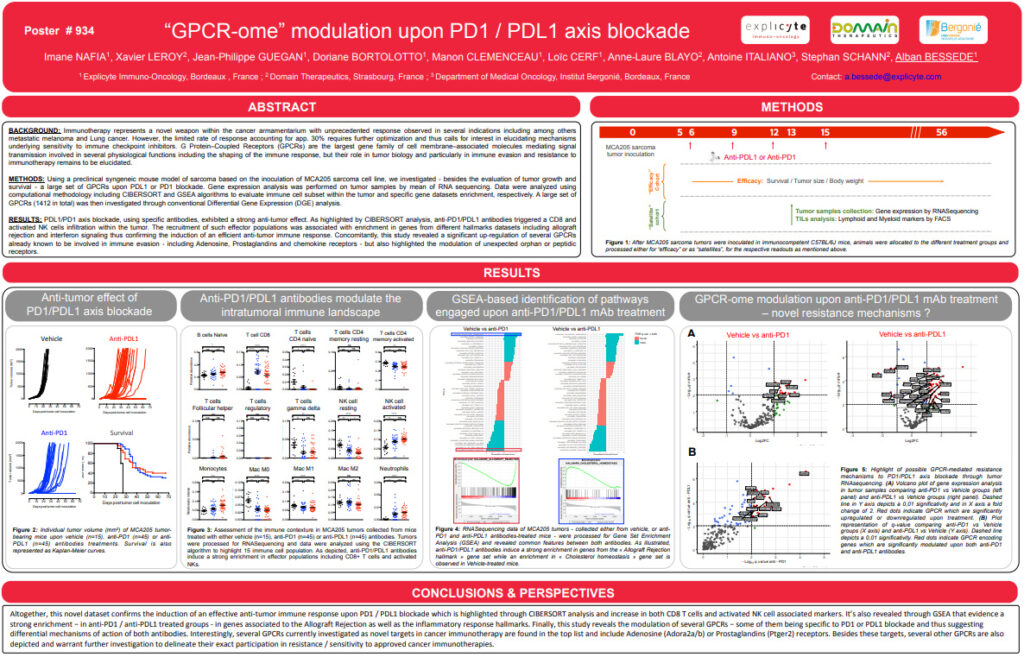
Using a preclinical syngeneic mouse model of sarcoma based on the inoculation of the MCA205 sarcoma cell line, we investigated tumor growth, survival, and the modulation of a large set of GPCRs following PD-L1 or PD-1 blockade.
Gene expression analysis was performed on tumor samples by RNA sequencing.
Data were analyzed using computational methods, including CIBERSORT and GSEA algorithms, to evaluate immune cell subsets within the tumor and enrichment of specific gene datasets, respectively.
A large set of GPCRs, 1,412 in total, was then investigated through conventional differential gene expression analysis.
Results
PD-L1/PD-1 axis blockade using specific antibodies exhibited a strong anti-tumor effect.
CIBERSORT analysis showed that anti-PD-1 and anti-PD-L1 antibodies induced infiltration of CD8 T cells and activated NK cells within the tumor.
The recruitment of these effector immune populations was associated with enrichment of gene signatures related to allograft rejection and interferon signaling, confirming the induction of an effective anti-tumor immune response.
Concomitantly, the study revealed a significant upregulation of several GPCRs already known to be involved in immune evasion, including adenosine receptors, prostaglandin receptors, and chemokine receptors.
The analysis also highlighted the modulation of unexpected orphan and peptide receptors.