
Background
Malignant ovarian cancer ascites are increasingly recognized as major contributors to tumorigenesis and cancer progression.
Ascites create a complex microenvironment where tumor cells interact with soluble mediators, metabolic factors, and immune cells. These interactions can influence tumor behavior, immune response, and treatment sensitivity.
Characterizing the immune and metabolic composition of ovarian cancer ascites, together with evaluating their biological effects on tumor and immune cells, is therefore critical to better understand how the ascitic microenvironment contributes to disease progression.
Methods
Ascites samples were collected during initial laparoscopy from patients with advanced high-grade serous ovarian cancer.
The immune and metabolic landscape of these samples was profiled using multiplexed approaches, including flow cytometry, LEGENDplex, and metabolomics.
These analyses enabled the characterization of immune cell populations, the quantification of soluble mediators such as cytokines and chemokines, and the assessment of broader metabolic alterations.
In parallel, ascitic fluids were functionally screened to evaluate their biological effects on healthy monocytes, either undifferentiated or undergoing M1 polarization, healthy PBMCs, and ovarian tumor cells, either at baseline or under chemotherapy challenge.
Results
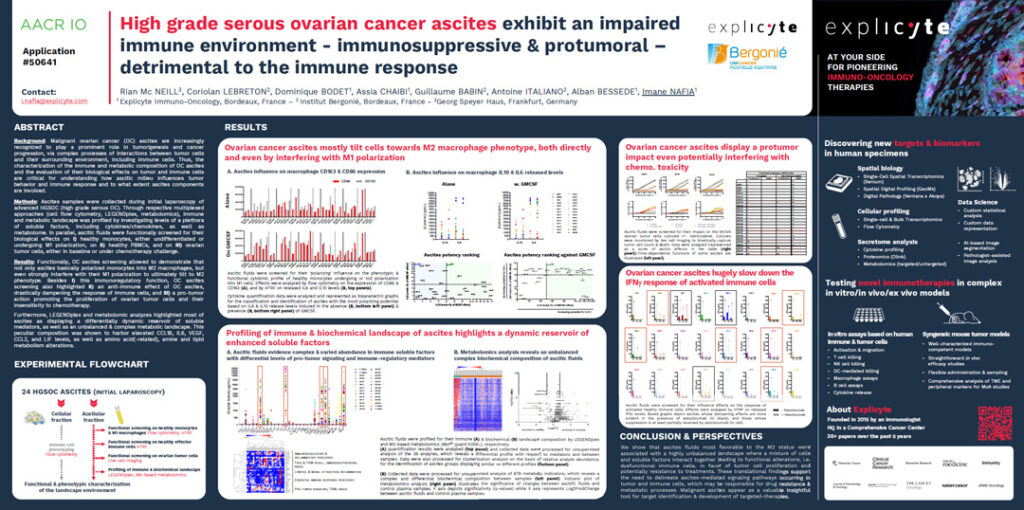
Functional screening demonstrated that ovarian cancer ascites were able to polarize monocytes toward an M2-like macrophage phenotype.
Ascites also strongly interfered with M1 polarization, ultimately shifting monocytes toward an M2-like immunosuppressive status.
In addition to this immunoregulatory activity, ovarian cancer ascites showed a marked anti-immune effect by drastically dampening immune cell responses.
Ascites also displayed pro-tumor activity, promoting ovarian tumor cell proliferation and reducing tumor cell sensitivity to chemotherapy.
LEGENDplex and metabolomic analyses showed that most ascites acted as dynamic reservoirs of soluble mediators and displayed an unbalanced and complex metabolic landscape.
This specific composition was characterized by elevated levels of CCL18, IL6, VEGF, CCL2, and LIF.
Metabolomic profiling also revealed alterations in amino acid-related metabolism, amine metabolism, and lipid metabolism.
Conclusion
These findings demonstrate that malignant ovarian cancer ascites actively contribute to the establishment of an immunosuppressive and pro-tumor microenvironment.
Ascites not only promote M2-like macrophage polarization and suppress immune cell activity, but also enhance tumor cell proliferation and reduce sensitivity to chemotherapy.
This work supports the relevance of combining functional assays, immune profiling, soluble mediator analysis, and metabolomics to better understand ovarian cancer ascites biology and identify therapeutic opportunities to counteract ascites-driven immune suppression and tumor progression.