
Background
The composition of the tumor microenvironment is a key determinant of effective anti-tumor immunity. In sarcomas, the presence of organized B and T cell aggregates, known as tertiary lymphoid structures, has recently been shown to predict response to immune checkpoint blockers.
However, only a minority of patients derive clinical benefit from immune checkpoint blockade, suggesting that additional determinants may influence the response in TLS-positive sarcomas. Among these factors, TLS composition may play an important role.
Using high-throughput spatial transcriptomics and multiplex immunofluorescence, this study aimed to investigate the association between TLS immune composition and clinical outcome in sarcoma patients treated with immune checkpoint blockers.
Methods
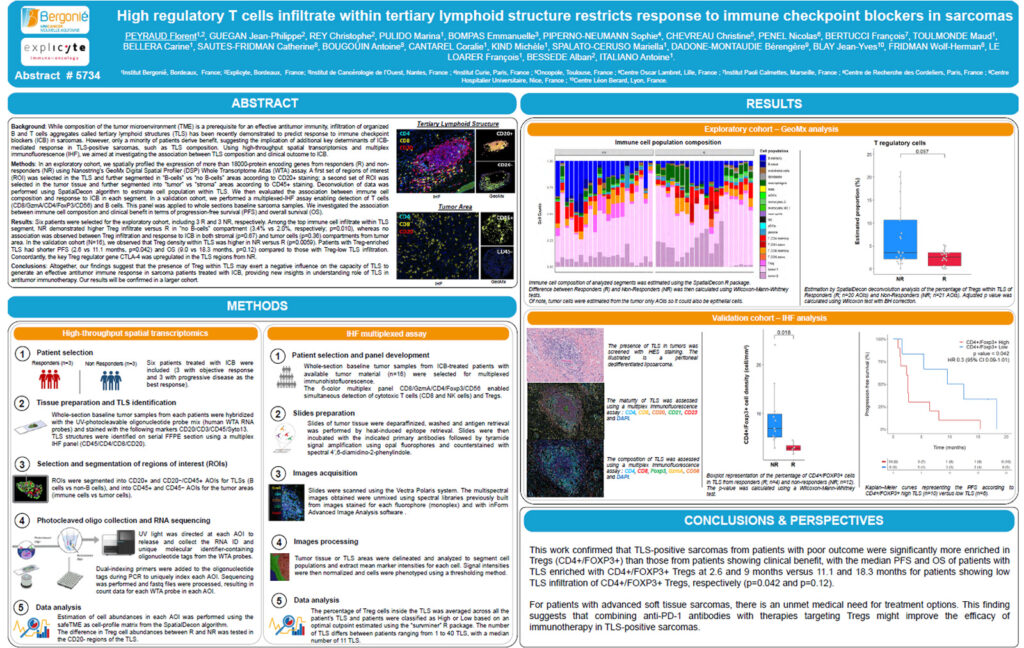
In an exploratory cohort, the expression of more than 18,000 protein-coding genes was spatially profiled in responder and non-responder patients using NanoString GeoMx Digital Spatial Profiler Whole Transcriptome Atlas assay.
A first set of regions of interest was selected within TLS and further segmented into “B-cell” and “non-B-cell” areas according to CD20 staining.
A second set of regions of interest was selected within tumor tissue and further segmented into “tumor” and “stroma” areas according to CD45 staining.
SpatialDecon analysis was then performed to estimate immune cell populations within TLS. The association between immune cell composition and response to immune checkpoint blockade was evaluated in each tissue segment.
In a validation cohort, a multiplex immunofluorescence assay was performed on whole-section baseline sarcoma samples. The panel enabled detection of T cells, including CD8, GzmA, CD4, FoxP3 and CD56 markers, as well as B cells.
The association between immune cell composition and clinical benefit was assessed in terms of progression-free survival and overall survival.
Results
Six patients were included in the exploratory cohort, including three responders and three non-responders.
Among the main immune cell populations infiltrating TLS, non-responders showed a higher Treg infiltrate compared with responders in the non-B-cell compartment, with 3.4% versus 2.0%, respectively.
In contrast, no association was observed between Treg infiltration and response to immune checkpoint blockade in the stromal or tumor compartments from the tumor area.
In the validation cohort of 16 patients, Treg density within TLS was higher in non-responders compared with responders.
Patients with Treg-enriched TLS had shorter progression-free survival, with 2.6 months versus 11.1 months, and shorter overall survival, with 9.0 months versus 18.3 months, compared with patients showing low Treg infiltration within TLS.
In line with these findings, the key Treg regulator gene CTLA-4 was upregulated in TLS regions from non-responder patients.
Conclusion
These findings suggest that the presence of Tregs within TLS may negatively influence the ability of TLS to generate an effective anti-tumor immune response in sarcoma patients treated with immune checkpoint blockers.
This study provides new insights into the role of TLS composition in anti-tumor immunotherapy and highlights the importance of spatially resolved immune profiling to better understand response and resistance mechanisms.
These results will be further confirmed in a larger cohort.