
Background
In the era of immuno-oncology, identifying primary resistance mechanisms to immune checkpoint inhibitors remains crucial.
A better understanding of these mechanisms may help to identify novel pathways that can be targeted to improve response rates, as well as biomarkers that could support the selection of patients more likely to benefit from cancer immunotherapies.
Among the metabolic pathways involved in immunosuppression, L-arginine deprivation through arginase activity plays an important role.
This study aimed to evaluate the association between baseline plasma L-arginine levels, used as a surrogate of arginase activity, and clinical benefit to immune checkpoint inhibitors.
Methods
A preclinical syngeneic mouse model of colorectal cancer, MC38, known to be responsive to immune checkpoint inhibitors, was first used.
Plasma samples were collected before treatment onset to assess L-arginine levels and evaluate their association with tumor rejection status following anti-PD(L)1 treatment.
Human plasma samples from two independent cohorts of patients with advanced cancer, including a discovery cohort and a validation cohort, were then processed for L-arginine quantification.
Plasma L-arginine levels were analyzed in association with clinical data, including progression-free survival, overall survival, and clinical benefit.
In addition, matched PBMC and plasma samples were used to assess the relationship between L-arginine levels and immune cell features measured by multiplex flow cytometry.
Results
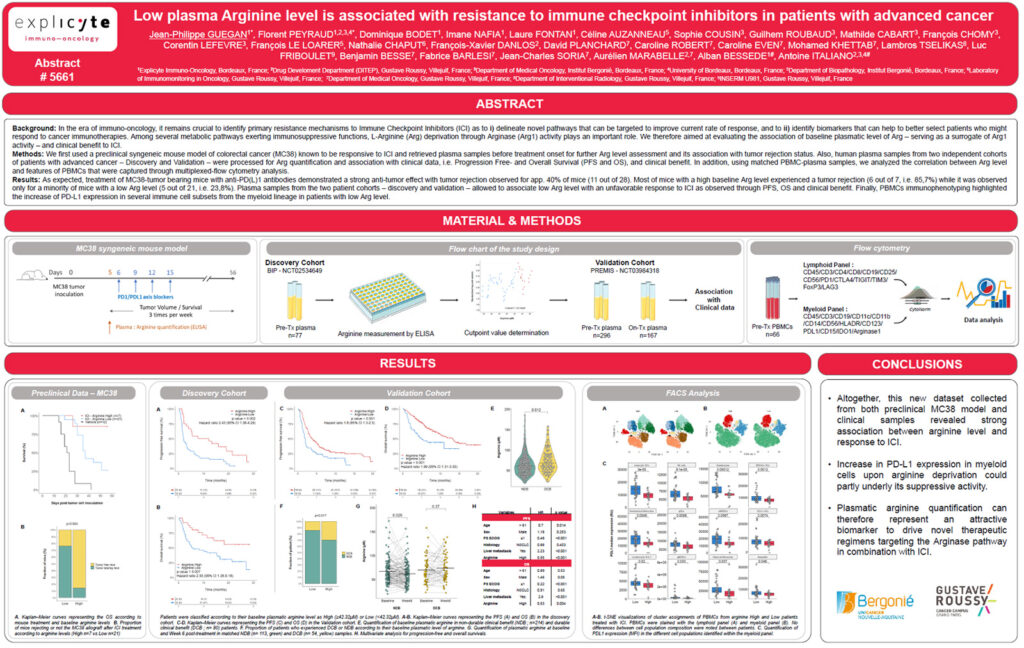
As expected, treatment of MC38 tumor-bearing mice with anti-PD(L)1 antibodies demonstrated a strong anti-tumor effect, with tumor rejection observed in approximately 40% of mice.
Most mice with high baseline plasma L-arginine levels experienced tumor rejection, with 6 out of 7 mice showing rejection. In contrast, tumor rejection was observed in only a minority of mice with low baseline L-arginine levels, with 5 out of 21 mice showing rejection.
In human patient cohorts, low plasma L-arginine levels were associated with an unfavorable response to immune checkpoint inhibitors.
This association was observed across progression-free survival, overall survival, and clinical benefit analyses in both the discovery and validation cohorts.
Finally, PBMC immunophenotyping showed increased PD-L1 expression in several immune cell subsets from the myeloid lineage in patients with low plasma L-arginine levels.
Conclusion
These findings suggest that low baseline plasma L-arginine levels are associated with reduced clinical benefit to immune checkpoint inhibitors.
The data support the relevance of arginine metabolism as a potential contributor to resistance to cancer immunotherapy and highlight plasma L-arginine as a candidate biomarker for patient stratification.
This study also suggests a link between low L-arginine levels and increased PD-L1 expression in myeloid immune cell subsets, providing further insight into the immunosuppressive mechanisms associated with resistance to immune checkpoint blockade.