
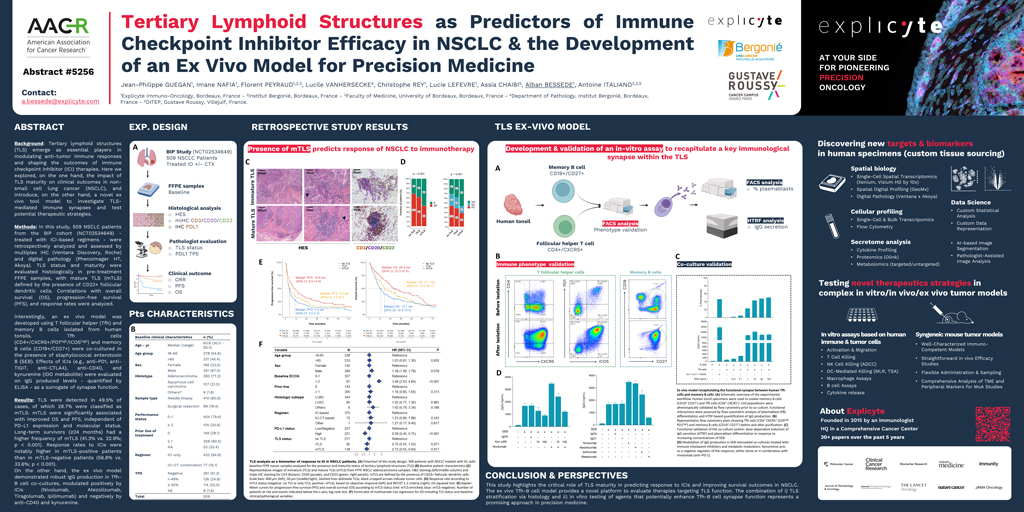
Tertiary lymphoid structures (TLS) emerge as essential players in modulating anti-tumor immune responses and shaping the outcomes of immune checkpoint inhibitor (ICI) therapies. Here we explored, on the one hand, the impact of TLS maturity on clinical outcomes in non-small cell lung cancer (NSCLC), and introduce, on the other hand, a novel ex vivo tool model to investigate TLS-mediated immune synapses and test potential therapeutic strategies.
Methods
In this study, 509 NSCLC patients from the BIP cohort (NCT02534649) – treated with ICI-based regimens – were retrospectively analyzed and assessed by multiplex IHC (Ventana Discovery, Roche) and digital pathology (PhenoImager HT, Akoya). TLS status and maturity were evaluated histologically in pre-treatment FFPE samples, with mature TLS (mTLS) defined by the presence of CD23+ follicular dendritic cells. Correlations with overall survival (OS), progression-free survival (PFS), and response rates were analyzed.
Interestingly, an ex vivo model was developed using T follicular helper (Tfh) and memory B cells isolated from human tonsils. Tfh cells (CD4+/CXCR5+/PD1high/ICOShigh) and memory B cells (CD19+/CD27+) were co-cultured in the presence of staphylococcal enterotoxin B (SEB). Effects of ICIs (e.g., anti-PD1, anti-TIGIT, anti-CTLA4), anti-CD40, and kynurenine (IDO metabolite) were evaluated on IgG produced levels – quantified by ELISA – as a surrogate of synapse function.
Results
TLS were detected in 49.5% of cases, of which 28.7% were classified as mTLS. mTLS were significantly associated with improved OS and PFS, independent of PD-L1 expression and molecular status. Long-term survivors (≥24 months) had a higher frequency of mTLS (41.3% vs. 22.9%; p < 0.001). Response rates to ICIs were notably higher in mTLS-positive patients than in mTLS-negative patients (56.8% vs. 33.6%; p < 0.001).
On the other hand, the ex vivo model demonstrated robust IgG production in Tfh-B cell co-cultures, modulated positively by ICIs (Nivolumab, Atezolizumab, Tiragolumab, Ipilimumab) and negatively by anti-CD40 and kynurenine.