
Background
Sarcomas are heterogeneous malignant mesenchymal tumors known to be particularly resistant to immunotherapy. This resistance highlights the need to better understand the biological mechanisms limiting response to immune checkpoint inhibitors.
We previously observed increased activity of the kynurenine pathway in the plasma of patients treated with pembrolizumab and metronomic cyclophosphamide.
The kynurenine pathway is known to promote immune tolerance and immune escape through the degradation of L-tryptophan and the production of several metabolites, including L-kynurenine.
Although IDO1, one of the first rate-limiting enzymes of the kynurenine pathway, remains an attractive therapeutic target, its exact functional role in the context of immunotherapy remains to be fully clarified.
Methods
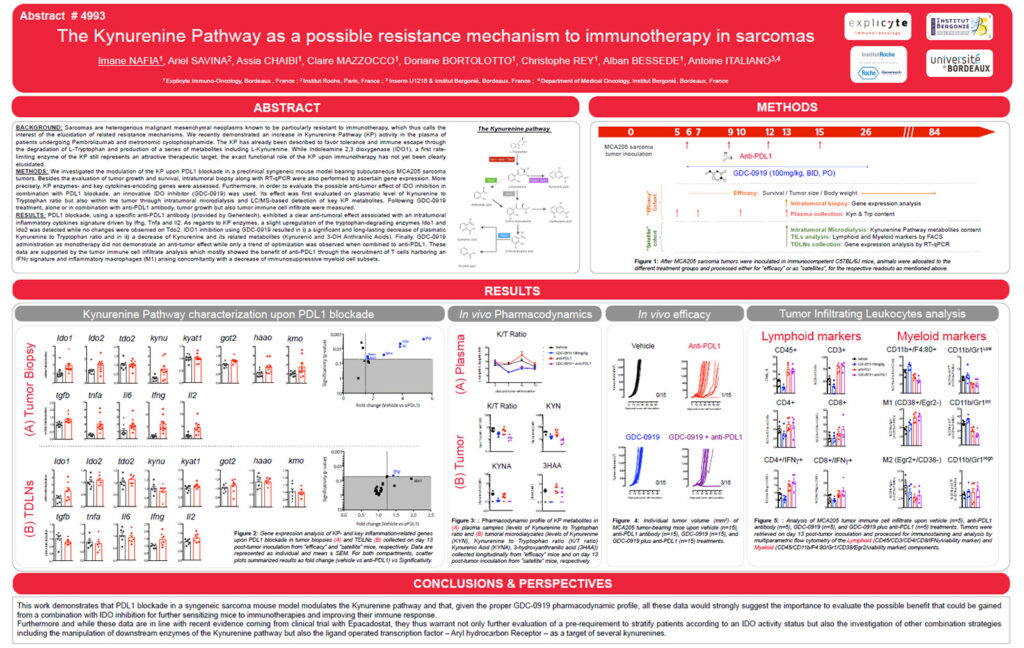
The modulation of the kynurenine pathway was investigated upon PD-L1 blockade in a preclinical syngeneic mouse model bearing subcutaneous MCA205 sarcoma tumors.
Tumor growth and survival were monitored following treatment. Intratumoral biopsies were also collected and analyzed by RT-qPCR to assess the expression of genes encoding kynurenine pathway enzymes and key cytokines.
To evaluate the potential anti-tumor effect of IDO inhibition in combination with PD-L1 blockade, the IDO inhibitor GDC-0919 was used.
Its pharmacodynamic effect was assessed by measuring the plasma kynurenine-to-tryptophan ratio. Intratumoral microdialysis combined with LC/MS-based detection was also used to quantify key kynurenine pathway metabolites within the tumor.
Following treatment with GDC-0919, alone or in combination with anti-PD-L1 antibody, tumor growth and tumor immune cell infiltration were evaluated.
Results
PD-L1 blockade using a specific anti-PD-L1 antibody demonstrated a clear anti-tumor effect in the MCA205 sarcoma model.
This anti-tumor activity was associated with an intratumoral inflammatory cytokine signature driven by Ifng, Tnfa, and Il2.
Regarding kynurenine pathway enzymes, a slight upregulation of the tryptophan-degrading enzymes Ido1 and Ido2 was detected, while no change was observed for Tdo2.
IDO inhibition using GDC-0919 induced a significant and sustained decrease in the plasma kynurenine-to-tryptophan ratio.
GDC-0919 also decreased intratumoral levels of kynurenine and related metabolites, including kynurenic acid and 3-hydroxyanthranilic acid.
As monotherapy, GDC-0919 did not demonstrate a significant anti-tumor effect. When combined with anti-PD-L1 treatment, only a trend toward improved anti-tumor activity was observed.
Tumor immune cell infiltrate analysis mainly highlighted the benefit of anti-PD-L1 treatment, which promoted the recruitment of T cells with an IFNγ-associated signature and inflammatory M1-like macrophages.
This immune remodeling occurred concomitantly with a decrease in immunosuppressive myeloid cell subsets.
Conclusion
These findings show that PD-L1 blockade induces a strong anti-tumor immune response in the MCA205 sarcoma model, associated with inflammatory cytokine signaling and immune cell remodeling within the tumor microenvironment.
Although IDO inhibition effectively reduced systemic and intratumoral kynurenine pathway activity, GDC-0919 alone did not show anti-tumor activity, and only a trend toward benefit was observed in combination with anti-PD-L1.
This study supports the importance of combining metabolic and immune profiling to better understand resistance mechanisms and evaluate therapeutic combinations targeting immunosuppressive pathways in sarcoma.