
Background
Monoclonal antibodies targeting programmed cell death-1, or PD-1, and its ligand PD-L1 have revolutionized the treatment of patients with advanced non-small cell lung cancer.
However, most patients with advanced NSCLC display primary resistance to PD1/PD-L1 blockade. Identifying targetable alterations involved in resistance represents a promising approach to improve immunotherapy efficacy.
TROP2 expression is associated with poor prognosis in NSCLC and represents a promising therapeutic target, particularly with the development of new antibody-drug conjugates.
Although TROP2 has been suggested to play a role in innate immune response, it remains unclear whether TROP2 expression by tumor cells is specifically detrimental in the context of PD1/PD-L1 blockade.
This study aimed to investigate the role of TROP2 expression in the outcome of NSCLC patients treated with immune checkpoint inhibitors.
Methods
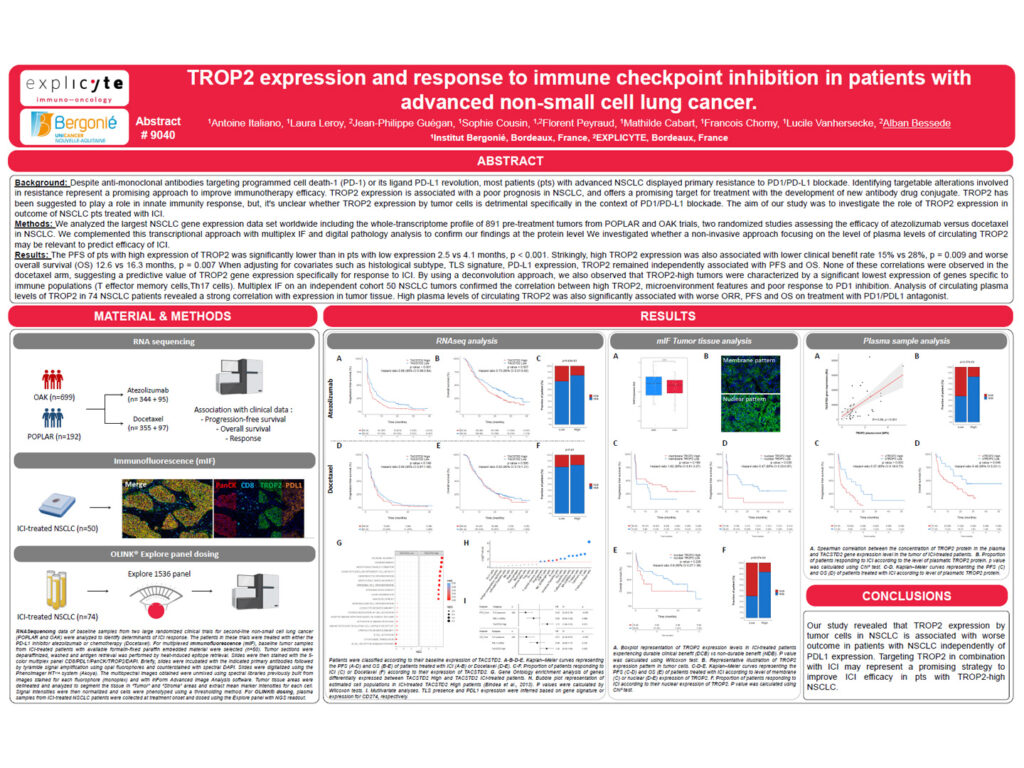
The analysis was performed using the largest available NSCLC gene expression dataset, including whole-transcriptome profiles from 891 pre-treatment tumor samples collected in the POPLAR and OAK trials.
These two randomized studies assessed the efficacy of atezolizumab compared with docetaxel in patients with NSCLC.
This transcriptional approach was complemented by multiplex immunofluorescence and digital pathology analysis to confirm the findings at the protein level.
In addition, the study investigated whether a non-invasive approach based on circulating plasma TROP2 levels could be relevant to predict the efficacy of immune checkpoint inhibitors.
Results
Patients with high TROP2 expression had significantly shorter progression-free survival compared with patients with low TROP2 expression, with 2.5 months versus 4.1 months, respectively.
High TROP2 expression was also associated with a lower clinical benefit rate, with 15% versus 28%, and worse overall survival, with 12.6 months versus 16.3 months.
After adjustment for covariates including histological subtype, TLS signature, and PD-L1 expression, TROP2 remained independently associated with progression-free survival and overall survival.
These correlations were not observed in the docetaxel arm, suggesting that TROP2 gene expression may have predictive value specifically for response to immune checkpoint inhibition.
Deconvolution analysis showed that TROP2-high tumors were characterized by significantly lower expression of genes associated with immune populations, including effector memory T cells and Th17 cells.
Multiplex immunofluorescence analysis performed on an independent cohort of 50 NSCLC tumors confirmed the association between high TROP2 expression, specific tumor microenvironment features, and poor response to PD1 inhibition.
Analysis of circulating plasma TROP2 levels in 74 NSCLC patients revealed a strong correlation with TROP2 expression in tumor tissue.
High circulating plasma TROP2 levels were also significantly associated with worse objective response rate, progression-free survival, and overall survival in patients treated with PD1/PD-L1 antagonists.
Conclusion
These findings suggest that high TROP2 expression is associated with reduced clinical benefit from PD1/PD-L1 blockade in patients with NSCLC.
The data support TROP2 as a potential predictive biomarker of resistance to immune checkpoint inhibitors and highlight its relevance as a therapeutic target in NSCLC.
The association between tumor TROP2 expression and circulating plasma TROP2 levels also supports the potential development of a non-invasive biomarker approach to help predict response to immunotherapy.