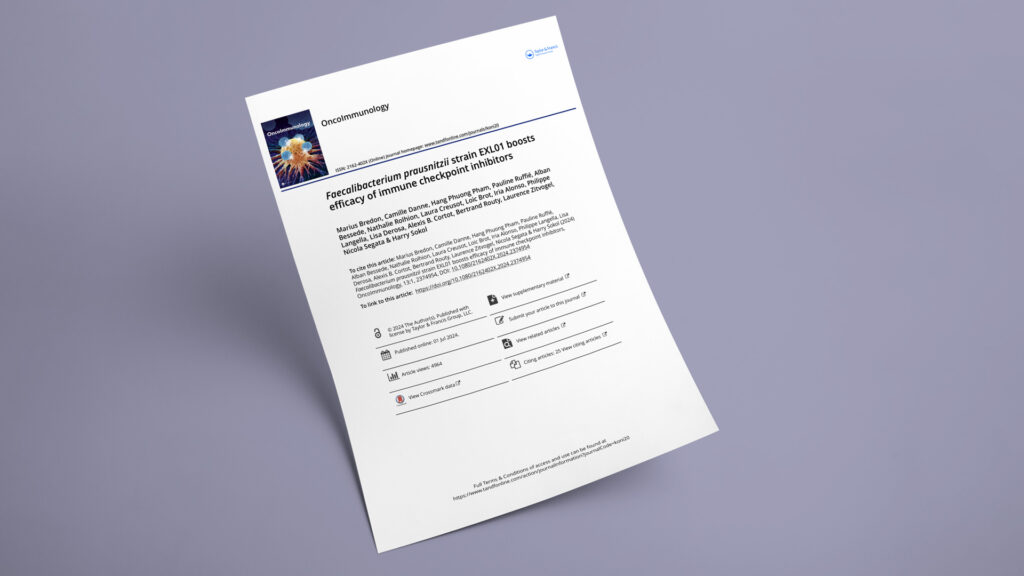
Publication in OncoImmunology

Can a single gut bacterium rescue failing immunotherapy? F. prausnitzii strain EXL01 restores checkpoint-inhibitor response

Faecalibacterium prausnitzii strain EXL01 boosts efficacy of immune checkpoint inhibitors
JournalOncoImmunology
DateJul 2024
Read full paper →

Gut bacteria shape whether cancer immunotherapy works, and high levels of Faecalibacterium prausnitzii have repeatedly tracked with better checkpoint-inhibitor response — but a defined, deployable strain has been missing. This study confirms the association across two patient cohorts (lung cancer and melanoma), then tests EXL01, a clinical-stage F. prausnitzii strain. In mice whose microbiota was disrupted by antibiotics, oral EXL01 restored the anti-tumor effect of anti-PD-L1 at both the clinical and tumor-transcriptomic level — without shifting overall microbiota composition. Explicyte's animal and human immune-cell studies showed EXL01 directly activates dendritic cells and T cells alongside checkpoint blockade, pointing to a direct immune mechanism.

This original research in OncoImmunology, led by Prof. Harry Sokol at Sorbonne Université (Centre de Recherche Saint-Antoine / Paris Center for Microbiome Medicine), with Marius Bredon and Camille Danne as co-first authors, tested whether a single, clinical-stage gut bacterium can boost immune checkpoint inhibitor efficacy. The team combined reanalysis of two patient cohorts with an antibiotic-perturbed mouse model and human immune-cell assays. EXL01 is a strain of Faecalibacterium prausnitzii already in clinical development for inflammatory bowel disease (NCT05542355). Explicyte performed the experimental core of the study — the in vivo MCA205 sarcoma mouse model of anti-PD-L1 efficacy and the human dendritic-cell and T-cell in vitro assays that established EXL01’s direct effect on immune cells alongside checkpoint blockade. The clinical-cohort reanalysis, 16S sequencing, tumor RNA-seq, and metagenomics were provided by the Paris and Gustave Roussy teams and their collaborators.

The question

Can supplementation with a single defined gut bacterium — F. prausnitzii strain EXL01 — restore or boost the anti-tumor efficacy of immune checkpoint inhibitors?

Key steps

  1. 1

    Confirm the F. prausnitzii–response link in patients

    Reanalyzing two independent cohorts, the team showed higher baseline fecal F. prausnitzii predicted better overall survival on checkpoint inhibitors. In 337 advanced NSCLC patients, higher F. prausnitzii tracked with better survival in a dose-dependent way (p = 0.008), an effect lost in patients recently exposed to antibiotics. In a pooled melanoma cohort (165 patients across 5 studies), high F. prausnitzii was independently associated with better survival in the dominant microbiota community type.

  2. 2

    Explicyte's mouse model shows EXL01 restores anti-PD-L1 efficacy

    In an MCA205 sarcoma mouse model run by Explicyte, broad-spectrum antibiotics were used to mimic the microbiota disruption seen in patients. Antibiotics blunted anti-PD-L1 efficacy, and daily oral EXL01 (10¹⁰ cells/day) restored it, reducing tumor volume and improving survival versus anti-PD-L1 alone. Strikingly, EXL01 did this without changing overall fecal microbiota diversity or composition (16S sequencing), and the strain was not even detectable in feces — pointing to a direct effect rather than microbiota remodeling.

  3. 3

    Tumor transcriptomics confirm restored anti-tumor program

    RNA sequencing of tumor biopsies from Explicyte’s mouse model showed antibiotics reversed the anti-PD-L1 gene-expression program — upregulating cell-proliferation pathways that checkpoint blockade normally suppresses. Adding EXL01 restored the anti-tumor transcriptomic signature: mice given anti-PD-L1 + antibiotics + EXL01 clustered with the anti-PD-L1-alone group, with almost no differentially expressed genes between them.

  4. 4

    Explicyte's immune assays reveal a direct mechanism

    In human immune-cell assays run by Explicyte, EXL01 acted directly on dendritic cells and T cells. In the presence of anti-PD-L1, EXL01 dose-dependently increased IFN-γ (and IL-2) production by CD4+ T cells, raised dendritic-cell activation markers (CD80, CD1a) while lowering the regulatory marker CD209/DC-SIGN, and in a mixed lymphocyte reaction strongly boosted IFN-γ and CD4+ T-cell proliferation — evidence EXL01 potentiates immunotherapy by activating both cell types.

Impact

The study advances gut-microbiome oncology from correlation toward a defined, manufacturable intervention: a single clinical-stage strain that potentiates checkpoint blockade through a direct immune mechanism.

337
advanced NSCLC patients in whom higher baseline F. prausnitzii predicted better survival (dose-dependent, p = 0.008)
restored
anti-PD-L1 anti-tumor efficacy in antibiotic-disrupted mice given oral EXL01
↑ IFN-γ
dose-dependent T-cell activation by EXL01 with anti-PD-L1 in human immune-cell assays

For developers of live biotherapeutic products and immuno-oncology combinations, this is a translational proof of concept: a defined, characterized strain — not a fecal transplant — that rescues checkpoint-inhibitor efficacy through a direct effect on host immune cells, sidestepping the reproducibility and safety concerns of FMT. Because EXL01 is already in clinical development, the path to combination trials is short; the authors note evaluation as an ICI adjuvant beginning in metastatic gastric cancer (NCT06253611). For partners, the in vivo syngeneic efficacy model and human MLR / DC–T-cell assay platform used here are directly applicable to screening and characterizing other immunomodulatory strains or biologics.

Developing a live biotherapeutic or immuno-oncology combination and need assays to demonstrate mechanism? Let's talk.

Talk to us
Explicyte Oncology CRO logo

Capabilities

Modalities