
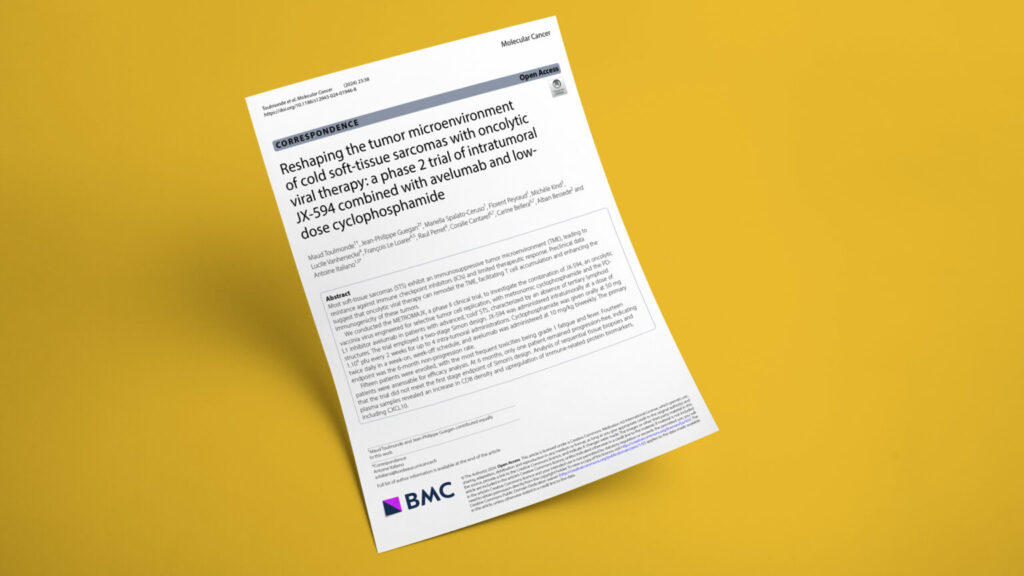
Most soft-tissue sarcomas are immunologically "cold" — they lack the tertiary lymphoid structures that mark the ~20% of tumors responsive to checkpoint inhibitors — so the field is hunting for ways to warm them up. The METROMAJX phase 2 trial tested whether intratumoral injection of the oncolytic virus JX-594, paired with metronomic cyclophosphamide and the PD-L1 inhibitor avelumab, could do it in TLS-negative sarcoma. Explicyte's CD8 immunohistochemistry on paired biopsies and Olink plasma proteomics showed the virus did remodel the microenvironment — CD8 T-cell density rose in most patients and immune proteins like CXCL10 climbed — yet only 1 of 14 patients was progression-free at 6 months.
This phase 2 METROMAJX trial, run by the Early Phase Trials and Sarcoma Units at Institut Bergonié and led by Prof. Antoine Italiano, with Dr. Maud Toulmonde and Explicyte’s Dr. Jean-Philippe Guégan as co-first authors, asked whether oncolytic viral therapy could convert immunologically “cold” soft-tissue sarcoma into a checkpoint-responsive tumor. Patients with advanced, TLS-negative sarcoma received intratumoral JX-594 (Pexa-Vec) — a thymidine-kinase-inactivated, GM-CSF-expressing vaccinia virus — combined with metronomic low-dose cyclophosphamide and the PD-L1 inhibitor avelumab. The work was supported by the French government’s France 2030 program via the National Research Agency (ANR 21 RHUS 0010). Explicyte’s teams processed the paired tumor biopsies and plasma samples, running the CD8 immunohistochemistry and digital quantification that measured T-cell infiltration and the Olink plasma proteomics that tracked the systemic immune response.
The trial cleanly separates two things that don't always travel together: the oncolytic virus succeeded at reshaping the immune microenvironment, but that remodeling did not convert into durable tumor control.
For developers pursuing “cold-to-hot” strategies in sarcoma, this trial is an instructive dissociation: intratumoral JX-594 plus avelumab measurably increased CD8 infiltration in distant lesions and moved systemic immune proteins, yet clinical benefit remained limited — reinforcing that T-cell accumulation alone is not sufficient and that histology may matter (the strongest CD8 responses and the only objective response clustered in specific subtypes). The paired non-injected-lesion biopsy design plus CD8 IHC and Olink proteomics offers a reusable pharmacodynamic toolkit for reading out whether an oncolytic or immune agent is actually remodeling the tumor, independent of RECIST.