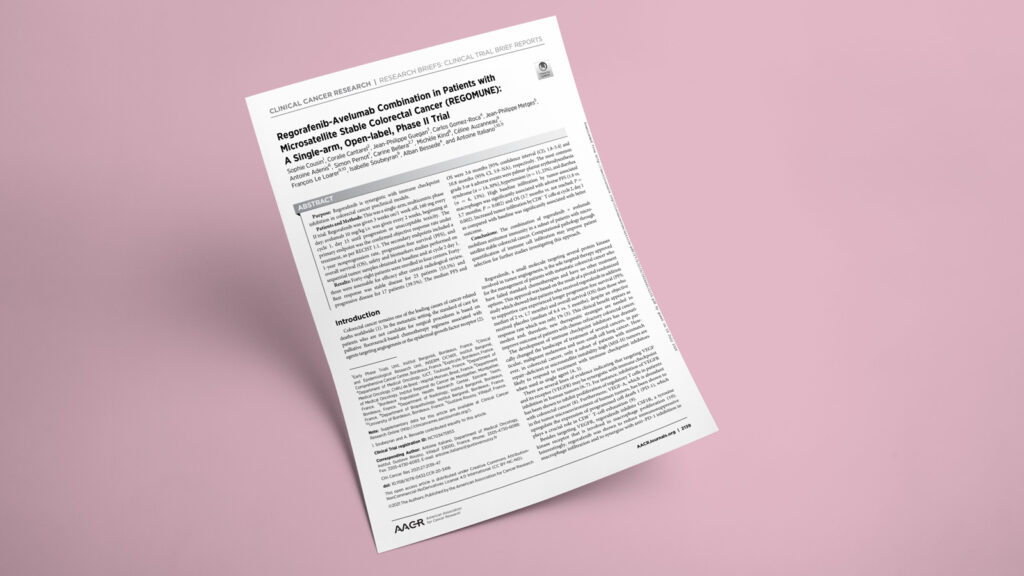
Publication in Clinical Cancer Research

Can CD163 macrophages help select MSS colorectal cancer patients for regorafenib plus avelumab?

Can CD163 macrophages help select MSS colorectal cancer patients for regorafenib plus avelumab
JournalClinical Cancer Research
DateJan 2021
Read full paper →

MSS metastatic colorectal cancer rarely responds to immune checkpoint inhibition, making patient selection central to combination strategies. In the REGOMUNE phase II cohort, Institut Bergonié evaluated regorafenib plus avelumab in 48 patients, while Explicyte developed and ran multiplex immunohistofluorescence and digital pathology analyses on FFPE tumor samples. Low baseline CD163+ macrophage infiltration and early CD8+ T-cell increase were associated with better outcomes, supporting immune-contexture profiling as a translational selection tool.

Explicyte contributed to the REGOMUNE colorectal cancer cohort by developing and running a multiplex immunohistofluorescence workflow to characterize tumor immune contexture in FFPE biopsies from patients treated with regorafenib plus avelumab. The panel included CD8, PD-1, PD-L1, CD163, IDO1, PanKeratin, and DAPI, using the Discovery XT automated staining platform and multispectral image acquisition with Vectra Polaris. The trial was sponsored by Institut Bergonié and funded by Bayer and Merck. It tested whether combining regorafenib — a kinase inhibitor targeting angiogenesis and CSF1R biology — with avelumab, an anti-PD-L1 antibody, could mobilize antitumor immunity in microsatellite stable metastatic colorectal cancer after standard treatment failure.

The question

Can tumor immune-contexture profiling identify MSS colorectal cancer patients more likely to benefit from regorafenib plus avelumab?

Key steps

  1. 1

    Treat refractory MSS colorectal cancer

    REGOMUNE enrolled 48 patients with advanced or metastatic MSS colorectal cancer across four French centers. Patients received regorafenib 160 mg daily on a 3-weeks-on/1-week-off schedule, with avelumab 10 mg/kg every 2 weeks starting at cycle 1, day 15. Forty-seven patients were included in the safety analysis and 43 were assessable for efficacy after central radiological review.

  2. 2

    Measure clinical activity

    The primary endpoint was not met: no patient achieved an objective response at 6 months. However, 23 of 43 assessable patients had stable disease, including 12 patients with tumor shrinkage ranging from 0.8% to 26.6%. Median progression-free survival was 3.6 months and median overall survival was 10.8 months.

  3. 3

    Profile FFPE immune contexture

    Explicyte developed and ran multiplex immunohistofluorescence on baseline FFPE tumor samples using CD8, PD-1, PD-L1, CD163, IDO1, PanKeratin, and DAPI. Slides were stained on the Discovery XT platform, acquired with Vectra Polaris, and analyzed digitally to segment tumor and stromal compartments. Baseline tumor samples were available for 24 patients, and paired baseline/cycle 2 day 1 biopsies were available for 15 patients.

  4. 4

    Quantify macrophage infiltration

    CD163+ macrophage density was calculated within the tumor compartment, with patients classified as macrophage-high above 175 cells/mm². High baseline CD163+ macrophage infiltration was associated with shorter PFS — 1.8 vs 3.7 months — and shorter OS — 3.7 months vs not reached. The association was statistically significant for both endpoints, with P = 0.002.

  5. 5

    Track CD8 dynamics

    In paired biopsies, CD8+ T-cell infiltration increased at cycle 2 day 1 in 9 of 15 patients, or 60% of evaluable cases. Patients with increased CD8+ T-cell infiltration had longer PFS — 3.7 vs 2.3 months — and longer OS, not reached vs 4.3 months. PD-L1 expression above 10% was observed in 6 of 24 baseline samples but did not correlate with PFS or OS.

Impact

The work positions digital pathology as a practical translational layer for immunotherapy-combination trials in MSS colorectal cancer. Instead of relying on PD-L1 alone, it highlights baseline macrophage burden and on-treatment CD8+ T-cell dynamics as measurable signals linked to outcome.

48
patients enrolled in the REGOMUNE MSS colorectal cancer cohort
3.6 months
median progression-free survival with regorafenib plus avelumab
60%
paired biopsies showing increased CD8+ T-cell infiltration at cycle 2 day 1

For clinical trial teams, this paper shows why immune-cell spatial context matters in MSS colorectal cancer, where checkpoint blockade alone has limited activity. CD163+ macrophage density may help enrich for patients more likely to benefit from regorafenib-avelumab combinations, while early CD8+ T-cell changes provide a pharmacodynamic readout for immune mobilization.

Designing a translational biomarker strategy for MSS colorectal cancer immunotherapy combinations? Let’s talk.

Talk to us
Explicyte Oncology CRO logo

Capabilities

Modalities