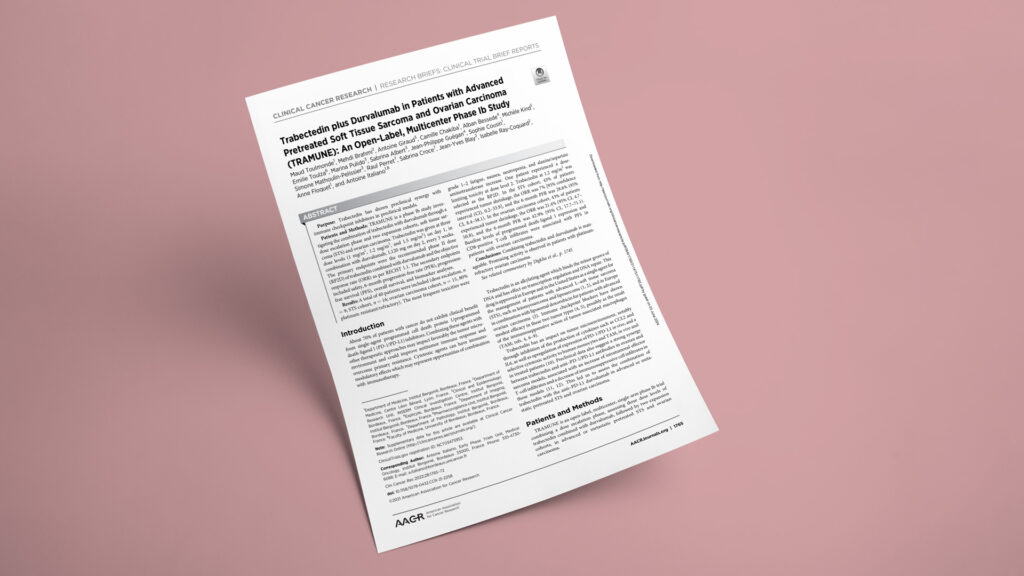
Publication in Clinical Cancer Research

Can trabectedin plus durvalumab help platinum-resistant ovarian carcinoma and soft tissue sarcoma?

Trabectedin plus Durvalumab in Patients with Advanced Pretreated Soft Tissue Sarcoma and Ovarian Carcinoma (TRAMUNE): An Open-Label, Multicenter Phase Ib Study
JournalClinical Cancer Research
DateNov 2021
Read full paper →

Most patients with advanced soft tissue sarcoma or platinum-resistant ovarian carcinoma derive limited benefit from single-agent immune checkpoint blockade. TRAMUNE tested trabectedin plus durvalumab in a phase Ib dose-escalation and expansion design, with Explicyte contributing to the translational biomarker work. The combination was manageable at trabectedin 1.2 mg/m² and showed stronger activity in ovarian carcinoma, where baseline PD-L1 expression and CD8-positive T-cell density were associated with longer PFS.

TRAMUNE was an Institut Bergonié-sponsored, multicenter phase Ib trial led by Maud Toulmonde and Antoine Italiano, with participation from Centre Léon Bérard and support from PharmaMar and AstraZeneca. The study explored whether trabectedin, a chemotherapy with reported immunomodulatory effects on the tumor microenvironment, could be combined safely with the anti-PD-L1 antibody durvalumab in advanced pretreated soft tissue sarcoma and ovarian carcinoma. Explicyte contributed to the translational component of the study through methodology, investigation, data curation, and formal analysis, supporting the immune-contexture work that linked baseline tumor biomarkers with patient outcome. The paper reports sequential tumor biopsy analyses focused on PD-L1 expression, CD8-positive T-cell density, and CD163-positive macrophage density at baseline and cycle 2 day 8.

The question

Can trabectedin make advanced sarcoma and ovarian carcinoma more responsive to PD-L1 blockade — and which immune biomarkers identify patients most likely to benefit?

Key steps

  1. 1

    Build the combination rationale

    Trabectedin has been reported to modulate the tumor microenvironment, including effects on cytokines, monocytes, tumor-associated macrophages, and PD-1/PD-L1 biology. TRAMUNE translated that rationale into a phase Ib trial combining trabectedin with durvalumab in two difficult settings: advanced pretreated soft tissue sarcoma and ovarian carcinoma, most of which was platinum resistant or refractory.

  2. 2

    Define the phase II dose

    The dose-escalation phase enrolled 9 patients and tested trabectedin at 1 mg/m², 1.2 mg/m², and 1.5 mg/m² on day 1, with durvalumab 1,120 mg on day 2 every 3 weeks. One dose-limiting toxicity occurred at dose level 2. Trabectedin 1.2 mg/m² with durvalumab 1,120 mg every 3 weeks was selected as the recommended phase II dose.

  3. 3

    Expand across two cohorts

    The expansion phase enrolled 16 patients with soft tissue sarcoma and 15 patients with ovarian carcinoma; 14 patients in each cohort were assessable for efficacy. In soft tissue sarcoma, 43% of patients had tumor shrinkage, the ORR was 7%, and the 6-month progression-free rate was 28.6%. In ovarian carcinoma, 43% also had tumor shrinkage, with an ORR of 21.4% and a 6-month progression-free rate of 42.9%.

  4. 4

    Profile sequential tumor biopsies

    Translational analyses used baseline and cycle 2 day 8 tumor biopsies to assess immune-contexture features. In the sarcoma ancillary cohort, 20 baseline and 13 on-treatment samples were available; 20% of baseline tumors expressed PD-L1 on tumor cells, increasing to 46% at C2D8. In the ovarian carcinoma ancillary cohort, 16 baseline and 9 C2D8 samples were available; 37.5% of baseline tumors expressed PD-L1, and CD163-positive macrophage density was generally higher than CD8-positive T-cell density.

  5. 5

    Link immunity with outcome

    In ovarian carcinoma, baseline PD-L1 positivity was associated with longer PFS: 6.8 months versus 1.3 months for PD-L1-negative tumors (P = 0.040). CD8-positive cell density above the median at baseline was also associated with longer PFS: 5.7 months versus 1.2 months (P = 0.018). CD163-positive cell density did not show the same association, suggesting that baseline inflammatory contexture may help prioritize patients for chemo-immunotherapy combinations.

Impact

TRAMUNE supports further clinical evaluation of trabectedin plus durvalumab in platinum-resistant or refractory ovarian carcinoma, while highlighting the need for biomarker-selected approaches in soft tissue sarcoma. The translational signal points to baseline PD-L1 and CD8-positive T-cell infiltration as practical stratification candidates.

40
patients included across dose escalation, soft tissue sarcoma expansion, and ovarian carcinoma expansion cohorts
21.4%
objective response rate in the ovarian carcinoma expansion cohort
6.8 vs 1.3 mo
median PFS in PD-L1-positive versus PD-L1-negative ovarian carcinoma tumors at baseline (P = 0.040)

For clinical and translational teams developing chemo-immunotherapy combinations, TRAMUNE reinforces the importance of pairing dose-finding with tissue-based immune monitoring. The ovarian carcinoma signal is clinically relevant in a heavily pretreated platinum-resistant/refractory population, while the sarcoma cohort suggests that unselected enrollment may dilute benefit. Biomarker strategies based on PD-L1, CD8-positive T-cell density, macrophage contexture, and potentially TLS status could help refine future trial designs.

Building a biomarker strategy for chemo-immunotherapy combinations in ovarian carcinoma or sarcoma? Let’s talk.

Talk to us
Explicyte Oncology CRO logo

Capabilities

Modalities