
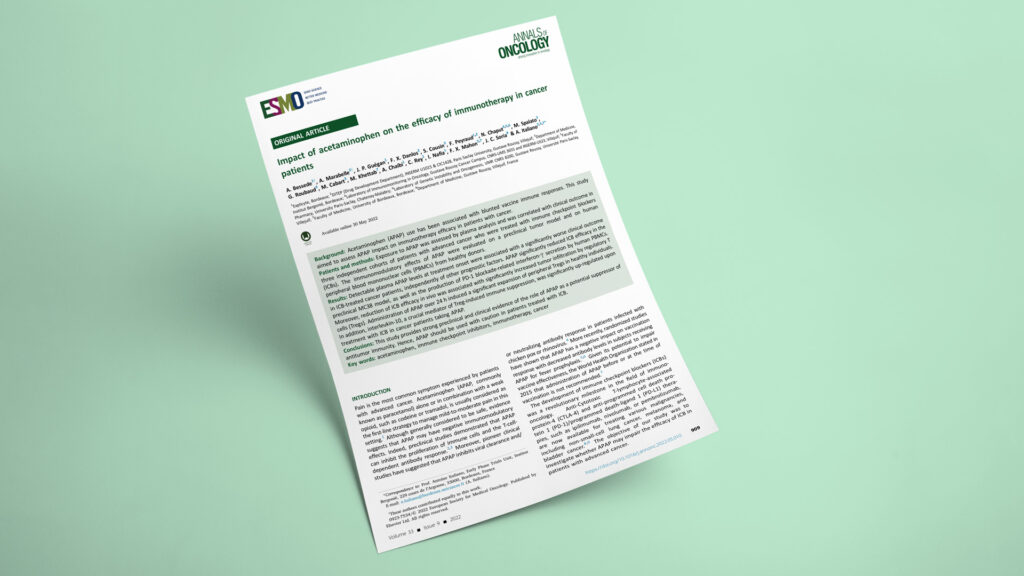
Acetaminophen (paracetamol) is the default painkiller in advanced cancer and is widely assumed to be immunologically harmless — but it already carries a warning around vaccination, where it blunts antibody responses. This study asked whether it also undercuts immune checkpoint blockade. Across three independent cohorts of patients on checkpoint inhibitors, those with detectable acetaminophen in plasma had worse survival, independent of other prognostic factors. Mouse models, human immune-cell assays, and high-throughput plasma profiling traced the effect to a mechanism: acetaminophen expands immunosuppressive regulatory T cells and raises IL-10. The practical message is direct — acetaminophen should be used cautiously in patients on immunotherapy.
This original article in Annals of Oncology, co-first-authored by Dr. Alban Bessede (Explicyte) and Dr. Aurélien Marabelle (Gustave Roussy) and led by Prof. Antoine Italiano, tested whether acetaminophen (APAP, paracetamol) — the first-line analgesic in advanced cancer — impairs the efficacy of immune checkpoint blockers. The team combined three clinical cohorts (the phase 3 CheckMate 025 trial in renal cell carcinoma, and the institutional profiling programs BIP at Institut Bergonié and PREMIS at Gustave Roussy) with a preclinical MC38 tumor model and human immune-cell studies. The work was supported by the Conseil Régional Nouvelle-Aquitaine, Fondation Bergonié, Explicyte, and Gustave Roussy. Explicyte anchored the biomarker and immune-profiling work — plasma metabolomics to detect acetaminophen exposure, Olink plasma proteomics, high-parameter flow-cytometry immunophenotyping of patient and donor blood, and the in vitro functional assays — that turned a clinical correlation into a mechanism.
The study reframes a ubiquitous, "harmless" supportive-care drug as a potential confounder of immunotherapy — with a defined mechanism and a simple, measurable biomarker.
For oncologists and trialists, the immediate takeaway is caution: concurrent acetaminophen may erode the benefit of checkpoint inhibitors and could confound immunotherapy trial results if not tracked. Because self-report is unreliable, objective plasma measurement of acetaminophen is the credible way to capture exposure — and plasma acetaminophen becomes a candidate stratification variable. For drug developers, the Treg/IL-10 mechanism suggests concomitant medications deserve systematic pharmacodynamic monitoring, and that antipyretic use is a variable worth pre-specifying rather than ignoring.