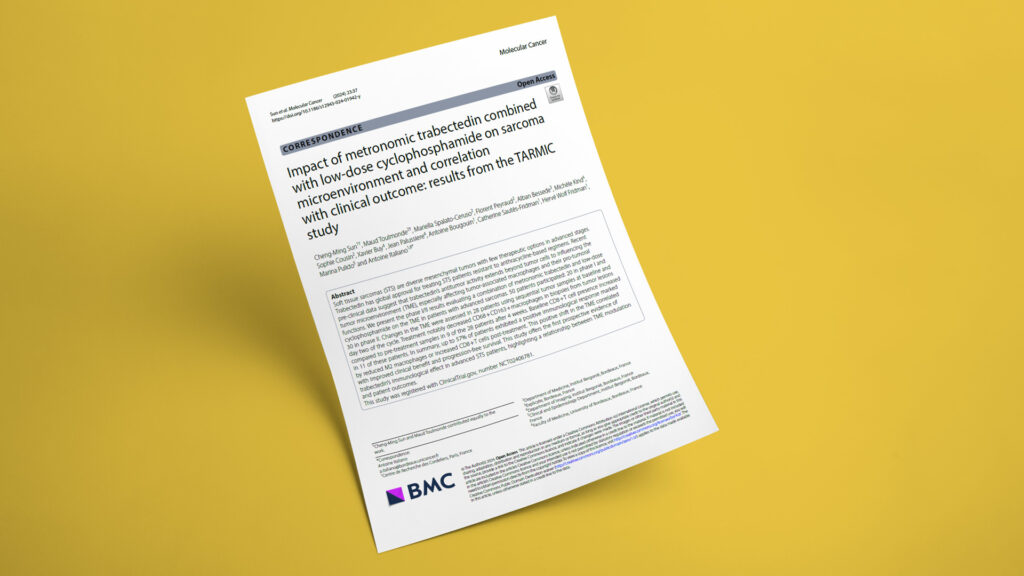
Publication in Molecular Cancer

Does metronomic trabectedin reprogram the sarcoma immune microenvironment? A macrophage-and-T-cell shift that tracks with better outcomes

Impact of metronomic trabectedin combined with low-dose cyclophosphamide on sarcoma microenvironment and correlation with clinical outcome: results from the TARMIC study
JournalMolecular Cancer
DateFeb 2024
Read full paper →

Trabectedin is an approved sarcoma chemotherapy, but preclinical work hints its real value may lie beyond killing tumor cells — in reprogramming the immune microenvironment, especially the pro-tumor macrophages that dominate these tumors. The phase 1/2 TARMIC trial tested metronomic trabectedin plus low-dose cyclophosphamide in 50 patients with advanced soft-tissue sarcoma, with paired biopsies to read the microenvironment. Explicyte's quantitative image analysis showed up to 57% of patients had a favorable immune shift — fewer M2 macrophages or more CD8 T cells — and that shift tracked with significantly better clinical benefit and progression-free survival, the first prospective evidence of trabectedin's immunomodulation in patients.

This phase 1/2 TARMIC trial, run at Institut Bergonié and led by Prof. Antoine Italiano, with Dr. Cheng-Ming Sun and Dr. Maud Toulmonde as co-first authors, asked whether metronomic trabectedin combined with low-dose cyclophosphamide reshapes the tumor microenvironment of advanced soft-tissue sarcoma — and whether that reshaping tracks with patient outcomes. The work was funded by PharmaMar and Institut National du Cancer (INCa). Explicyte conducted the quantitative image analysis of the paired tumor biopsies — the CD8 immunohistochemistry and the CD68/CD163 multiplex immunofluorescence used to score macrophage and T-cell content — that turned the trial’s correlative biology into its central finding.

The question

Does combining metronomic trabectedin with low-dose cyclophosphamide reprogram the sarcoma immune microenvironment — and does that immune shift predict which patients benefit?

Key steps

  1. 1

    Phase 1/2 trial with paired microenvironment biopsies

    TARMIC enrolled 50 patients with advanced soft-tissue sarcoma between December 2015 and August 2019 — 20 in dose escalation and 30 in phase 2 — receiving weekly trabectedin (recommended phase 2 dose 0.5 mg/m²) plus metronomic cyclophosphamide (50 mg twice daily, week-on/week-off). Sequential tumor biopsies were taken at baseline and cycle 2 day 1 in 28 patients to assess treatment’s impact on the microenvironment.

  2. 2

    Explicyte quantified the macrophage and T-cell shift

    Explicyte performed all the image analysis: CD8 immunohistochemistry (chromogenic, scanned on a Hamamatsu NanoZoomer) and a CD68/CD163 two-plex immunofluorescence (tyramide amplification, scanned on a Zeiss Axio Scan Z1), with positive-cell density quantified in HALO software excluding necrotic and serous areas. Treatment reduced pro-tumor CD68+CD163+ (M2) macrophages in 9 of 28 patients and increased baseline CD8+ T-cell infiltrate in 11 — a favorable immune shift in 16 patients overall.

  3. 3

    The immune shift correlated with clinical benefit

    The 57% of patients with a favorable immunological response (reduced M2 macrophages or increased CD8 T cells) had markedly better outcomes: clinical benefit rate 46.7% vs 0% (p = 0.007) and median progression-free survival 6 months vs 2.4 months (p = 0.014) compared with non-responders. Overall survival did not differ significantly (14.9 vs 11.9 months, p = 0.28), likely confounded by the subsequent therapies most patients received.

  4. 4

    Clinical activity modest, but a stratification signal emerges

    The trial did not meet its efficacy bar — the 6-month non-progression rate was 12.5% in phase 2 — consistent with trabectedin’s known modest single-regimen activity in pretreated sarcoma. The value of the study is mechanistic: because trabectedin remodels the microenvironment in only a subset of patients, the authors argue for a sequential strategy, using the on-treatment immune shift to select patients for subsequent PD-1 blockade rather than combining upfront.

Impact

The trial reframes an old chemotherapy as a conditional immunomodulator — valuable not for its response rate but for the patient-selection signal its immune effect provides.

57%
of profiled patients showed a favorable immune shift (fewer M2 macrophages or more CD8 T cells)
6 vs 2.4 mo
median progression-free survival, favorable vs unfavorable immune response (p = 0.014)
9/28
patients with reduced pro-tumor CD68+CD163+ macrophages on treatment

For sarcoma drug developers, TARMIC is a proof of principle that trabectedin’s macrophage-depleting, T-cell-favoring effect is real in patients — but conditional, appearing in roughly half. That argues against upfront trabectedin + checkpoint-inhibitor combinations (which have underdelivered) and for a sequential, biomarker-selected design: treat with trabectedin, measure the on-treatment M2/CD8 shift, then add anti-PD-1 in the immune responders. Operationally, the paired-biopsy CD8 IHC plus CD68/CD163 multiplex-IF readout used here is a reusable pharmacodynamic assay for detecting that shift, and lurbinectedin (a steroid-premedication-free analogue) is flagged as a cleaner candidate for the same strategy.

Studying a macrophage-modulating or cold-to-hot therapy in sarcoma and need quantitative CD8 IHC and CD68/CD163 multiplex-IF to measure the immune shift? Let's talk.

Talk to us
Explicyte Oncology CRO logo

Capabilities

Modalities