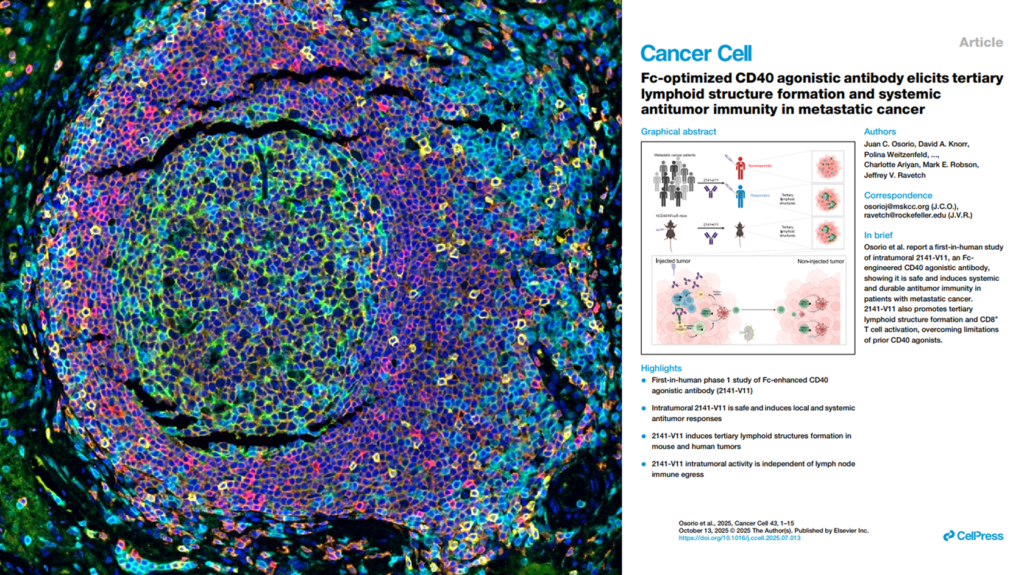
Publication in Cancer Cell

How an engineered CD40 antibody, injected into tumors, builds the immune structures that drive whole-body cancer responses

Fc-optimized CD40 agonistic antibody elicits tertiary lymphoid structure formation and systemic antitumor immunity in metastatic cancer
JournalCancer Cell
DateOct 2025
Read full paper →

An Fc-engineered CD40 agonist, injected directly into tumors, was safe in a first-in-human trial and pushed two metastatic cancers into complete remission — including a melanoma patient still disease-free at 28 months. The drug worked by building tertiary lymphoid structures, organized immune hubs, inside tumors. Explicyte's multiplex immunofluorescence made those structures visible in patient biopsies, confirming that mature TLS appeared in responders' injected and even non-injected lesions, but were absent in a non-responder.

The first-in-human phase 1 trial (NCT04059588) was led by Juan Osorio, David Knorr, and Jeffrey Ravetch’s group across Memorial Sloan Kettering Cancer Center and Rockefeller University, building on more than a decade of antibody-engineering work on CD40 agonism. Explicyte Immuno-oncology (Bordeaux) ran the multiplex immunofluorescence on patient FFPE biopsies — the readout that revealed tertiary lymphoid structures in responders — on an automated Ventana Discovery XT workflow with Opal/TSA multiplexing and a TLS-focused panel (CD8, CD4, CD20, CD21, CD23). It’s exactly the kind of spatial, multiplex IHF readout Explicyte’s translational platform is built to deliver, from TLS induction and maturation through dendritic-cell activation and chemokine programs.

The question

Can an engineered CD40 agonist, injected straight into a tumor, build the immune machinery to fight cancer locally and body-wide — without the toxicity that sank earlier CD40 drugs — and can that machinery be made visible as proof the mechanism is working?

Key steps

  1. 1

    Re-engineer the antibody, then inject it locally

    2141-V11 is a human IgG1 anti-CD40 agonist carrying five point mutations that increase binding to the inhibitory receptor FcγRIIB, boosting CD40 cross-linking and agonistic signaling while limiting systemic toxicity. In this phase 1 trial the team delivered it intratumorally across four dose levels (0.7–10 mg) to 12 patients with metastatic cancer rather than systemically.

  2. 2

    Track safety and tumor response

    The drug was well tolerated with no dose-limiting toxicities; adverse events were mostly low-grade (fever, chills, injection-site reactions). Six of 12 patients showed tumor reduction, including two complete responses — an 89-year-old melanoma patient (remission lasting ~28 months) and a 67-year-old breast cancer patient whose liver and nodal metastases cleared and whose tumor markers normalized. Regression appeared in both injected and distant non-injected lesions, an abscopal effect.

  3. 3

    Visualize the immune structures with multiplex IHF

    Explicyte’s multiplex immunofluorescence on FFPE biopsies (Ventana Discovery XT, Opal/TSA, PhenoImager HT, inForm analysis) mapped mature tertiary lymphoid structures in both complete responders — organized aggregates of CD11c+ dendritic cells, CD4+/CD8+ T cells, B cells, and CD21+ follicular dendritic cells. Crucially, TLS also formed in the melanoma patient’s non-injected lesions, while a non-responder’s tumor lacked them entirely — turning an abstract mechanism into a measurable tissue readout that tracked with response.

  4. 4

    Confirm the mechanism in humanized mice

    In CD40/FcγR humanized mice bearing bilateral E0771 breast tumors, intratumoral 2141-V11 induced de novo TLS in most injected tumors (5/6) but none in non-injected tumors or controls (0/6), drove rejection of both injected and distant tumors, and produced durable immune memory — with single-cell RNA-seq showing expansion of mature CCR7+ dendritic cells in TLS-bearing tumors.

Impact

The trial reframes TLS from a favorable bystander biomarker into something a therapy can deliberately build — and shows a local injection can generate body-wide, durable immunity.

2
durable complete responses (melanoma and breast cancer)
6/12
patients with tumor reduction
0
dose-limiting toxicities across the phase 1 cohort
28 mo
longest remission (melanoma responder, on + off study)

For drug developers, the work validates Fc engineering as a route to CD40 agonists that are both safer and more active, and it positions multiplex IHF as a practical, tissue-level readout for TLS-directed therapies. The findings support advancing 2141-V11 into phase 2 and offer a template for measuring TLS induction, maturation, and spatial immune remodeling in future immunotherapy programs.

If you're developing an immunomodulator and need to measure TLS induction, maturation, or spatial immune remodeling in tissue, Explicyte's translational platform can build that readout — the same multiplex IHF approach used to visualize TLS in this trial.

Talk to us
Explicyte Oncology CRO logo

Capabilities

Modalities