
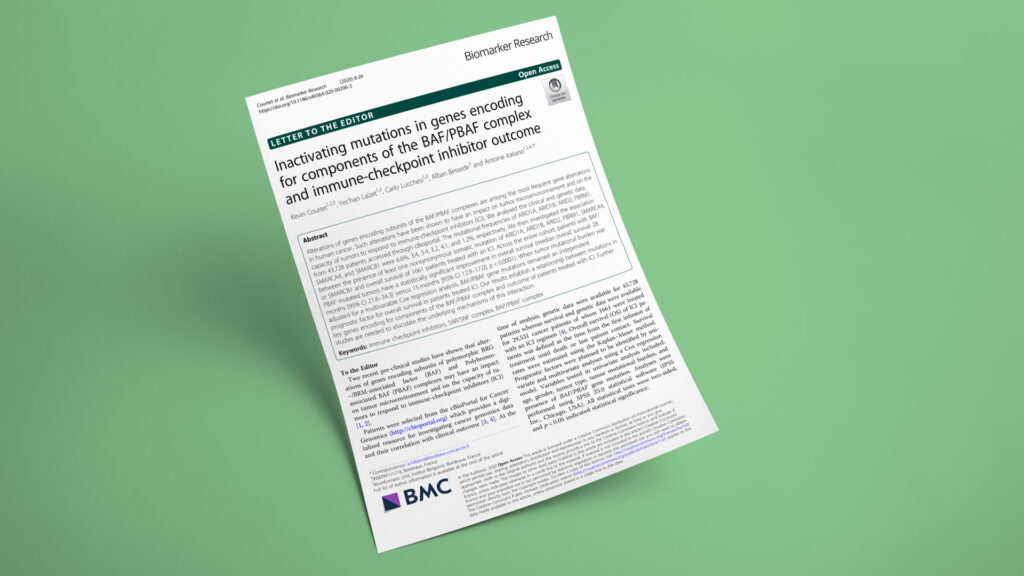
Genes of the BAF/PBAF chromatin-remodeling complexes are among the most frequently mutated in human cancer, but whether those mutations shape response to immune-checkpoint inhibitors was unresolved. Mining genomic and clinical data from 43,728 tumors on cBioPortal, the team found that patients with BAF/PBAF-mutated tumors treated with checkpoint inhibitors lived nearly twice as long — a median 28 versus 15 months. The signal held after adjusting for tumor mutational burden and was reversed in untreated patients, marking it as genuinely predictive rather than merely prognostic.
Published as a Letter to the Editor in Biomarker Research, this analysis was led by Prof. Antoine Italiano — of INSERM U1218, the University of Bordeaux, and the Early Phase Trials and Sarcoma Units at Institut Bergonié — with Kevin Courtet as first author. Explicyte contributed to the genomic data analysis
The work reframes BAF/PBAF mutations as a candidate predictive biomarker for checkpoint-inhibitor benefit — one that operates independently of tumor mutational burden and is most informative in the low-TMB tumors where existing markers underperform.
For drug developers and trial designers, BAF/PBAF mutation status offers a genomically defined way to enrich checkpoint-inhibitor trials — with particular value in low-TMB tumors that current burden-based selection leaves behind. Because the mutations reverse direction without immunotherapy, they behave as a predictive rather than purely prognostic signal, strengthening the case for prospective validation. The authors also flag a combination rationale: pairing checkpoint inhibitors with small-molecule inhibitors of chromatin-remodeling pathways such as EZH2.