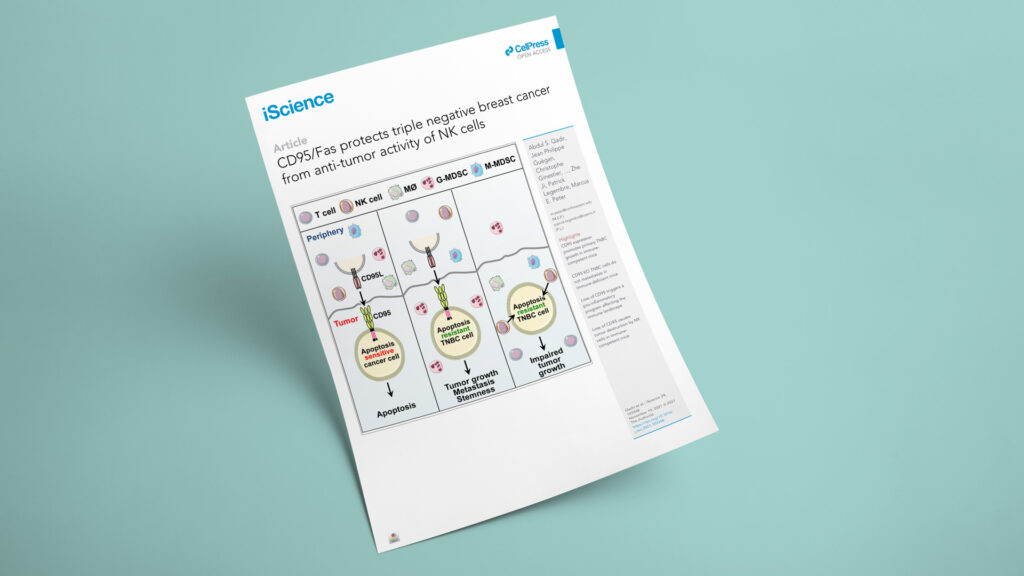
Publication in iScience

How CD95/Fas helps triple-negative breast cancer escape NK-cell control in preclinical models

CD95/Fas protects triple negative breast cancer from anti-tumor activity of NK cells
JournaliScience
DateNov 2021
Read full paper →

CD95/Fas is widely known as a death receptor, but apoptosis-resistant triple-negative breast cancer can use it for tumor-promoting biology. In this iScience paper, Explicyte-affiliated scientists contributed to a preclinical program using independent CD95 knockout 4T1 TNBC models, immune-deficient and immune-competent mice, RNA-seq, IHC, and flow cytometry. Loss of CD95 blocked lung metastasis and exposed tumors to NK-cell-mediated control, positioning CD95/Fas as an immune-escape node in TNBC.

Explicyte’s Jean Philippe Guégan, Assia Chaibi, and Alban Bessede joined a collaborative program led by Northwestern University and INSERM U1262 CRIBL / University of Limoges to dissect how tumor-cell CD95/Fas shapes triple-negative breast cancer growth, metastasis, and immune control. The work was supported by R35CA197450, INCa PLBIO18-059, Ligue Contre le Cancer, Fondation de France Prix Jean Valade, and the Lynn Sage Cancer Research Foundation / Lynn Sage Scholar fund.

The question

Does tumor-cell CD95/Fas protect triple-negative breast cancer from NK-cell attack — and does its loss reshape the immune landscape?

Key steps

  1. 1

    Build CD95-deficient TNBC models

    The team generated two independent sets of CD95 knockout 4T1 triple-negative breast cancer clones using different CRISPR/Cas9 strategies: U-clones deleting exon 9 and F-clones carrying a frameshift near the CD95 transcriptional start site. Both approaches produced cells with little or no detectable surface CD95. In vitro, CD95 loss did not strongly reduce proliferation or cell-cycle progression, but it reduced sphere-forming capacity, suggesting an effect on tumor features rather than simple cell survival.

  2. 2

    Separate immune-dependent tumor effects

    In immune-deficient NSG mice, orthotopic CD95 knockout tumors grew as well as, or faster than, wild-type tumors, showing that CD95 loss did not intrinsically block primary tumor growth. Yet these same CD95-deficient cells almost failed to seed lung metastases, with metastatic nodules sharply reduced versus controls (p=0.0003). In immune-competent BALB/c mice, the result flipped: CD95 knockout tumors barely grew, with strong reductions in tumor weight and volume across independent clone sets.

  3. 3

    Map the immune shift

    RNA-seq compared wild-type and CD95 knockout 4T1 cells grown in vitro, in NSG mice, and in BALB/c mice. The BALB/c setting produced 620 differentially expressed genes, within a broader set of 1,090 unique deregulated genes, and 10 of the 22 strongest GO enrichments related to immune function. IHC and multiparameter flow cytometry then showed broader immune infiltration in CD95 knockout tumors, including macrophages, CD4+ T cells, CD8+ T cells, Tregs, and M1/M2 macrophage subsets, while G-MDSCs were reduced and CD31 vessel density remained similar.

  4. 4

    Pinpoint NK-cell control

    Depleting CD8+ T cells did not restore growth of CD95 knockout tumors, and additional CD4+ T-cell and CSF1-R-targeting experiments did not explain the phenotype. The key contrast came from mouse strains: CD95 knockout tumors remained growth-impaired in NOD-SCID mice, which retain NK cells, but not in NSG mice, which lack them. CD95 knockout tumors also carried more NKp46+ NK cells, and anti-Asialo GM1 NK-cell depletion narrowed the growth difference between wild-type and CD95-deficient tumors.

Impact

CD95/Fas emerges here as more than an apoptosis receptor in TNBC. In apoptosis-resistant tumor cells, it can help maintain an immune landscape that limits NK-cell control while supporting metastasis.

2
independent CRISPR/Cas9 CD95 knockout clone systems generated with different strategies and convergent results
p=0.0003
reduction in lung metastatic nodules for CD95 knockout 4T1 tumors versus wild-type controls in NSG mice
620
differentially expressed genes in CD95 knockout versus wild-type tumors grown in immune-competent BALB/c mice

For drug developers and translational teams, CD95/Fas should be considered not only as an apoptosis or metastasis receptor, but also as a tumor-cell mechanism that can suppress innate anti-tumor immunity. The work is especially relevant for TNBC programs exploring NK-cell engagers, cytokine-based immunotherapy, innate immune modulation, or combinations designed to reverse immune exclusion.

Exploring innate immune resistance or NK-cell activity in breast cancer? Let’s talk.

Talk to us
Explicyte Oncology CRO logo

Capabilities

Modalities