Publication in iScience

How CD95 keeps NF-κB switched off in triple-negative breast cancer — and what its loss unleashes

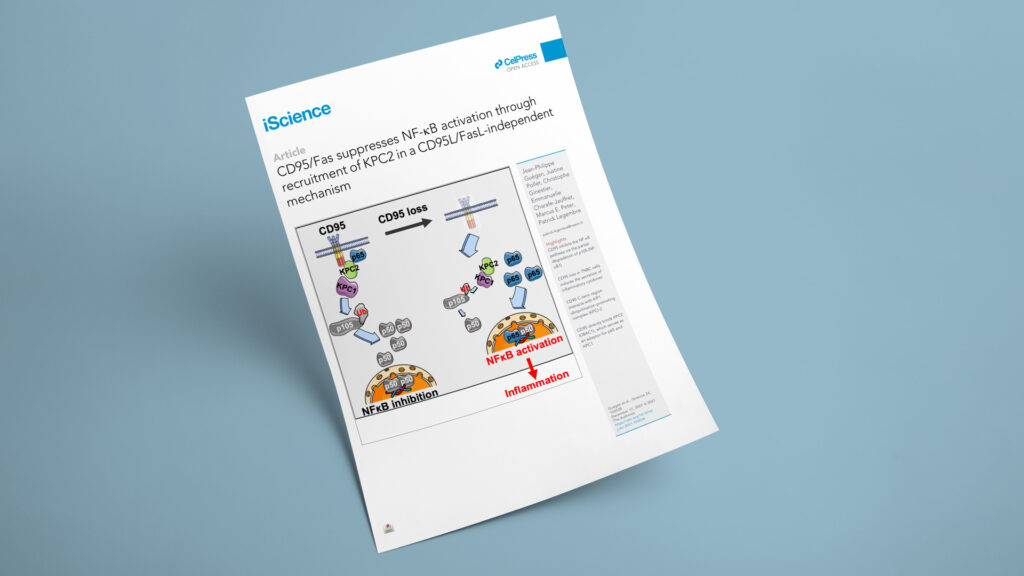
CD95/Fas suppresses NF-κB activation through recruitment of KPC2 in a CD95L/FasL-independent mechanism
JournaliScience
DateDec 2021
Read full paper →

Triple-negative breast cancer cells hold onto high surface CD95, and losing it sparks an anti-tumor inflammatory response — but why stayed unclear. Using proximity proteomics, the team found that CD95 recruits KPC2 (UBAC1), an adaptor that pulls in the ubiquitin ligase KPC1 and the NF-κB subunit p65. Bound to the receptor, the complex trims p105 into repressive p50/p50 homodimers and keeps NF-κB off. Independent of CD95L, deleting CD95 releases that brake — activating NF-κB and driving pro-inflammatory cytokine release.

Published in iScience, this work was led by Patrick Legembre (CRIBL, Université de Limoges — CNRS UMR 7276, INSERM U1262) and Marcus E. Peter (Northwestern University), with Jean-Philippe Guégan of Explicyte as first author. It reframes CD95 — classically a death receptor — as a ligand-independent brake on NF-κB signaling in triple-negative breast cancer (TNBC), and works out the molecular machinery behind it. The study was supported by INCa PLBIO, the Ligue Contre le Cancer, Fondation ARC, Fondation de France, the French National Research Agency (ANR PRCE), and NIH grant R35CA197450.

The question

How does CD95 hold NF-κB in check in triple-negative breast cancer — and why does losing it ignite inflammation?

Key steps

  1. 1

    CD95 loss reprograms TNBC toward inflammation

    CRISPR deletion of CD95 in human MDA-MB-231 and mouse 4T1 TNBC cells deregulated 386 and 244 genes respectively, with 148 shared. Across both lines, GSEA converged on a single common hallmark: “TNFα signaling via NF-κB.” A 105-factor cytokine array flagged 28 upregulated and 12 downregulated proteins in CD95-knockout cells, and ELISA confirmed higher CSF1, CSF2, IL1α, IL1β, and CXCL1. Knocking out CD95L or blocking it with neutralizing antibodies did not reproduce the signature — the effect is ligand-independent.

  2. 2

    An unbiased interactome hunt flags KPC2

    Proximity-dependent biotinylation (BioID) with BirA-fused CD95 constructs in CD95-knockout HEK293T cells tagged 198 proteins associated with full-length CD95, including caspase-8 (validating the approach). Among NF-κB inhibitors, KPC2 (UBAC1) stood out. Streptavidin pull-downs confirmed that KPC2 and p65 associate with wild-type CD95 but not with a receptor lacking its intracellular region — and the same interactions held in MDA-MB-231 TNBC cells.

  3. 3

    KPC2 docks on the CD95 C-terminus and bridges p65

    Domain mapping localized KPC2 and p65 binding to the very C-terminal stretch of CD95 (residues 303–319). GST pull-downs and a split-Renilla protein-fragment complementation assay confirmed direct KPC2–CD95 binding; p65 was recruited only when KPC2 was present, identifying KPC2 as the adaptor. p65 engaged via its N-terminal region (residues 1–307) spanning its nuclear localization sequence, suggesting CD95 masks p65’s NLS much as IκB does.

  4. 4

    The complex ubiquitinates p105, tilting NF-κB toward repression

    KPC2 also recruited the E3 ligase KPC1. Deleting CD95 caused p105 to accumulate, and in vitro ubiquitination assays showed the full-length CD95 complex ubiquitinated p105 while the intracellular-truncated receptor and KPC2-null complexes did not. In nuclei, the p50/p65 ratio fell from 1.5 in parental cells to 0.58 in CD95-knockout cells, and NF-κB reporter activity rose sharply in CD95-, KPC2-, and double-knockout TNBC cells.

Impact

The work recasts CD95 as a ligand-independent brake on NF-κB and explains, mechanistically, how its loss remodels the inflammatory tone of the TNBC microenvironment.

198
proteins mapped in the CD95 interactome by proximity proteomics
28
cytokines upregulated in CD95-knockout TNBC cells (of 105 screened)
aa 303–319
the C-terminal CD95 region that docks KPC2

For immuno-oncology, CD95 status emerges as a determinant of NF-κB inflammatory tone in TNBC — a subtype with few targeted options. The CD95–KPC2 axis, and the balance between repressive p50/p50 and active p50/p65 dimers, becomes a candidate lever for tuning the tumor immune microenvironment. It also flags that any therapy touching CD95 signaling could shift cytokine output and downstream NK-cell recruitment in ways worth modeling upfront.

Working on CD95 signaling, NF-κB modulation, or the inflammatory microenvironment in triple-negative breast cancer? Let's talk.

Talk to us
Explicyte Oncology CRO logo

Capabilities

Modalities