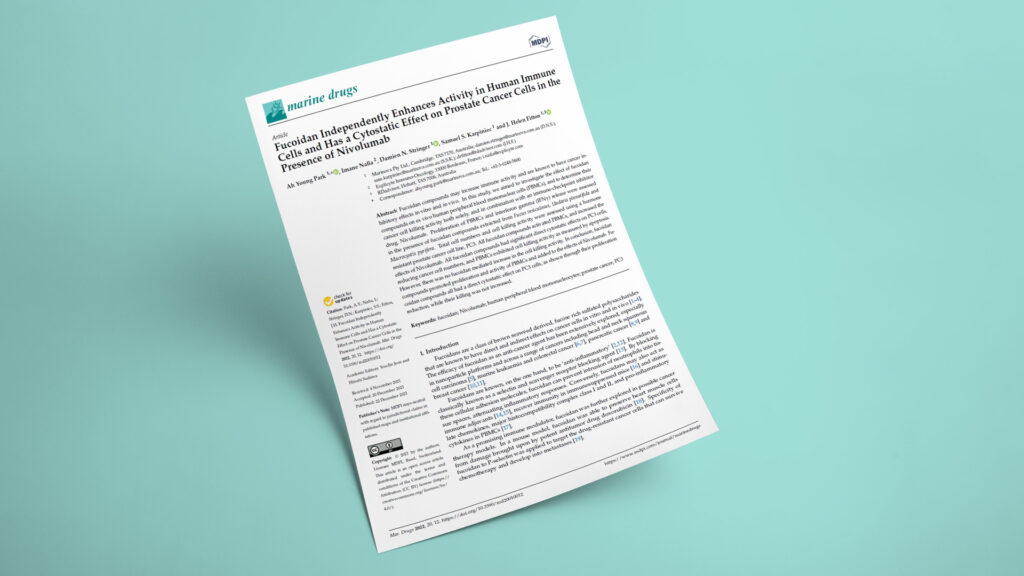
Publication in Marine Drugs

How fucoidan activates immune cells and independently stalls prostate cancer growth alongside Nivolumab

Fucoidan Independently Enhances Activity in Human Immune Cells and Has a Cytostatic Effect on Prostate Cancer Cells in the Presence of Nivolumab
JournalMarine Drugs
DateDec 2021
Read full paper →

Fucoidans — sulfated polysaccharides from brown seaweed sold as dietary supplements — are known to modulate immune cells, but how they behave alongside checkpoint inhibitors was largely untested. Explicyte ran the immuno-oncology assays: PBMC activation, IFNγ profiling, and live-cell tumor-killing co-cultures pairing healthy-donor immune cells with the checkpoint antibody Nivolumab and the hormone-resistant prostate line PC3. Fucoidans from three seaweed species activated immune cells and added to Nivolumab's effect, and independently slowed PC3 growth — yet the immune activation never translated into more cancer-cell killing.

A study in Marine Drugs — led by Ah Young Park of Marinova Pty Ltd — tested whether seaweed-derived fucoidan compounds interact usefully with immune-checkpoint blockade. Explicyte Immuno-Oncology, working from its Bordeaux laboratory, designed and ran the functional immuno-oncology program: PBMC activation and proliferation assays, HTRF-based IFNγ quantification, and the live-cell immune-cell-mediated tumor killing assays that anchored the study’s conclusions. Fucoidan extracts from three brown-seaweed species were supplied by Marinova, which also funded the research.

The question

Can fucoidan boost immune-checkpoint therapy against prostate cancer — and does it work by activating immune cells or by hitting tumor cells directly?

Key steps

  1. 1

    Profiling immune activation with three fucoidans

    Explicyte measured IFNγ release (HTRF) and live-cell proliferation from healthy-donor PBMCs treated with fucoidans from Fucus vesiculosus, Undaria pinnatifida, and Macrocystis pyrifera at 0–100 µg/mL, with and without anti-CD3 and Nivolumab. All three activated PBMCs and raised IFNγ, adding to Nivolumab’s effect. Activation peaked at low doses (~10 µg/mL) and followed a bell-shaped curve, falling at higher concentrations for UP and MP while remaining strong for FV.

  2. 2

    Amplified cytokine response in immune–tumor co-culture

    In PBMC–PC3 co-cultures at a 10:1 effector-to-target ratio, fucoidans raised IFNγ release in the supernatants roughly 10-fold, dose-dependently up to ~1 µg/mL for UP and MP and ~5 µg/mL for FV. The effect held across anti-CD3 doses and was further optimized by Nivolumab, showing that tumor cell exposure enhanced immune activation rather than dampening it.

  3. 3

    Direct cytostatic effect on prostate cancer cells

    Tested alone on NucLight Red–labeled PC3 cells by live-cell imaging (IncuCyte ZOOM), fucoidans dose-dependently reduced tumor cell counts starting from ~96 h at the three highest concentrations — but the caspase-3/7 apoptosis probe stayed flat, unlike the staurosporine (10 µM) positive control. The pattern points to a cytostatic, growth-arresting mechanism rather than direct cell killing.

  4. 4

    Immune activation that didn't increase killing

    In the immune-cell-mediated killing assay, PBMCs alone reduced PC3 counts and raised apoptosis, but adding fucoidan — despite its strong IFNγ boost — did not increase tumor cell apoptosis at the lower three doses. Only at higher fucoidan concentrations did counts fall, tracking the compounds’ own cytostatic effect rather than enhanced immune killing.

Impact

The study cleanly separates two things often conflated in immuno-oncology screening: immune activation and actual tumor-cell killing. Fucoidan does the first strongly, but its anti-cancer effect on prostate cells runs through a separate, direct cytostatic route.

~10×
rise in IFNγ release from fucoidan-treated PBMCs in tumor co-culture
~10 µg/mL
low dose driving peak PBMC activation (higher doses did less)
96 h
onset of fucoidan's direct, apoptosis-independent tumor growth arrest

For teams screening natural products or combination partners alongside checkpoint inhibitors, the takeaway is to measure killing directly, not just cytokine output — a strong IFNγ signal here did not mean more dead tumor cells. Fucoidan’s independent, non-toxic cytostatic effect on hormone-resistant prostate cells is worth pursuing mechanistically, and its low-dose activation window is relevant to anyone modeling orally delivered adjuncts to immunotherapy. Explicyte’s functional co-culture platform is built to resolve exactly this activation-versus-killing distinction.

Screening a checkpoint-inhibitor combination and need to tell immune activation apart from real tumor killing? Let's talk.

Talk to us
Explicyte Oncology CRO logo

Capabilities

Modalities