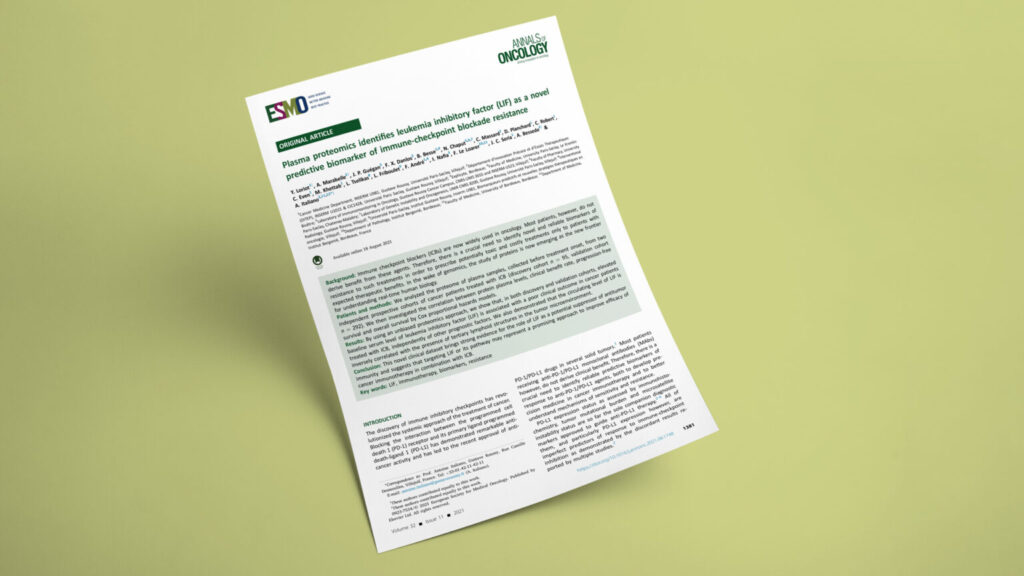
Publication in Annals of Oncology

How plasma LIF predicts immune-checkpoint blockade resistance and a TLS-poor tumor microenvironment

Plasma proteomics identifies leukemia inhibitory factor (LIF) as a novel predictive biomarker of immune-checkpoint blockade resistance
JournalAnnals of Oncology
DateAug 2021
Read full paper →

Most patients treated with immune-checkpoint blockers do not achieve durable benefit, and tissue biomarkers remain imperfect. In this Annals of Oncology paper, Explicyte-affiliated authors helped evaluate pre-treatment plasma proteomics and matched tumor immune profiling in two prospective cohorts of patients receiving PD-1/PD-L1 blockade. High baseline plasma LIF predicted poorer response, shorter PFS and shorter OS, and was linked to fewer tertiary lymphoid structures in tumors.

This Annals of Oncology publication brought together Gustave Roussy, Université Paris-Saclay, Institut Bergonié, University of Bordeaux, INSERM units, and Explicyte contributors Jean-Philippe Guégan, Imane Nafia, and Alban Bessede. The work focused on a practical translational question: can a blood-based protein biomarker help identify resistance to immune-checkpoint blockade before treatment starts? The team analyzed pre-treatment plasma from 95 patients in the MATCH-R discovery cohort and 292 patients in the PREMIS validation cohort. Plasma proteomics was paired with matched tumor profiling, including PD-L1 scoring, CD8+ T-cell quantification, RNA-seq immune deconvolution, and CD3/CD20-based assessment of tertiary lymphoid structures.

The question

Can baseline plasma LIF identify patients less likely to benefit from PD-1/PD-L1 immune-checkpoint blockade?

Key steps

  1. 1

    Profile baseline plasma proteins

    In the 95-patient MATCH-R discovery cohort, pre-treatment plasma was analyzed with the Olink Explore 1536 library, covering 1472 proteins and 48 control assays. The workflow quantified 1463 unique proteins across all samples. Among proteins associated with progression-free survival, LIF showed the strongest relationship with poor clinical outcome.

  2. 2

    Link LIF to clinical resistance

    Patients with low plasma LIF had a median PFS of 7.4 months versus 1.7 months in the LIF-high group (P < 0.0001). Median OS was also longer in the LIF-low group: 21.7 months versus 4.3 months (P < 0.0001). Durable clinical benefit reached 41.7% in LIF-low patients, compared with 6.4% in LIF-high patients.

  3. 3

    Test independence from PD-L1 and CD8

    In 59 patients with matched tumor tissue, the team compared plasma LIF with PD-L1 tumor proportion score and CD8+ T-cell density assessed by multiplexed immunohistochemistry. LIF levels were similar in PD-L1-positive and PD-L1-negative tumors, and low LIF remained associated with improved PFS across PD-L1 strata. CD8-high tumors showed lower peripheral LIF (P = 0.02), supporting a link between LIF and a less inflamed tumor contexture.

  4. 4

    Connect LIF to TLS biology

    RNA-seq immune deconvolution in 52 tumors showed an inverse association between plasma LIF and B-cell and T follicular helper cell signatures. Because these lineages are central to tertiary lymphoid structures, the team assessed TLS using CD3/CD20-based multiplexed immunohistochemistry. TLS were present in 22 of 59 tumors, and were more frequent in LIF-low cases than LIF-high cases: 50% versus 24.1% (P = 0.04).

  5. 5

    Validate in PREMIS

    In the independent 292-patient PREMIS cohort, plasma LIF was measured with the Olink Target 96 Inflammation panel. LIF-low patients had higher objective response rate (32.2% versus 16.4%, P = 0.002), higher durable clinical benefit rate (34.2% versus 17.8%, P = 0.001), longer PFS (5.1 versus 2.6 months, P < 0.0001), and longer OS (not reached versus 8.5 months, P < 0.001). In multivariate analysis, high LIF remained independently associated with shorter PFS and OS.

Impact

This work positions plasma LIF as a blood-accessible biomarker of immune-checkpoint blockade resistance and links it to a tumor microenvironment with fewer tertiary lymphoid structures.

387
patients analyzed across the MATCH-R discovery cohort and PREMIS validation cohort
1463
unique plasma proteins quantified in the discovery cohort using Olink Explore 1536
7.4 vs 1.7 months
median PFS in LIF-low versus LIF-high patients in the discovery cohort

For translational teams, plasma LIF offers a practical way to connect systemic protein biology with tumor immune architecture before checkpoint blockade begins. For drug developers, the findings support LIF-axis modulation as a rational combination strategy with PD-1/PD-L1 inhibitors, especially in patients with high circulating LIF and a TLS-poor tumor microenvironment.

Building a plasma proteomics strategy for immunotherapy resistance? Let’s talk.

Talk to us
Explicyte Oncology CRO logo

Capabilities

Modalities