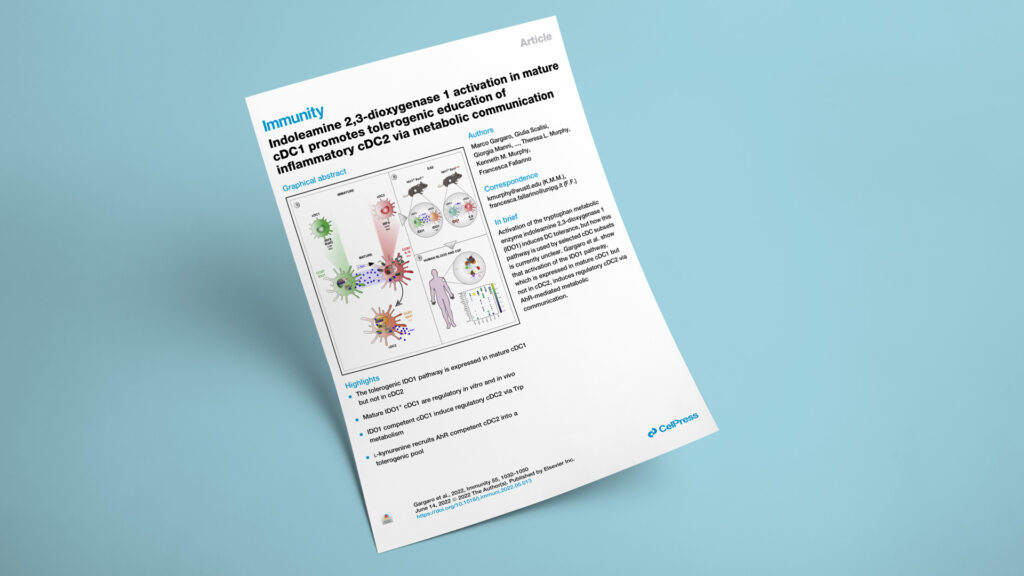
Publication in Immunity

How tolerogenic cDC1 dendritic cells “educate” inflammatory cDC2 by exporting the tryptophan metabolite L-kynurenine

Indoleamine 2,3-dioxygenase 1 activation in mature cDC1 promotes tolerogenic education of inflammatory cDC2 via metabolic communication

Dendritic cells decide between immunity and tolerance, and the tryptophan-degrading enzyme IDO1 is central to keeping them tolerogenic — but which dendritic-cell subsets actually use it has been unclear. This study shows that only mature cDC1 dendritic cells express IDO1, yet they can hand tolerance to neighboring inflammatory cDC2 cells by releasing the tryptophan metabolite L-kynurenine, which activates the aryl hydrocarbon receptor (AhR) in cDC2. Removing IDO1 specifically from cDC1 worsened autoimmune demyelinating disease in mice, and human data placed IDO1 in cDC1 alone — marking this metabolic hand-off as a target in autoimmune conditions such as multiple sclerosis.

This basic-immunology study, led by the laboratories of Prof. Kenneth M. Murphy (Washington University in St. Louis / Howard Hughes Medical Institute) and Prof. Francesca Fallarino (University of Perugia), with Marco Gargaro and Giulia Scalisi as co-first authors, maps how the tolerogenic enzyme IDO1 is distributed across conventional dendritic-cell subsets and how it spreads immune regulation between them. The team combined mouse genetics, single-cell transcriptomics, metabolomics, and a mouse model of autoimmune demyelination (experimental autoimmune encephalomyelitis, EAE) with re-analysis of dendritic cells from multiple-sclerosis patients.

The question

Which dendritic-cell subsets use the tolerogenic enzyme IDO1 — and can one subset transfer immune tolerance to another through a shared metabolite?

Key steps

  1. 1

    IDO1 mapped to mature cDC1, not cDC2

    Across mouse dendritic-cell cultures, only mature CCR7+ cDC1 expressed IDO1 — roughly half at baseline and about 80% after LPS activation — while isolated cDC2 and plasmacytoid DCs expressed none, even after stimulation. Expression depended on the transcription factor IRF8 binding a cDC1-specific enhancer element in the Ido1 gene.

  2. 2

    In-situ visualization of L-kynurenine in cDC1

    To confirm that IDO1-competent cDC1 actually produce and accumulate the tryptophan metabolite, the team stained sorted CCR7+ cDC1 using Immusmol’s anti-L-kynurenine monoclonal antibody and read it out by immunofluorescence. Wild-type activated cDC1 showed clear intracellular L-kynurenine signal that was absent in IDO1-deficient cells, tying the enzyme directly to metabolite output.

  3. 3

    cDC1 "teach" cDC2 through exported L-kynurenine

    When cDC1 and cDC2 were co-cultured, about half of the cDC2 acquired IDO1 expression and tolerogenic function after LPS — something they never did in isolation. This education required cDC1-derived L-kynurenine acting on the aryl hydrocarbon receptor (AhR) in cDC2, cooperating with RelB to switch on the Ido1 gene; AhR-deficient cDC2 could not respond.

  4. 4

    The axis controls autoimmune demyelination in vivo

    Deleting IDO1 specifically in cDC1 (Ido1-flox × Xcr1-Cre mice) worsened clinical scores and CNS inflammation in EAE, with fewer regulatory T cells and higher IL-6, confirming the pathway’s protective role. Conversely, oral L-kynurenine reduced EAE severity in an AhR-in-dendritic-cell–dependent manner. Re-analysis of single-cell transcriptomes from blood and cerebrospinal fluid of multiple-sclerosis patients placed IDO1 expression in cDC1 but not cDC2, extending the mechanism to humans.

Impact

The work reframes dendritic-cell tolerance as a division of labor: one subset runs the tolerogenic enzyme, then shares its product so a second, inflammatory subset can become regulatory too.

~80%
of mature (CCR7+) cDC1 express the tolerogenic enzyme IDO1 after activation — while isolated cDC2 express none
0% → ~50%
of inflammatory cDC2 gain IDO1 when educated by neighboring cDC1 (none in isolation)
65K+
single cells from blood and cerebrospinal fluid re-analyzed across MS patients and controls, confirming cDC1-restricted IDO1 in humans

For anyone developing tolerance-promoting therapies in autoimmune and demyelinating disease, this identifies a specific, druggable metabolic hand-off — IDO1 in cDC1, L-kynurenine as the messenger, AhR/RelB in cDC2 as the receiver — rather than a single cell type to target. It also suggests that IDO1 status in cDC1 could serve as a readout of tolerogenic capacity in patients, and that AhR-directed or kynurenine-pathway agents deserve evaluation in multiple sclerosis. In-situ detection of tryptophan metabolites like L-kynurenine is a way to make this axis visible in tissue.

Studying tryptophan–kynurenine–AhR immunometabolism and need in-situ detection of L-kynurenine or IDO1-pathway readouts? Let's talk

Talk to us
Explicyte Oncology CRO logo

Capabilities

Modalities