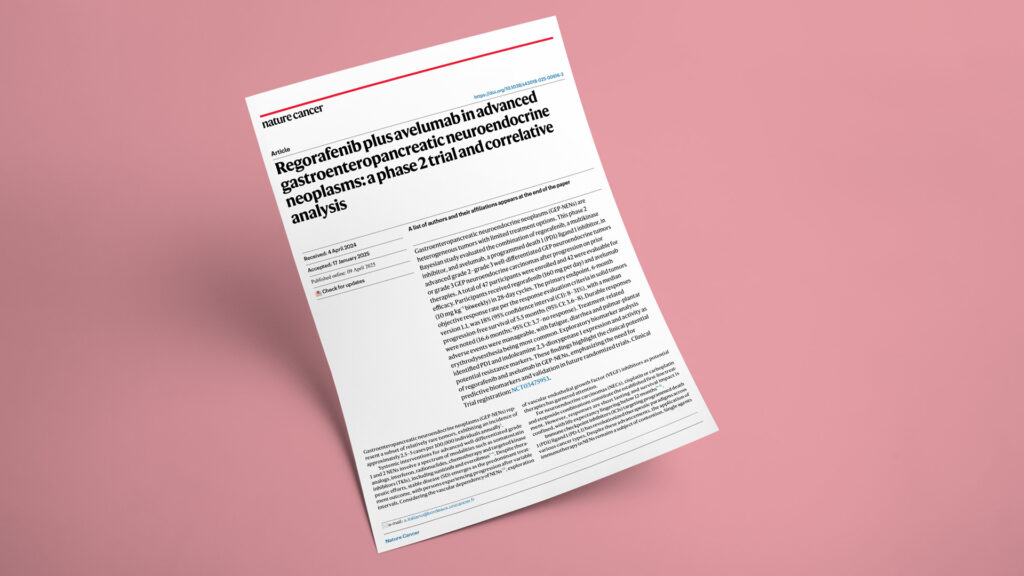
Publication in Nature Cancer

Regorafenib plus avelumab in advanced neuroendocrine tumors — and the IDO1 biomarker that predicts resistance

Regorafenib plus avelumab in advanced gastroenteropancreatic neuroendocrine neoplasms: a phase 2 trial and correlative analysis
JournalNature Cancer
DateApr 2025
Read full paper →

Advanced gastroenteropancreatic neuroendocrine neoplasms (GEP-NENs) have few effective options, and checkpoint inhibitors alone rarely deliver. In the REGOMUNE phase 2 trial, 42 evaluable patients received regorafenib plus the PD-L1 inhibitor avelumab, yielding an 18% objective response rate with durable responses lasting a median of 16.6 months. Explicyte's correlative program — multiplex immunofluorescence, Olink plasma proteomics, and kynurenine/tryptophan metabolite profiling — pinpointed tumor PD1/IDO1 co-expression and IDO1 pathway activity as markers of resistance, pointing to who benefits and how to combine smarter.

A new phase 2 trial in Nature Cancer — the neuroendocrine cohort of the REGOMUNE basket study, led by corresponding author Prof. Antoine Italiano (Institut Bergonié, Gustave Roussy) with Sophie Cousin and Explicyte’s Jean-Philippe Guégan as co-first authors — tested whether pairing the multikinase inhibitor regorafenib with the PD-L1 inhibitor avelumab could move the needle in advanced GEP-NENs after prior progression. The study was sponsored by Institut Bergonié, with funding from Bayer, the Association pour la Recherche contre le Cancer, and the French National Cancer Institute (INCa), and nonfinancial support from Merck. Explicyte designed and ran the correlative program that turned the trial’s clinical signal into a mechanistic read on resistance: a 7-plex multiplex immunofluorescence panel, Olink plasma proteomics, and targeted Kyn/Trp metabolite quantification.

The question

Can pairing regorafenib with avelumab overcome the limited activity of immunotherapy in advanced GEP-NENs — and which patients are most likely to benefit?

Key steps

  1. 1

    A Bayesian phase 2 test of the combination

    REGOMUNE enrolled 47 patients with advanced grade 2–3 well-differentiated GEP neuroendocrine tumors or grade 3 neuroendocrine carcinomas that had progressed on prior therapy; 42 were evaluable for efficacy. On regorafenib (160 mg/day) plus biweekly avelumab (10 mg/kg) in 28-day cycles, the objective response rate was 18% (95% CI: 8–31%), with median progression-free survival of 5.5 months. Responses skewed toward grade 2 NETs (30% ORR) over higher-grade disease, and those that occurred were durable, lasting a median of 16.6 months.

  2. 2

    Multiplex imaging links PD1/IDO1 to resistance

    Explicyte built a 7-plex immunofluorescence panel on the Ventana Discovery platform with Akoya Opal chemistry, profiling CD8, CD163, PD1, PD-L1, IDO1, and PanCK across 30 baseline FFPE tumors. CD8+ and CD163+ densities did not separate responders from non-responders, but tumors rich in PD1+/IDO1+ double-positive cancer cells fared markedly worse — median PFS 2.7 vs 9.2 months (P = 0.032) and shorter OS (P = 0.033). PD-L1 itself, positive in only 3 of 28 evaluable cases, was not predictive.

  3. 3

    Plasma IDO1 activity tracks with poor outcome

    To validate the IDO1 axis, Explicyte quantified baseline plasma kynurenine/tryptophan ratios by HPLC — a surrogate for IDO1 enzymatic activity — in 37 patients. The ratio correlated with tumor IDO1 expression, and a high ratio marked dramatically worse outcomes: clinical benefit 13% vs 79% (P < 0.001) and median PFS 3.4 vs 26 months (P < 0.001). Olink Target 96 proteomic profiling of plasma (n = 37) added soluble PD1 and PD-L1 as further markers of poor response.

  4. 4

    Resistance signal sharpens with tumor grade

    Both tumor IDO1 expression and peripheral Kyn/Trp activity rose stepwise from grade 2 NETs to grade 3 NETs to neuroendocrine carcinomas. That gradient offers a mechanistic explanation for why immunotherapy sensitivity falls as GEP-NEN grade climbs — and nominates IDO1 or AhR blockade as a rational addition for high-grade disease.

Impact

The trial gives an option-poor disease a combination with real, sometimes durable activity — and Explicyte's biomarker work explains why it fails when it fails, handing drug developers a ready hypothesis for the next combination.

18%
objective response rate to regorafenib plus avelumab (95% CI 8–31%)
16.6 mo
median duration of response among responders
<0.001
P value linking high plasma Kyn/Trp (IDO1 activity) to shorter PFS
13% vs 79%
clinical benefit rate, high vs low IDO1 activity

For teams working the IDO1, kynurenine, or AhR axes, this is a concrete combination rationale: layering IDO1/AhR blockade onto an antiangiogenic-plus-checkpoint backbone to disarm the resistance pathway Explicyte mapped here. The PD1/IDO1 tissue signature and the plasma Kyn/Trp ratio are both candidate enrichment biomarkers for trial design, and the grade-dependent gradient flags high-grade GEP-NENs as the population most likely to need them. GEP-NENs remain badly underserved by targeted therapy — a validated resistance mechanism is a credible place to start.

Building a biomarker strategy around IDO1, the kynurenine pathway, or checkpoint-plus-antiangiogenic combinations? Let's talk.

Talk to us
Explicyte Oncology CRO logo

Capabilities

Modalities