
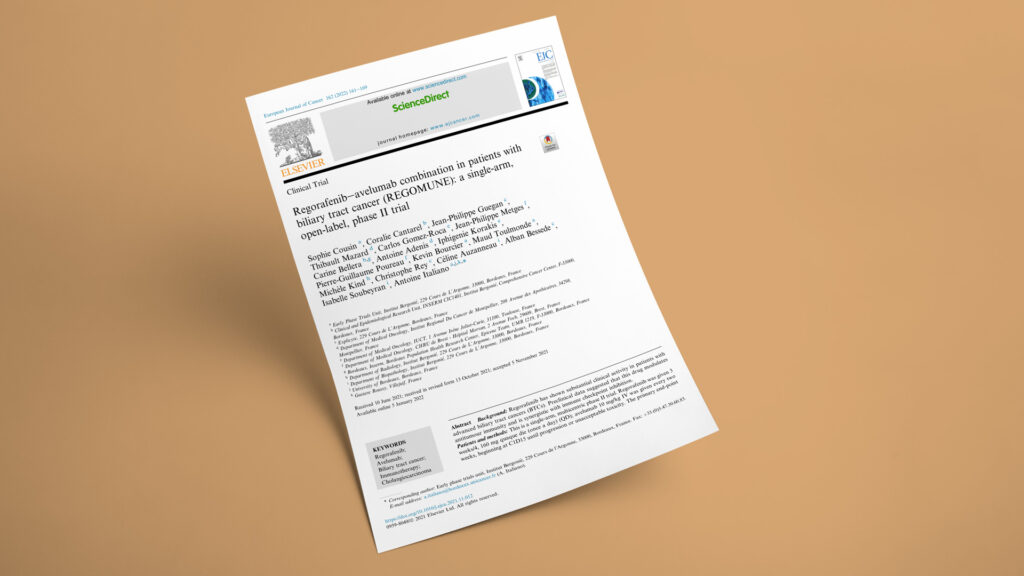
Therapeutic options remain limited after chemotherapy failure in advanced biliary tract cancer, and single-agent checkpoint blockade has shown modest activity. REGOMUNE tested regorafenib plus avelumab in a multicenter phase II trial, with Explicyte supporting multiplex tumor immune profiling on sequential biopsies. The trial did not meet its primary response threshold, but a subset of patients benefited, especially those whose tumors showed high baseline PD-L1 or IDO1 expression.
REGOMUNE was an Institut Bergonié-sponsored, multicenter phase II trial led by Sophie Cousin and Antoine Italiano, with patients recruited across four French centers. The study evaluated whether combining the multikinase antiangiogenic agent regorafenib with the anti-PD-L1 antibody avelumab could improve outcomes in advanced biliary tract cancer after standard chemotherapy. Explicyte contributed to the translational biomarker component, using multiplex immunohistofluorescence and digital image analysis on baseline and cycle 2 day 1 tumor biopsies. The team profiled CD8, CD163, PD-L1, cytokeratin 19, IDO1, and tumor–stroma compartments to connect tumor microenvironment features with clinical benefit, PFS, and resistance patterns. The study was funded by Bayer and Merck, with Institut Bergonié as sponsor.
REGOMUNE shows that regorafenib plus avelumab has activity in a biologically defined subset of advanced biliary tract cancer, even though the unselected trial population did not meet its prespecified efficacy threshold. The translational signal points to PD-L1 and IDO1 as practical baseline biomarkers for future combination strategies.
For drug developers and translational teams, REGOMUNE reinforces a key lesson in biliary tract cancer: antiangiogenic–checkpoint combinations may require tumor microenvironment selection rather than broad enrollment. Baseline PD-L1 and IDO1 expression could help enrich future trials for patients more likely to achieve durable benefit. Multiplex immune profiling on pretreatment biopsies can provide a practical bridge between clinical trial design and biomarker-driven development.