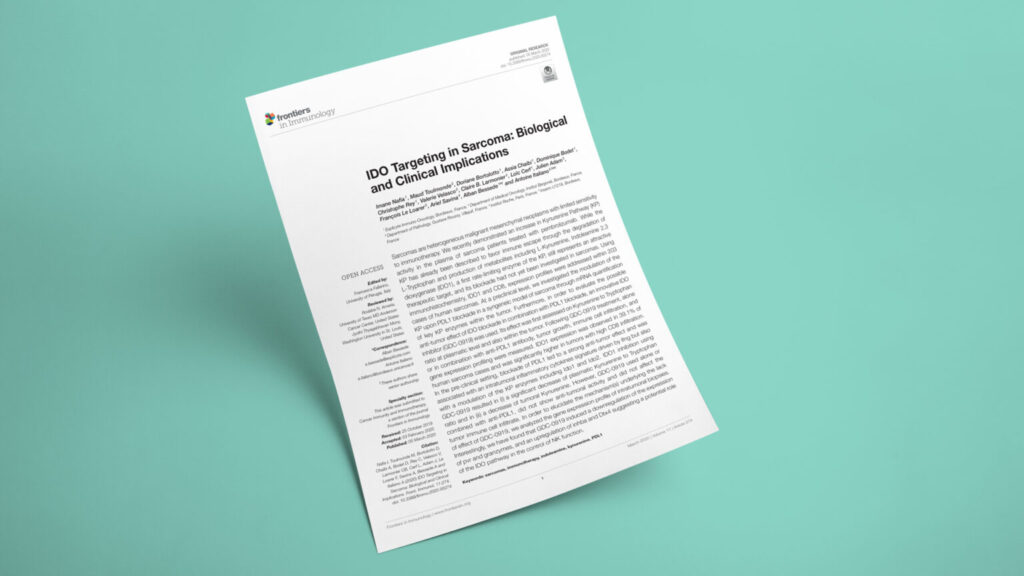
Publication in Frontiers in Immunology

Why IDO1 blockade lowered kynurenine but failed to improve anti-PDL1 efficacy in sarcoma

IDO Targeting in Sarcoma: Biological and Clinical Implications.
JournalFrontiers in Immunology
DateMar 2020
Read full paper →

IDO1 is a plausible resistance mechanism in sarcoma immunotherapy, but pathway inhibition does not automatically translate into tumor control. Explicyte contributed the human sarcoma tissue profiling, kynurenine/tryptophan pharmacodynamic assays, flow-cytometry immune profiling, in vivo sarcoma experiments, and gene-expression analyses that tested GDC-0919 alone and with anti-PDL1. IDO1 was present in 39.1% of human sarcomas and enriched in CD8-high tumors, while GDC-0919 lowered kynurenine but did not improve anti-PDL1 efficacy in the MCA205 model.

Published in Frontiers in Immunology, this Explicyte-led translational and preclinical study examined whether the IDO1/kynurenine pathway could explain part of the limited sensitivity of sarcomas to PD1/PDL1 blockade. The work connected human FFPE sarcoma tissue profiling from Institut Bergonié with functional sarcoma cell-line assays, plasma and intratumoral metabolite readouts, flow-cytometry profiling of tumor-infiltrating leukocytes, and NanoString immune gene-expression analysis. The study was funded by Institut Roche and Explicyte Immuno-Oncology and involved collaborators from Institut Bergonié, INSERM U1218, Gustave Roussy, Institut Roche, and University of Bordeaux. It addressed a clinically relevant question: whether inhibiting IDO1 with GDC-0919 could convert kynurenine-pathway modulation into better anti-PDL1 activity in sarcoma.

The question

Can IDO1 inhibition overcome kynurenine-pathway activation and improve anti-PDL1 response in sarcoma?

Key steps

  1. 1

    Profile human sarcoma tissues

    The team analyzed 203 human sarcoma FFPE cases with genomic complexity using IHC for IDO1, CD8, and PDL1. IDO1 staining was detected in 79 cases, representing 39.1% of the cohort. IDO1 positivity was far more frequent in CD8-high tumors than in CD8-low tumors — 65.3% vs 12.9%, p < 0.001 — linking IDO1 expression to inflamed sarcoma microenvironments.

  2. 2

    Test kynurenine production in cells

    Two primary human sarcoma cell lines, IB115 dedifferentiated liposarcoma and IB136 leiomyosarcoma, were exposed to recombinant human IFNγ for 48 hours. Both cell lines increased kynurenine production, measured by ImmuSmol immunoassay, with a stronger response in IB115. GDC-0919 inhibited IFNγ-induced kynurenine production with IC50 values of 5.1 × 10⁻⁷ M in IB115 and 2.4 × 10⁻⁷ M in IB136.

  3. 3

    Map pathway activity in vivo

    Intratumoral microdialysis compared kynurenine and tryptophan levels across CT26 colon cancer, A20 lymphoma, EMT6 breast cancer, and MCA205 sarcoma models. MCA205 showed the highest tumor kynurenine/tryptophan ratio, supporting it as a relevant sarcoma model for IDO-pathway testing. In MCA205 tumors, anti-PDL1 treatment increased inflammatory cytokine expression and modulated kynurenine-pathway genes, including Ido1 and Ido2.

  4. 4

    Measure pharmacodynamic inhibition

    GDC-0919 was tested at 100 mg/kg orally twice daily, alone or with anti-PDL1. Treatment significantly reduced the plasma kynurenine/tryptophan ratio at early time points, although the effect was transient by day 13. Intratumoral microdialysis confirmed reduced kynurenine, kynurenine/tryptophan ratio, and kynurenic acid inside the tumor compartment.

  5. 5

    Test antitumor impact

    In the MCA205 model, anti-PDL1 produced a significant antitumor effect, including 1 tumor rejection among 15 mice. GDC-0919 alone did not reduce tumor growth, and the combination with anti-PDL1 produced only a non-significant trend, with 3 tumor rejections among 15 mice. Flow cytometry showed that adding GDC-0919 did not improve the anti-PDL1-driven immune infiltrate; gene-expression profiling instead pointed to downregulation of Pvr and granzymes and upregulation of Inhba and Dtx4.

Impact

The paper separates pharmacodynamic pathway inhibition from therapeutic efficacy. GDC-0919 did what an IDO1 inhibitor should do biochemically, but that was not enough to improve sarcoma tumor control in this model.

203
human sarcoma FFPE cases profiled for IDO1, CD8, and PDL1 expression
39.1%
of human sarcomas showed IDO1 expression
65.3% vs 12.9%
IDO1 positivity in CD8-high vs CD8-low sarcomas, p < 0.001

For drug developers, the data argue that IDO1/kynurenine pharmacodynamics should not be treated as a surrogate for antitumor activity. Sarcoma programs targeting immunometabolism need paired tissue, plasma, immune-cell, and gene-expression readouts to understand whether pathway inhibition strengthens or unexpectedly counterbalances immune control. The GDC-0919 signal around Pvr, granzymes, Inhba, and Dtx4 also points to NK-cell biology as a critical axis to monitor in future IDO-pathway combinations.

Evaluating IDO, kynurenine, or immunometabolic resistance mechanisms in sarcoma immunotherapy? Let’s talk.

Talk to us
Explicyte Oncology CRO logo

Capabilities

Modalities