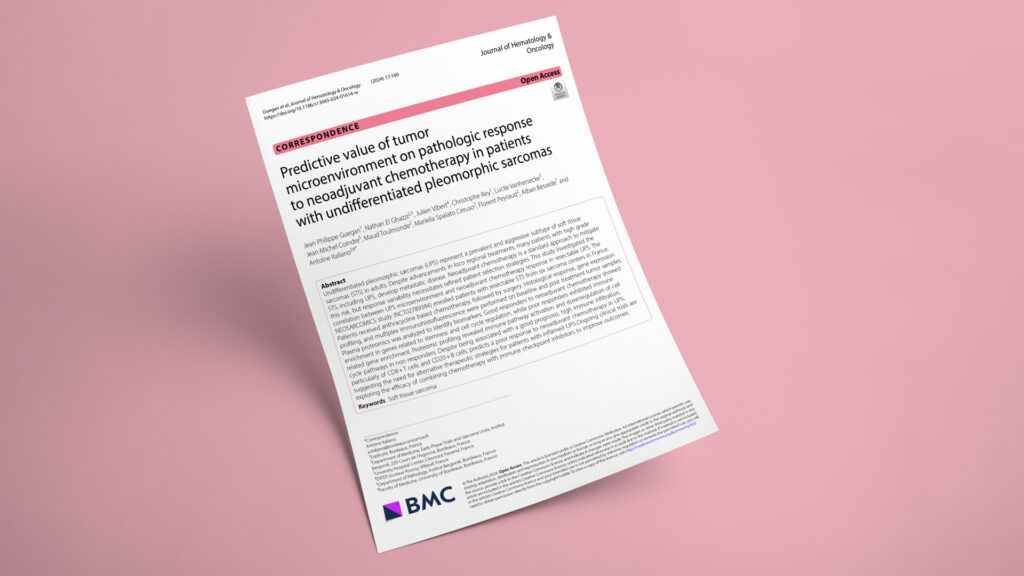
Publication in Journal of Hematology & Oncology

Why immune-inflamed pleomorphic sarcomas respond poorly to neoadjuvant chemotherapy — and how to stratify patients before surgery

Explicyte collaborated with: CHU Clermont-Ferrand·Institut Bergonié·Institut Gustave Roussy·University of Bordeaux
Predictive value of tumor microenvironment on pathologic response to neoadjuvant chemotherapy in patients with undifferentiated pleomorphic sarcomas
Bone and soft tissueBiomarker analysisTrialsFFPE tissuePlasmaMultiplex IF/IHCProteomics
JournalJournal of Hematology & Oncology
DateOct 2024
Read full paper →

Undifferentiated pleomorphic sarcoma (UPS) is aggressive and often treated with neoadjuvant chemotherapy — yet response varies widely and no marker reliably predicts who benefits. Profiling the tumor microenvironment across a 47-patient surgical cohort and the NEOSARCOMICS neoadjuvant trial with multiplex immunohistofluorescence, gene expression, and plasma proteomics, the team found a counterintuitive pattern: immune-inflamed tumors rich in CD8+ T cells — which carry a better overall prognosis — respond worst to chemotherapy, while proliferative, immune-low tumors respond best. Immune status could therefore guide who gets chemotherapy versus chemo–immunotherapy combinations.

This study in the Journal of Hematology & Oncology — with Jean-Philippe Guegan (Explicyte) as first author and led by Prof. Antoine Italiano (Institut Bergonié, University of Bordeaux; Gustave Roussy) — asks whether the immune makeup of undifferentiated pleomorphic sarcoma can predict response to neoadjuvant chemotherapy. The work draws on the NEOSARCOMICS trial (NCT02789384), which enrolled resectable soft-tissue sarcoma patients across six French sarcoma centers, and was supported by the RHU CONDOR program with funding from the Institut National du Cancer (INCa) and the Association pour la Recherche contre le Cancer (ARC). Explicyte contributed the multiplex immunohistofluorescence profiling and the plasma proteomics that anchored the microenvironment analysis.

The question

Can the immune makeup of an undifferentiated pleomorphic sarcoma predict whether it will respond to neoadjuvant chemotherapy?

Key steps

  1. 1

    Immune infiltration and survival in a surgical cohort

    Explicyte applied a multiplex immunohistofluorescence panel (CD8, CD14, CD20, CD45, CD68, cMAF, DAPI) to tissue microarrays from 47 UPS patients who underwent surgery for localized disease. Tumors with high SARCULATOR scores (poorer predicted survival) were sparsely infiltrated, particularly by CD8+ T cells and M1 macrophages (CD68+/cMAF). Conversely, patients with dense CD20+, CD8+, CD14+ or M2-macrophage (CD68+/cMAF+) infiltration tended toward better overall survival.

  2. 2

    Gene expression separates chemo responders from non-responders

    Baseline tumors from 24 resectable UPS patients in the NEOSARCOMICS trial, treated with anthracycline-based neoadjuvant chemotherapy, underwent gene expression profiling; 12 achieved a good histological response. A total of 1,058 genes distinguished good from poor responders. Good responders were enriched for stemness, cell-cycle and oncogenic programs (LHX8, CCNE1, CDC25A, CDK2, POLE/POLM/POLD1), while poor responders showed immune-response signatures (type I IFN, myeloid and lymphocyte activation). CIBERSORT confirmed high immune-cell content in poor responders.

  3. 3

    Multiplex IHF confirms the counterintuitive pattern

    Explicyte’s multiplex IHF panel on baseline FFPE samples confirmed the transcriptomic signal: tumors from poor responders were the most heavily infiltrated by immune cells, with CD8+ cell density tracking inversely with the proportion of residual tumor at surgery. High baseline immune infiltration — normally a favorable prognostic sign — marked the tumors least likely to respond to chemotherapy.

  4. 4

    Plasma proteomics links immune status to circulating markers

    Explicyte ran plasma proteomics on the Olink Explore 3072 panel comparing CD8-high (n=5) and CD8-low (n=5) patients at baseline. Immune-low (CD8-low) tumors showed upregulated cell-cycle pathways in plasma, mirroring the tissue findings, and a good chemotherapy response was associated with higher CD5L and lower GDF-15.

Impact

The study flips a common assumption: in UPS, the immune-hot tumors that carry a better prognosis are also the ones that resist neoadjuvant chemotherapy.

47
UPS surgical cases profiled by multiplex IHF to link immune infiltration with survival
24
resectable UPS patients in the NEOSARCOMICS neoadjuvant chemotherapy cohort
2
opposite immune subgroups — inflamed (better prognosis, poor chemo response) vs. immune-low (better chemo response)

Immune status, readable from a baseline biopsy, could stratify UPS patients before surgery — sparing inflamed tumors ineffective chemotherapy and steering them toward checkpoint-inhibitor combinations, while reserving standard neoadjuvant chemo for proliferative, immune-low disease. For sponsors running sarcoma trials, it argues for immune-based enrichment and for testing chemo–immunotherapy combinations in the inflamed subset. Ongoing trials such as NCT04968106 are already probing chemoimmunotherapy in high-grade UPS.

Building an immune-stratification or chemo–immunotherapy strategy in sarcoma? Let's talk about mapping the microenvironment.

Talk to us
Explicyte Oncology CRO logo

Capabilities

Modalities