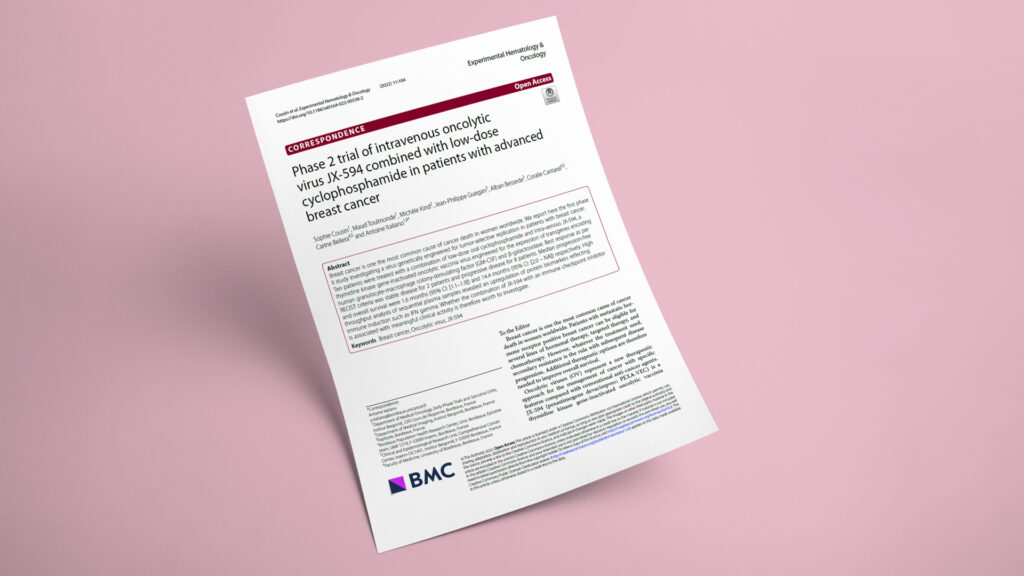
Publication in Experimental Hematology & Oncology

Why intravenous oncolytic virus JX-594 lit up immune biomarkers but not tumor responses in HR+ breast cancer

Explicyte collaborated with: Inserm·Institut Bergonié·University of Bordeaux
Phase 2 trial of intravenous oncolytic virus JX-594 combined with low-dose cyclophosphamide in patients with advanced breast cancer
JournalExperimental Hematology & Oncology
DateDec 2022
Read full paper →

Hormone-receptor-positive breast cancer eventually outruns every hormonal, targeted, and chemotherapy option, and these tumors are largely "cold" — poorly infiltrated and low in PD-L1. This single-arm phase 2 trial tested whether the intravenous oncolytic vaccinia virus JX-594, paired with metronomic cyclophosphamide, could turn that around in 10 heavily pretreated patients. Explicyte's high-throughput plasma proteomics showed the virus triggered a clear immune-activation signature — CD8A, CCL19, IFN-γ, and the co-stimulatory receptor 4-1BB all rose after dosing. Yet no patient had an objective response, making the case that immune priming alone is not enough and pointing toward checkpoint- and 4-1BB–directed combinations.

This single-arm phase 2 trial, run by the Early Phase Trials and Sarcoma Units at Institut Bergonié and led by Prof. Antoine Italiano with Dr. Sophie Cousin as first author, asked whether a systemically delivered oncolytic virus could bring immune activity to advanced hormone-receptor-positive, HER2-negative breast cancer. Patients received intravenous JX-594 (pexastimogene devacirepvec, PEXA-VEC) — a thymidine-kinase-inactivated vaccinia virus engineered to express GM-CSF and β-galactosidase — combined with metronomic low-dose cyclophosphamide. The work was funded by the French National Cancer Institute (INCa) and the Association pour la Recherche contre le Cancer (ARC). Explicyte contributed the high-throughput plasma proteomic profiling used to read out the systemic immune response to the virus.

The question

Can a systemically delivered oncolytic virus, added to metronomic chemotherapy, generate meaningful anti-tumor immunity in "cold" hormone-receptor-positive breast cancer?

Key steps

  1. 1

    Single-arm phase 2 in pretreated HR+ breast cancer

    Between May 2017 and April 2018, 10 women with advanced HR-positive, HER2-negative breast cancer were enrolled at Institut Bergonié under an optimal Simon two-stage design. The population was heavily pretreated — 80% had received more than two prior chemotherapy lines and 90% had metastatic disease. Treatment paired 50 mg cyclophosphamide twice daily (one week on, one week off) with intravenous JX-594 at 1×10⁹ pfu every 2 weeks for the first 3 injections, then every 3 weeks.

  2. 2

    No tumor responses, but manageable safety

    Best response was stable disease in 2 patients and progressive disease in 8 — no objective responses. Median progression-free survival was 1.6 months (95% CI 1.1–1.9) and median overall survival 14.4 months (95% CI 2.0–NA). Systemic delivery was tolerable: fever occurred in all patients as an expected on-target effect, grade 3 events were limited to one fever and one lymphopenia, and no grade 4 toxicity was seen.

  3. 3

    Explicyte profiled the immune response by plasma proteomics

    Explicyte ran high-throughput proteomic profiling (Olink panel) on sequential plasma samples. Low-dose cyclophosphamide alone (cycle 1 day 8 vs baseline) moved little, but the first JX-594 injection (cycle 1 day 22 vs day 8) drove significant upregulation of immune-activation proteins — including soluble CD8A, the T-cell co-receptor CD6, the T-cell–recruiting chemokine CCL19, IFN-γ, and the co-stimulatory receptor TNFRSF9 (4-1BB). The signature reflected a strong antiviral immune response with type-1 interferon and lymphocyte-trafficking chemokines.

  4. 4

    The signal nominates combination strategies

    The proteomic readout gave a mechanistic rationale for combining JX-594 with immune-directed agents rather than using it alone. 4-1BB (TNFRSF9) rose after dosing and has shown synergy with oncolytic viruses in preclinical models, and checkpoint blockade is a logical partner given the immune priming observed. A trial combining JX-594 with the PD-L1 antagonist avelumab in advanced breast cancer is already underway.

Impact

The trial reinforces a recurring lesson in oncolytic-virus development: systemic delivery can be safe and can measurably activate immunity, yet that activation does not automatically convert into tumor shrinkage.

0/10
objective responses — best response was stable disease (2 patients) or progression (8)
1.6 mo
median progression-free survival
100%
of patients had fever — the expected on-target viral effect; no grade 4 toxicity

For teams developing oncolytic viruses or cold-to-hot strategies in breast cancer, the safety of systemic JX-594 delivery is meaningful derisking, and the plasma proteomics show the virus does engage an immune program — but single-agent priming was not enough for clinical benefit. The rise of 4-1BB and checkpoint-relevant proteins argues for rational combinations, and serial plasma proteomics emerges as a practical pharmacodynamic readout for early-phase virotherapy trials where tissue sampling is limited.

Running an oncolytic-virus or immunotherapy trial in breast cancer and need plasma proteomic readouts of the immune response? Let's talk.

Talk to us
Explicyte Oncology CRO logo

Capabilities

Modalities