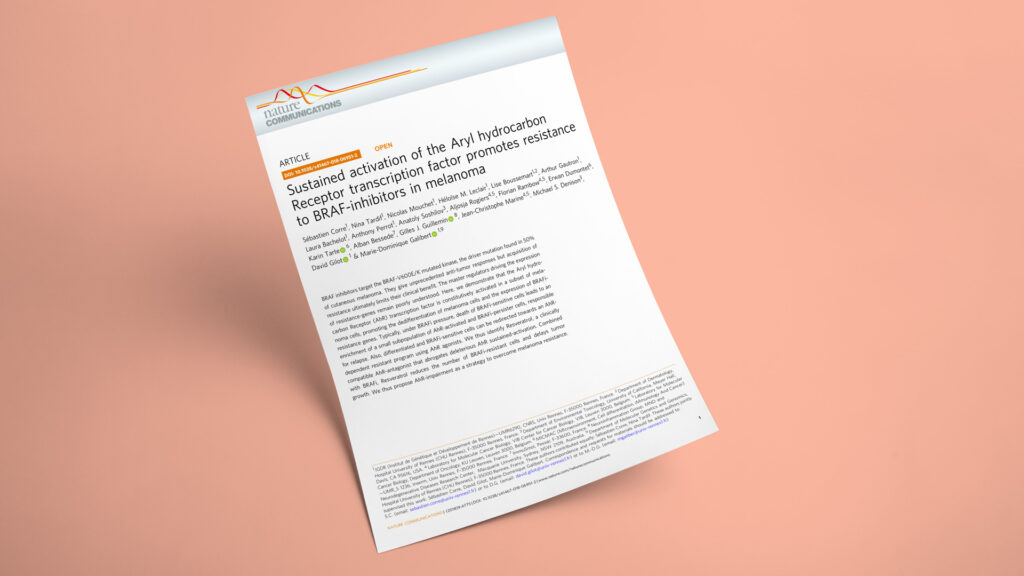
Publication in Nature Communications

Why melanoma escapes BRAF inhibitors — the AhR transcription factor behind resistance and relapse

Sustained activation of the Aryl hydrocarbon Receptor transcription factor promotes resistance to BRAF-inhibitors in melanoma
JournalNature Communications
DateNov 2018
Read full paper →

BRAF inhibitors work strikingly well against the BRAF-V600E/K mutation found in about half of cutaneous melanomas — until resistance returns and relapse follows. The master switches driving that resistance had stayed elusive. This work identifies the Aryl hydrocarbon Receptor (AhR) as one of them: constitutively active in a small subpopulation of melanoma cells, it drives dedifferentiation and a BRAFi-resistance gene program. BRAF inhibitors themselves bind AhR in a way that keeps cells sensitive, but canonical agonists like kynurenine flip cells into a resistant state. Blocking AhR with resveratrol shrank the persister pool and delayed relapse in cell and PDX models.

Published in Nature Communications, this study was led by Sébastien Corre, David Gilot, and Marie-Dominique Galibert at IGDR (Institut de Génétique et Développement de Rennes, CNRS UMR6290, University of Rennes), with structural and toxicology input from Michael Denison’s group at UC Davis and single-cell/PDX resources from Jean-Christophe Marine’s lab at the VIB–KU Leuven Center for Cancer Biology. Funding came from AVIESAN Plan Cancer, Fondation ARC, the Ligue Nationale Contre le Cancer, Région Bretagne, CNRS, and INSERM. Alban Bessede (listed here under Immusmol, the mother company of Explicyte) is among the study’s investigators due to his expertise on the kynurenine/tryptophan axis and AhR-ligand biology.

The question

What master regulator drives BRAF-inhibitor resistance in melanoma — and can blocking it delay relapse?

Key steps

  1. 1

    BRAF inhibitors act as non-canonical AhR ligands

    Vemurafenib bound AhR directly and drove its nuclear translocation, yet — unlike the canonical agonist TCDD — failed to activate the AhR/ARNT/XRE pathway, inducing neither CYP1A1 nor EROD activity. Docking placed vemurafenib in a distinct “β-pocket” versus the canonical “α-pocket.” Dabrafenib behaved identically, marking this as a class property of BRAFi. The β-signature these drugs induced was enriched for MITF and pigmentation genes — hallmarks of a differentiated, drug-sensitive state.

  2. 2

    An α-signature tracks dedifferentiation and resistance

    Using Cancer Cell Line Encyclopedia melanoma lines and defined gene sets (a 14-gene β-signature, a 19-gene α-signature, and a 16-gene BRAFi-resistance signature), the team showed the β-signature dominated proliferative, BRAFi-sensitive lines while the α-signature marked resistant, dedifferentiated (neural crest-like and undifferentiated) states. Across three sensitive/resistant cell-line pairs, acquired resistance correlated with a β-to-α shift.

  3. 3

    AhR signatures classify patient tumors

    In treatment-naive TCGA cutaneous melanoma (n = 479), tumors segregated by the α/β signatures — roughly 8% α/resistance-high and 9% β-high in bulk analysis. In patient biopsies sampled before, during, and at relapse under BRAFi or BRAFi+MEKi, tumors underwent the same β-to-α switch, co-occurring with dedifferentiation.

  4. 4

    Resistance hides in a rare persister subpopulation

    Single-cell RNA-seq of BRAFi-resistant melanoma (19 patients, ~4,650 cells) showed only about 10% of cells carried the α/resistance program, corresponding to neural crest-like and undifferentiated states and EGFR positivity. These pre-existing α-cells expand under drug pressure as sensitive β-cells die off — a non-genomic reservoir for relapse.

  5. 5

    Resveratrol blocks the α-program and delays relapse

    Resveratrol, a well-tolerated antagonist that selectively binds the AhR α-pocket, suppressed TCDD-induced CYP1A1 and the α-signature without blunting BRAFi efficacy. Combined with a BRAF inhibitor, it cut the number of BRAFi-persister cells across sensitive and resistant cell pairs, and in a melanoma PDX (MEL006) it slowed tumor growth and pushed time-to-endpoint out to 24 days versus 16 for BRAFi alone.

Impact

The study reframes BRAF-inhibitor resistance as a transcription-factor-driven, non-genomic persister problem — and points to a repurposable antagonist as a combination sensitizer.

~50%
of cutaneous melanomas carry the BRAF-V600E/K mutation that BRAFi target
24 vs 16
days to max tumor volume, BRAFi + resveratrol vs BRAFi alone (PDX)
~8%
of treatment-naive TCGA melanomas already show the α/resistance signature

For melanoma drug developers, resistance here is not a new mutation but a pre-existing, AhR-driven cell state that BRAFi pressure selects for — which means it can in principle be intercepted rather than merely chased. AhR antagonism, including a clinically compatible molecule like resveratrol, becomes a rational partner for BRAF/MEK inhibition, and the α/β/resistance signatures offer a way to stratify tumors by relapse risk before treatment. Because canonical AhR agonists such as kynurenine and environmental ligands feed the resistant state, teams working the tryptophan–kynurenine–AhR axis have a direct translational hook in targeted-therapy melanoma.

Working on the kynurenine–AhR axis or non-genomic resistance in targeted therapy and need signature-based tumor stratification? Let's talk.

Talk to us
Explicyte Oncology CRO logo

Capabilities

Modalities