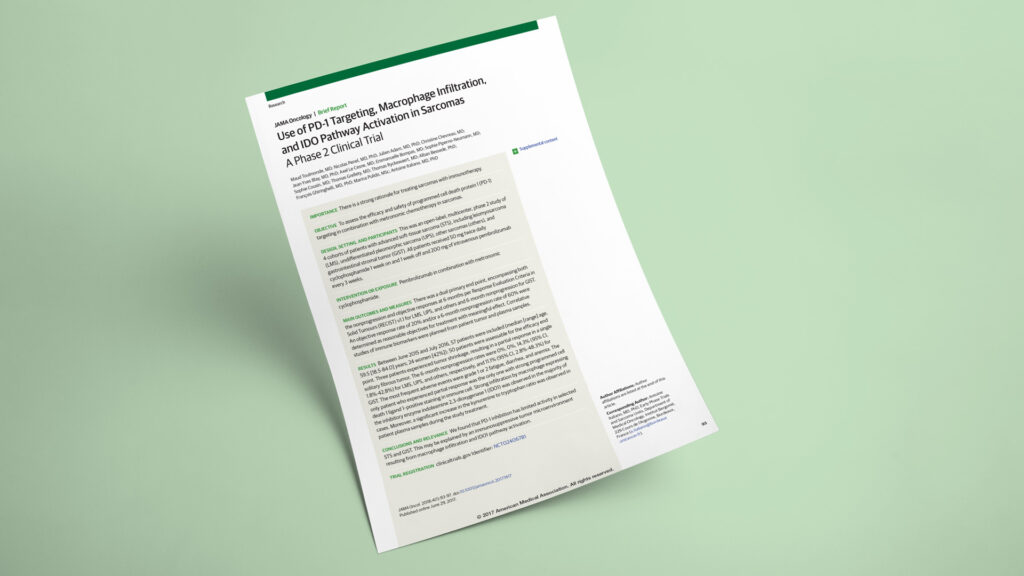
Publication in JAMA Oncology

Why PD-1 blockade falls short in soft-tissue sarcoma — and the macrophage/IDO1 axis behind it

Use of PD-1 Targeting, Macrophage Infiltration, and IDO Pathway Activation in Sarcomas
JournalJAMA Oncology
DateJun 2017
Read full paper →

Sarcomas were among the first cancers proposed for immunotherapy, yet whether PD-1 blockade alone benefits patients had not been tested in a controlled sarcoma trial. This phase 2 study paired pembrolizumab with metronomic cyclophosphamide across four cohorts — leiomyosarcoma, undifferentiated pleomorphic sarcoma, other sarcomas, and GIST — while profiling immune biomarkers in tumor and plasma. Clinical activity was minimal: a single objective response among 50 evaluable patients. The tumors explained why — dense M2 macrophages expressing IDO1, sparse CD8 T cells, and a rising plasma kynurenine-to-tryptophan ratio, together marking an immunosuppressive microenvironment that blunts checkpoint therapy.

This phase 2 trial in JAMA Oncology — led by Prof. Antoine Italiano at Institut Bergonié (Bordeaux), with Maud Toulmonde as first author — enrolled patients across seven French Sarcoma Group centers to test PD-1 blockade in advanced soft-tissue sarcoma and GIST. The study was sponsored by Institut Bergonié, with funding from the French Ministry of Health and MSD France. The correlative immune-biomarker program — quantifying the tumor immune infiltrate and tracking the plasma kynurenine/tryptophan ratio as a readout of IDO1 activity — was contributed by Alban Bessede’s group (listed here under Immusmol, the mother company of Explicyte).

The question

Does PD-1 blockade work in soft-tissue sarcoma and GIST — and if not, what in the tumor microenvironment is shutting it down?

Key steps

  1. 1

    Four-cohort phase 2 trial of pembrolizumab plus metronomic cyclophosphamide

    A Simon 2-stage, open-label trial enrolled 57 patients with advanced sarcoma across seven French Sarcoma Group centers, split into leiomyosarcoma, undifferentiated pleomorphic sarcoma (UPS), other sarcomas, and GIST cohorts. All received oral cyclophosphamide (50 mg twice daily, one week on/off) plus 200 mg IV pembrolizumab every three weeks. Fifty patients were assessable for the primary efficacy endpoint.

  2. 2

    Efficacy was minimal across every cohort

    Only one objective response occurred among 50 evaluable patients — a partial response in a solitary fibrous tumor. Six-month nonprogression was 0% in both the LMS and UPS cohorts, 14.3% in other sarcomas, and 11.1% in GIST, missing the first-stage bar in all four. Median progression-free survival was 1.4 months in every cohort.

  3. 3

    Immune profiling revealed an M2-macrophage–dominated microenvironment

    Immunohistochemical quantification of the immune infiltrate on 49 tumors (CD8, CD68, CD163, PD-L1, IDO1) showed a strong skew toward protumor M2 macrophages: the median CD163/(CD68+CD163) ratio was 0.8, peaking at 0.96 in UPS (P = .01 across cohorts). Against an independent resected NSCLC cohort stained by the same methods, CD8 density in sarcoma was far lower — median 48 vs 422 cells/mm² — indicating a “cold,” T-cell–poor landscape.

  4. 4

    IDO1 activity linked tumor and plasma

    IDO1 was expressed in immune cells — largely macrophages — in up to 73% of UPS tumors (69% LMS, 63% GIST, 29% others). The plasma kynurenine-to-tryptophan ratio rose significantly during treatment (median increase 34.6; P < .001), and that increase tracked with higher IDO1 expression in the pretreatment tumor (P = .04), tying the systemic metabolite signal to the tumor’s own IDO1 machinery.

  5. 5

    The lone responder fit the mechanism

    The single responding patient was also the only one with >10% PD-L1–positive immune cells, paired with high CD8 density (439 cells/mm²) and low macrophage infiltration. The pattern points to the M2/IDO1 axis as a driver of primary PD-1 resistance and nominates combinations with CSF1R inhibitors and/or IDO inhibitors for future sarcoma trials.

Impact

A negative efficacy result made useful: the correlative biomarker work converted "PD-1 monotherapy doesn't work in sarcoma" into a testable mechanism — and a rationale for the next generation of combinations.

1 of 50
objective responses to PD-1 blockade in evaluable patients
~9×
higher CD8 T-cell density in NSCLC vs sarcoma (422 vs 48 cells/mm²)
73%
of UPS tumors expressed IDO1 in immune cells, largely macrophages

For sarcoma drug developers, this trial reframes the problem: checkpoint monotherapy fails not for lack of a target but because an M2-macrophage/IDO1 microenvironment keeps T cells out and active. The tumor-plus-plasma biomarker package — immune-infiltrate IHC alongside a kynurenine/tryptophan activity readout — offers a ready way to stratify patients and to select rational combinations, particularly PD-1/PD-L1 blockade paired with CSF1R or IDO inhibition. Teams designing immuno-oncology trials in cold tumors can use the same correlative framework to explain response and resistance rather than just measure it.

Building an immuno-oncology combination study in a cold tumor and need macrophage/IDO1 biomarker readouts on tumor and plasma? Let's talk.

Talk to us
Explicyte Oncology CRO logo

Capabilities

Modalities